
Saturday, March 5

Friday, March 4
From the Back Porch

It has been several weeks since I have actually been able to sit on my back porch and ponder the realities of my existence as it relates and interrelates with your existence as well as the existence of everyone in close proximity to me......
So, what the hell does that actually mean?
It means that I think about the world around me that includes my home and yard, my community, my city, my county, my state, my country, my hemisphere, my world.... in short, everything that life has to offer.
Specifically, it means, I think about gasoline prices, food prices, energy prices, healthcare, weather, politics, history, psychology, war, honesty, integrity, faith and belief, the future, and technology... I added in technology because technology changes so fast and influences every aspect of our lives and if you don't keep up with technology, it will run over you and leave you behind.
BUT THIS MORNING... I am thinking about the war in Ukraine and how Russia and in particular Putin, believes that he has the natural ability to take over territory... just as we have the right, I suppose, to destroy him for his right once he acts upon it.
WAR reminds me of how people drive their vehicles in East TN... and, while that may seem an odd comparison to you, it is perfectly logical to me. Let me explain:
Whenever I get on the interstate, I drive the speed limit and sometimes 5 mph faster just because I can... other cars pass me by as if I am standing still... and, the demographics of such action includes everyone: males, females, old, young, clergy, police, all races, all colors, all income levels, all educational levels...
WHY do they need to do this?
HOW much time do they save?
HOW much extra gasoline do they burn?
HoW many accidents do they cause?
WHAT examples do they set for their children?
In the city, these drivers speed as well... even when there are several traffic lights. I will be with several cars at a traffic light and the light turns and they speed away... then, at the next traffic light, we are together again... the light changes and they speed away... then at the next traffic light, we are together again...
WHAT have they accomplished?
PUTIN takes over land that eventually the people will take back in the future because he can... and drivers drive fast even though they gain very little in the proicess... both actions are illogical, pointless, and stupid... yet, everyone still does it...
WHY EVEN THINK ABOUT THIS?
Well, I suppose, because I can... just like you driving your vehicle fast and/or deciding that you want to take someone else's land...
I think about other things as well... and, I will get to those thoughts later... maybe one of these will attract your attention and cause YOU TO THINK...

What is DeFi?

DeFi (or “decentralized finance”) is an umbrella term for financial services on public blockchains, primarily Ethereum. With DeFi, you can do most of the things that banks support — earn interest, borrow, lend, buy insurance, trade derivatives, trade assets, and more — but it’s faster and doesn’t require paperwork or a third party. As with crypto generally, DeFi is global, peer-to-peer (meaning directly between two people, not routed through a centralized system), pseudonymous, and open to all.
Why is DeFi important?
DeFi takes the basic premise of Bitcoin — digital money — and expands on it, creating an entire digital alternative to Wall Street, but without all the associated costs (think office towers, trading floors, banker salaries). This has the potential to create more open, free, and fair financial markets that are accessible to anyone with an internet connection.
What are the benefits?
- Open: You don’t need to apply for anything or “open” an account. You just get access by creating a wallet.
- Pseudonymous: You don’t need to provide your name, email address, or any personal information.
- Flexible: You can move your assets anywhere at any time, without asking for permission, waiting for long transfers to finish, and paying expensive fees.
- Fast: Interest Rates and rewards often update rapidly (as quickly as every 15 seconds), and can be significantly higher than traditional Wall Street.
- Transparent: Everyone involved can see the full set of transactions (private corporations rarely grant that kind of transparency)
How does it work?
Users typically engage with DeFi via software called dapps (“decentralized apps”), most of which currently run on the Ethereum blockchain. Unlike a conventional bank, there is no application to fill out or account to open.
Here are some of the ways people are engaging with DeFi today:
- Lending: Lend out your crypto and earn interest and rewards every minute - not once per month.
- Getting a loan: Obtain a loan instantly without filling in paperwork, including extremely short-term “flash loans” that traditional financial institutions don’t offer.
- Trading: Make peer-to-peer trades of certain crypto assets — as if you could buy and sell stocks without any kind of brokerage.
- Saving for the future: Put some of your crypto into savings account alternatives and earn better interest rates than you’d typically get from a bank.
- Buying derivatives: Make long or short bets on certain assets. Think of these as the crypto version of stock options or futures contracts.
Fluctuating transaction rates on the Ethereum blockchain mean that active trading can get expensive.
Depending on which dapps you use and how you use them, your investment could experience high volatility – this is, after all, new tech.
You have to maintain your own records for tax purposes. Regulations can vary from region to region.
Russia Uses Vacuum Bombs in Ukraine

Russia has been accused of planning to use thermobaric weapons - also known as vacuum bombs - in its invasion of Ukraine. These are controversial because they are much more devastating than conventional explosives of similar size, and have a terrible impact on anyone caught in their blast radius.
How does a vacuum bomb work?
A vacuum bomb, also called an aerosol bomb or fuel air explosive, consists of a fuel container with two separate explosive charges. This can be launched as a rocket or dropped as a bomb from aircraft. When it hits its target, the first explosive charge opens the container and widely scatters fuel mixture as a cloud.
This cloud can penetrate any building openings or defences that are not totally sealed. A second charge then detonates the cloud, resulting in a huge fireball, a massive blast wave and a vacuum which sucks up all surrounding oxygen. The weapon can destroy reinforced buildings, equipment and kill or injure people.
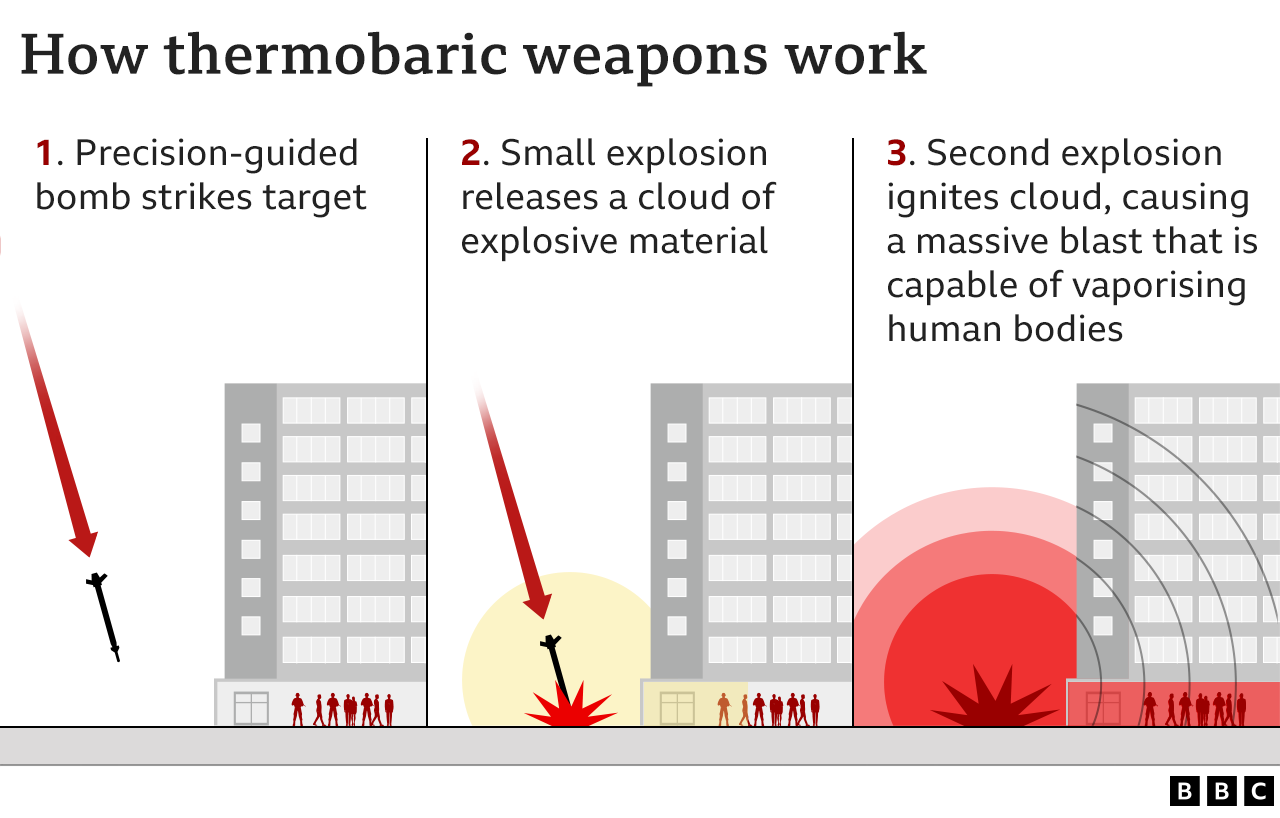
They are used for a variety of purposes and come in a range of sizes - including weapons for use by individual soldiers such as grenades and hand-held rocket launchers. Huge air-launched versions have also been designed, specifically to kill defenders in caves and tunnel complexes - the effects of this weapon are at their most severe in enclosed spaces.
In 2003, the US tested a 9,800kg bomb, nicknamed the "Mother of all bombs". Four years later, Russia developed a similar device, the Father of all bombs". This created an explosion equivalent to a 44-tonne conventional bomb - making it the biggest non-nuclear explosive device in the world. READ MORE...
Oil Prices Rise

The cost of oil surged on Wednesday, as traders snapped up non-Russian oil, increasing the chance of further price rises at UK forecourts. Brent crude - the global benchmark for oil prices - passed $113 a barrel, its highest level since June 2014. Traders are struggling to sell Russian oil, even at a discount, because of the new difficulties in shipping and payments amid its invasion of Ukraine.
Gas prices also doubled, which could feed through to energy bills. Almost 70% of Russian crude oil exports do not have a buyer according to UK-based research consultancy, Energy Aspects. On Tuesday, oil trader Trafigura offered a cargo load of Russian crude oil at a record discount of $18.60 per barrel below the market rate for Brent, but could not find a buyer willing to take the risk.
Amrita Sen, its founding partner told the BBC World Service that buyers are concerned that they could run afoul of Western sanctions and "lawyers are poring through the language" of the new rules. The RAC said if the higher oil price is sustained, the cost of filling up a car in the UK will increase with it.
"The sudden $10 jump in the oil price is likely to take the average price of petrol towards 155p a litre and diesel to 160p, particularly as it's looking like this price isn't just a market blip caused by the US and allies deciding to dip into the strategic oil reserve. "If oil does stay at this level, the journey to an average unleaded price of 155p may be far too quick." said RAC fuel spokesperson Simon Williams.
The average price of petrol across UK forecourts on Tuesday was 151.6p per litre, according to the RAC.
Energy price cap
Household gas and electricity bills are set to rise after the annual energy price cap increases to £1,971 in April, but the rise in wholesale prices amid the war in Ukraine may mean the price cap ratchets up to £3,000 by the end of the year, according to one energy analyst.
"Wholesale prices make up between 40-50% of household bills," said independent energy analyst David Cox. "If these high prices stay around 400p per therm we may see the price cap head closer to £3,000 per year, which is terrifying."
Energy analysts at Cornwall Insights also predicted a jump in the energy price cap in October, based on turmoil in the European wholesale gas prices, to over £2,900. READ MORE...

Thursday, March 3

Replacing Gas Turbines

Tesla has now deployed and unveiled a big 37-Megapack project in Alaska that will help replace gas turbines with a more sustainable solution.
Homer Electric, a member-owned electric utility cooperative based in Alaska, announced the project based in Kenai Peninsula back in 2019 – shortly after Tesla first unveiled the Megapack.
The Megapack is Tesla’s latest and biggest energy storage product, following the Powerpack and the Powerwall. It is meant as an even bigger option targeting electric utility projects.
According to Tesla, a single Megapack has up to 3 MWh of storage capacity and a 1.5 MW inverter.
With a capacity of 93 MWh, the project in Kenai Peninsula was one of the biggest announced at the time, but Tesla has since delivered bigger 1 GWh Megapack systems.
Homer Electric said that the project would replace gas turbines and enable better deployment of renewable energy:
The BESS also provides a great side benefit of opening the door to renewable intermittent energy projects that would have otherwise stretched current thermal generation assets.
The project has now been deployed, and Tesla wrote about it:
Alaska’s Kenai Peninsula has historically relied on gas turbines to distribute power to the community up to four months out of the year. To reduce the community’s reliance on fossil fuels to power the turbines, Homer Electric installed 37 Tesla Megapacks, providing grid stability even in freezing temperatures.
Tesla also released a new video about the project:
Tesla has now deployed and unveiled a big 37-Megapack project in Alaska that will help replace gas turbines with a more sustainable solution. READ MORE...
Challenge For China

Hours before Russian President Vladimir Putin announced a military operation in eastern Ukraine, the US accused Moscow and Beijing of combining to create a "profoundly illiberal" world order.
The Ukraine-Russia crisis is posing a major challenge for China on many fronts.
The ever-closer diplomatic relationship between Russia and China could be seen at the Winter Games with Mr Putin coming to Beijing as one of only a handful of known world leaders to attend.
Significantly, Mr Putin waited until just after the Games were over to recognise the two breakaway regions of Ukraine and send in troops to back them.
In its public pronouncements, the Chinese government has urged all sides to de-escalate tensions in Ukraine.
But now that Russia has dispensed with all such restraint, where does that leave China's official position as clashes escalate?
The Chinese government thinks it cannot be seen to support war in Europe but also wants to strengthen military and strategic ties with Moscow.
Ukraine's number one trading partner is China and Beijing would ideally like to maintain good relations with Kyiv but this could be difficult to sustain when it is clearly so closely aligned with the government which is sending its troops into Ukrainian territory.
There is also the potential for trade blowback on China from Western Europe if it is judged to be backing Russia's aggression.
Significantly, Mr Putin waited until just after the Games were over to recognise the two breakaway regions of Ukraine and send in troops to back them.
In its public pronouncements, the Chinese government has urged all sides to de-escalate tensions in Ukraine.
But now that Russia has dispensed with all such restraint, where does that leave China's official position as clashes escalate?
The Chinese government thinks it cannot be seen to support war in Europe but also wants to strengthen military and strategic ties with Moscow.
Ukraine's number one trading partner is China and Beijing would ideally like to maintain good relations with Kyiv but this could be difficult to sustain when it is clearly so closely aligned with the government which is sending its troops into Ukrainian territory.
There is also the potential for trade blowback on China from Western Europe if it is judged to be backing Russia's aggression.
A shift in China's foreign policy?
Furthermore, a constant refrain from China's leaders is that it does not interfere in the internal affairs of others and that other countries should not interfere in its internal affairs.
But last week, in a surprising move, China abstained from a UN Security Council vote condemning the invasion of Ukraine.
Some analysts had expected Beijing to join Russia in voting against the motion, but the fact that it did not has been described as a "win for the west" - and is a sign of Beijing's non-interference.
China however, is still far from condemning the situation, with Foreign Ministry spokesman Wang Wenbin refusing to refer to what is happening there as an "invasion".
There are also unconfirmed reports that Beijing had been aware of the situation and had deliberately turned a blind eye.
According to a New York Times report citing unidentified US officials, the US had over the past months repeatedly urged China to intervene and tell Russia not to invade Ukraine.
However, the report adds that officials later found out that Beijing had shared this information with Moscow, saying the US was trying to sow discord and that China would not try to impede Russian plans. READ MORE...
But last week, in a surprising move, China abstained from a UN Security Council vote condemning the invasion of Ukraine.
Some analysts had expected Beijing to join Russia in voting against the motion, but the fact that it did not has been described as a "win for the west" - and is a sign of Beijing's non-interference.
China however, is still far from condemning the situation, with Foreign Ministry spokesman Wang Wenbin refusing to refer to what is happening there as an "invasion".
There are also unconfirmed reports that Beijing had been aware of the situation and had deliberately turned a blind eye.
According to a New York Times report citing unidentified US officials, the US had over the past months repeatedly urged China to intervene and tell Russia not to invade Ukraine.
However, the report adds that officials later found out that Beijing had shared this information with Moscow, saying the US was trying to sow discord and that China would not try to impede Russian plans. READ MORE...
Kamala Harris Says...
FOX NEWS REPORTS...
 Kamala Harris blasted for claiming 'voters got what they asked for' in electing her, Biden
Vice President Kamala Harris was blasted by critics Monday for claiming during a speech at the White House that American voters "got what they asked for" when they elected her and President Biden.
Harris made the claim during a celebration for Black History month when she took a moment to celebrate Biden's nomination of Judge Ketanji Jackson to be the first Black woman to sit on the Supreme Court.
"I felt such pride and such hope this past Friday when President Joe Biden nominated Judge Ketanji Brown Jackson," Harris told those gathered for the event. "Because as we all know, elections matter. And when folks vote, they order what they want, and in this case they got what they asked for."
"I went off script a little bit," Harris added, laughing.
Critics jumped to social media to blast Harris, with some listing what they saw as the administration's numerous failures, and others predicting a defeat for Democrats in the November midterm elections.
"The American people didn’t ask for any of this: Record Inflation, Record border crisis, Closed schools. A war on American energy, Afghanistan disaster, Russia invasion of Ukraine," wrote Sen. Ted Cruz, R-Texas, while former White House press secretary and Arkansas gubernatorial candidate Sarah Sanders called the Biden administration a "complete and total failure." READ MORE...
'No one asked for the Democrats' soaring inflation'
Vice President Kamala Harris was blasted by critics Monday for claiming during a speech at the White House that American voters "got what they asked for" when they elected her and President Biden.
Harris made the claim during a celebration for Black History month when she took a moment to celebrate Biden's nomination of Judge Ketanji Jackson to be the first Black woman to sit on the Supreme Court.
"I felt such pride and such hope this past Friday when President Joe Biden nominated Judge Ketanji Brown Jackson," Harris told those gathered for the event. "Because as we all know, elections matter. And when folks vote, they order what they want, and in this case they got what they asked for."
"I went off script a little bit," Harris added, laughing.
Critics jumped to social media to blast Harris, with some listing what they saw as the administration's numerous failures, and others predicting a defeat for Democrats in the November midterm elections.
"The American people didn’t ask for any of this: Record Inflation, Record border crisis, Closed schools. A war on American energy, Afghanistan disaster, Russia invasion of Ukraine," wrote Sen. Ted Cruz, R-Texas, while former White House press secretary and Arkansas gubernatorial candidate Sarah Sanders called the Biden administration a "complete and total failure." READ MORE...


Wednesday, March 2


Hallucinogens Used As A Tactic

It’s easy to imagine that dosing followers with hallucinogens is a practice invented by contemporary cult leaders like Charles Manson (or the United States government), but recent archeological findings indicate at least one example that dates back more than a thousand years.
Excavation at a site in the southern Peruvian town of Quilcapampa (a place where the Wari people settled in the Sihuas Valley) uncovered artifacts related to hallucinogenic beverages, in an area with buildings that were likely used for feasting. The findings included 16 vilca seeds and remains of a fermented fruit drink referred to as “chicha de molle.” As the team of researchers wrote in a paper published by the journal Antiquity, the drink would have created a strong psychotropic effect, and: “The resulting psychotropic experience reinforced the power of the Wari state.”
The hallucinogenic powers of the vilca seeds, amplified by delivery within chicha de molle, would have been taken as a spiritual experience by the consumer. Researchers label this discover as particularly significant, because it helps contextualize the social practices of the Wari with respect to the use of hallucinogens during the Formative period (900–300 BCE) — associated with political strategies defined as “exclusionary” — versus during the Late Horizon (approximately 1450–1532 CE), when Inca leaders implemented “corporate” strategies via the mass consumption of alcohol.
Excavation at a site in the southern Peruvian town of Quilcapampa (a place where the Wari people settled in the Sihuas Valley) uncovered artifacts related to hallucinogenic beverages, in an area with buildings that were likely used for feasting. The findings included 16 vilca seeds and remains of a fermented fruit drink referred to as “chicha de molle.” As the team of researchers wrote in a paper published by the journal Antiquity, the drink would have created a strong psychotropic effect, and: “The resulting psychotropic experience reinforced the power of the Wari state.”
The hallucinogenic powers of the vilca seeds, amplified by delivery within chicha de molle, would have been taken as a spiritual experience by the consumer. Researchers label this discover as particularly significant, because it helps contextualize the social practices of the Wari with respect to the use of hallucinogens during the Formative period (900–300 BCE) — associated with political strategies defined as “exclusionary” — versus during the Late Horizon (approximately 1450–1532 CE), when Inca leaders implemented “corporate” strategies via the mass consumption of alcohol.
The paper’s authors argue that findings from Quilcapampa locate the shift between these two practices during the Middle Horizon (600–1000 CE), when beer made from Schinus molle was combined with the hallucinogen Anadenanthera colubrina, and represent an intermediate step between exclusionary and corporate political strategies.
“Almost certainly, it would have been a spiritual experience,” wrote study co-author Justin Jennings, a curator of new world archaeology at the Royal Ontario Museum, as quoted in Live Science. Since vilca seeds were not naturally proximate to Quilcapampa, a certain amount of effort must have been expended to gather them, indicating their importance to the social fabric. READ MORE...
Higher Emotional Awareness

Abstract
The tendency to reflect on the emotions of self and others is a key aspect of emotional awareness (EA)—a trait widely recognized as relevant to mental health. However, the degree to which EA draws on general reflective cognition vs. specialized socio-emotional mechanisms remains unclear. Based on a synthesis of work in neuroscience and psychology, we recently proposed that EA is best understood as a learned application of domain-general cognitive processes to socio-emotional information. In this paper, we report a study in which we tested this hypothesis in 448 (125 male) individuals who completed measures of EA and both general reflective cognition and socio-emotional performance. As predicted, we observed a significant relationship between EA measures and both general reflectiveness and socio-emotional measures, with the strongest contribution from measures of the general tendency to engage in effortful, reflective cognition. This is consistent with the hypothesis that EA corresponds to the application of general reflective cognitive processes to socio-emotional signals.
Introduction
Trait differences in emotional awareness (EA) have been the topic of a growing body of empirical work in psychology and psychiatry. Individuals with high EA report granular emotional experiences and perceive similar experiences in others, often promoting more adaptive social and emotional functioning (for a review, see1; for related work, see2). Current theoretical models posit that the tendency to consciously reflect on the emotions of self and others (e.g., their causes, associated sensations, and how they can be regulated) is a key aspect of EA3, as well as of related constructs such as emotional intelligence4,5,6,7 and alexithymia8,9,10. As measured by the Levels of Emotional Awareness Scale (LEAS;11,12), multiple studies suggest that EA is an important determinant of adaptive emotional functioning. High EA has been linked to emotion recognition abilities and openness to experience, among other adaptive skills11,13,14,15,16,17,18,19. Low EA has also been associated with multiple affective disorders20,21,22,23,24,25. The neurocognitive basis of EA is also an important question within both basic science and clinical research, with a growing number of studies on its developmental basis16,26,27 and neural correlates (e.g., for a review, see28; for more recent studies, see23,29,30,31,32,33,34,35,36,37).
One important unanswered question pertains to the degree to which the tendency to reflect on emotion in EA depends on domain-general reflective cognitive processes vs. specialized socio-emotional mechanisms. Some models make strong distinctions between emotional and cognitive processes and suggest that the brain contains specialized emotional mechanisms38,39; and some neuroscientific studies also suggest the presence of brain regions selectively engaged by social cognition40,41,42,43,44. In contrast, other cognitive and neural models suggest less separability between socio-emotional and cognitive process1,45,46,47,48,49. In a recent review50, we drew on work within evolutionary, developmental, and cognitive neuroscience to argue that EA may have an important dependence on domain-general cognitive processes.
Specifically, EA appears to require holding emotional information in mind, integrating it with other available information in perception and memory, and using this information to reflectively plan adaptive courses of action (especially in social situations). While these abilities may be constrained by cognitive capacity (e.g., working memory span, IQ;32), it is suggested that trait differences in EA may further depend on the tendency to engage these reflective processes, independent of whether latent cognitive capacity is high or low. In this view, EA involves the application of effortful cognitive processes to emotion-related information (e.g., interoceptive information within oneself, facial, postural, and vocal cues in others, context cues, etc.), which may be facilitated during development by prepared learning and automatic attention biases toward socio-affective signals. The domain-general processes under discussion are “reflective” in the sense that they operate on mental contents in an integrative, slow, and deliberate manner—often reducing the chances of responding maladaptively in emotionally charged situations. However, the degree to which EA depends on domain-general reflective cognitive processes requires further empirical testing. READ MORE...
Controlling the Moon

Photo Illustration by Elizabeth Brockway and Luis G. Rendon/The Daily Beast/Getty
In 1961, U.S. President John F. Kennedy declared that his nation would be the first to land a man on the moon. That ambitious goal would later be fulfilled as two NASA astronauts took wobbly steps across the lunar surface on July 20, 1969, much to the dismay of Russia’s own space program leaders.
More than 60 years later, a new space race to the moon has begun, albeit with much higher stakes and brand new players ready to make the 238,855-mile journey. This time, the race to the moon is about much more than just planting a flag on its dusty surface. Getting to the moon first could also mean calling dibs on its limited resources, and controlling a permanent gateway to take humans to Mars—and beyond.
Whether it’s NASA, China, Russia, or a consortium of private companies that end up dominating the moon, laying claim to the lunar surface isn’t really about the moon anyway—it’s about who gets easier access to the rest of the solar system.
Everyone’s Got an Agenda
James Rice, a senior scientist at the School of Earth and Space Exploration at Arizona State University, remembers growing up with the Apollo program and getting bitten by the space bug as he watched the 1969 moon landing unfold on television.
“As a kid, I saw that happening and I wanted to be a part of it,” Rice told The Daily Beast. “That’s basically why I’m in this career today.”
As Rice reflected on the current space race, he recognized some key differences. “Things have really changed dramatically in terms of the technology and the players that are out there,” he said. “This is not the moon we thought of during the Apollo days.” Scientists have learned so much more about the moon through more detailed analysis of lunar samples, as well as several missions that have probed exactly what might be sitting on the moon’s surface and remain hidden deep underground. READ MORE...
James Rice, a senior scientist at the School of Earth and Space Exploration at Arizona State University, remembers growing up with the Apollo program and getting bitten by the space bug as he watched the 1969 moon landing unfold on television.
“As a kid, I saw that happening and I wanted to be a part of it,” Rice told The Daily Beast. “That’s basically why I’m in this career today.”
As Rice reflected on the current space race, he recognized some key differences. “Things have really changed dramatically in terms of the technology and the players that are out there,” he said. “This is not the moon we thought of during the Apollo days.” Scientists have learned so much more about the moon through more detailed analysis of lunar samples, as well as several missions that have probed exactly what might be sitting on the moon’s surface and remain hidden deep underground. READ MORE...

Tuesday, March 1


Forgiveness Isn't Always Required

Since the first empirically based study on person-to-person forgiveness was published in the social sciences (Enright et al., 1989), thousands of articles have been published on the topic.
Because the psychological exploration of forgiveness is still relatively new, there has been disagreement and debate on what, exactly, forgiveness is and whether it is an appropriate response in the mental health professions for people hurt by the injustices of others.
In the spirit of this continuing debate, I would like to offer my response to a recent post, “Why Forgiveness Is Not Required in Trauma Recovery.”
My intent is: If people who are traumatized or who are therapists read the essay, they may be discouraged from trying forgiveness. This would be most unfortunate if they rejected it because of incorrect information.
To help therapists and clients make as informed a decision as possible, I want to counter what appears to be misunderstandings about what forgiveness actually is and what encompasses forgiveness therapy.
Five points for your consideration
1. The author stated: “Forgiveness diminishes harms and wrongs, which can inhibit safety.” This is not correct. When people begin to truly forgive, they realize that what happened to them was unfair, is unfair, and always will be unfair.
To forgive is not to excuse the wrong, but to stand firm in the truth that this was an injustice (Enright & Fitzgibbons, 2015). Thus, the one considering forgiveness has a rational understanding that the one who did the harm could do so again.
2. As a moral virtue, forgiveness never ever should be forced onto anyone. On this point, I agree with the author. Instead, people should be drawn to forgiveness by their own free will. That is the case for all moral virtues. For example, in the case of altruism, we do not put pressure on people to be altruistic, hovering over them and insisting that they must give money to the poor.
The criticism by the author on this point needs to center, not on forgiveness, but instead on the person who pressures the unjustly injured person to forgive. The wrong here is within the person who is putting on the pressure, not on forgiveness itself.
As my colleague, Chontay Glenn, an assistant professor in the School of Nursing at the University of Michigan-Flint, who suffered the trauma of sexual abuse, has said to me: “No one can be forced into forgiveness anyway because it is an internal response to an injustice....it is the healing of one’s own soul against an injustice.” READ MORE...
Ways to be Happy

There are days when the world can feel extremely chaotic and overwhelming in complexity—whether it’s politics, the economy, global issues, or just the stress you face at work or at home. Through it all, happiness is a key priority. People want joy, contentment, and satisfaction in their work and life. While happiness may seem fleeting, there are paths you can take (some that may see strike you as surprising) to find happiness.
In my research on happiness, there are some significant sources that matter most. Feeling a sense of purpose in your contribution; sustaining meaningful connections with others; having opportunities to stretch, learn, and grow; and gratitude are all correlated with happiness.
But there are also some certain pathways to feeling happy which may surprise you.
DON’T CHASE IT
The happiness paradox suggests if you seek to be happy, you’ll be less likely to accomplish it. Instead, you should seek to create the conditions associated with happiness, rather than pursuing happiness for its own sake.
This is true because chasing happiness reminds you of what you don’t have (since you are pursuing it, after all) and it focuses you on your own needs, rather than those of others—and the opposite is linked with happiness. You’re more likely to experience happiness when you’re contributing to the needs of others, rather than yourself.
The happiness paradox suggests if you seek to be happy, you’ll be less likely to accomplish it. Instead, you should seek to create the conditions associated with happiness, rather than pursuing happiness for its own sake.
This is true because chasing happiness reminds you of what you don’t have (since you are pursuing it, after all) and it focuses you on your own needs, rather than those of others—and the opposite is linked with happiness. You’re more likely to experience happiness when you’re contributing to the needs of others, rather than yourself.
SPEND TIME WISELY
If you want to be happy, you’ll also do well to spend your time on activities which are both relaxing and rejuvenating. Research at the University of Nottingham found when you spend time on a hobby you enjoy or whiling away the hours playing games, these are correlated with happiness. Taking naps is also a great way to boost your happiness.
And interestingly, research at the University of Colorado found if you set your alarm to wake up an hour earlier each day (assuming you’re getting enough sleep overall), this is also correlated with happiness—likely because you have more control over your time and because you can fill your day with more of what you love to do. READ MORE...
If you want to be happy, you’ll also do well to spend your time on activities which are both relaxing and rejuvenating. Research at the University of Nottingham found when you spend time on a hobby you enjoy or whiling away the hours playing games, these are correlated with happiness. Taking naps is also a great way to boost your happiness.
And interestingly, research at the University of Colorado found if you set your alarm to wake up an hour earlier each day (assuming you’re getting enough sleep overall), this is also correlated with happiness—likely because you have more control over your time and because you can fill your day with more of what you love to do. READ MORE...
Stress Changes Brain

For the first time, researchers looked at the entire duration of such a situation. They found not only changes in the communication of brain regions, but also a dynamic process: Different networks behaved differently during acute stress.
From this, the scientists were able to determine how susceptible a person is to negative mood and how much this increased their risk of mental illness.
Until now, experts knew little about the dynamic processes in the brain during acute stress. Research has usually focused on the brain areas that are active at a given time. Now, however, scientists from the Max Planck Institute of Psychiatry (MPI) and the Department of Psychiatry and Psychotherapy at Tübingen University Hospital have observed what happens in the brain over the entire period of a stressful situation, such as while solving a tricky math problem.
“Our study shows not only where changes occur, but how different brain regions interact and how their communication changes over the course of the situation,” summarizes first author Anne Kühnel from the MPI.
The results of the study were recently published in the journal Biological Psychiatry.
The participants were asked to solve math problems under time pressure while inside a magnetic resonance imaging scanner. No matter how well they did, they only received negative feedback—a stressful situation. The dynamic response of the brain’s networks differed in the study participants.
The scientists were able to relate the responses to how anxious or depressed the participants were. It is known that the more negative a person’s basic temperament is, the higher their risk of mental illness.
“The altered communication between brain regions supports the theory that mental disorders are network diseases in which the interaction of neural units is disturbed,” says MPI Director Elisabeth Binder and continues, “The new findings are important for developing more individualized diagnoses and personalized therapies.” READ MORE...

Subscribe to:
Posts (Atom)