Saturday, March 5
From the Back Porch
Google to Pay French Publishers
Google has signed a new agreement to pay French publishers for the right to display their news content online. The deal means that media organisations in France will be fairly renumerated when their news articles appear on the search engine's results pages.
A new agreement was unveiled on Thursday by Google and the Alliance for the General Information Press (Apig), which brings together nearly 300 national, regional and local news groups. The deal replaces a previous agreement that was announced last January.
Facebook reached a similar agreement with Agip in October to pay French publishers over the copyright of their content.
The dispute over so-called "neighbouring rights" has soured relations between French news organisations and the US tech giant for more than two years. Google and Facebook have long argued against the principle, stating that French publishers are already exposed on their platforms and promoted to customers.
But in 2019, a European Union Directive entrenched "neighbouring rights" into law, a move that France swiftly adopted. Although Google and Agip reached an agreement last year, the US company was fined €500 million for not having negotiated with French publishers "in good faith".
A French watchdog had asked Google to resume negotiations and propose a new compensation offer.
Google and Agip said in a joint statement that the new agreement on "neighbouring rights" was a "historic step". The exact amount of compensation offered to French news organisations has not been made public.
Google also hopes to sign a similar deal with another French media group, SEPM, in the future.
Snowflake
NEW YORK, March 3 (Reuters Breakingviews) - Snowflake’s (SNOW.N) melting market capitalization reflects investors’ overly lofty expectations. Its share price fell by nearly a fifth on Thursday even though the $65 billion data warehouse firm said fourth-quarter revenue doubled.
Fast growing firms are hard to value, but the market’s ardor read more is cooling. Snowflake thinks revenue will rise by two-thirds next year, to $1.9 billion.
Snowflake will continue to thrive. The same might not be true of other highfliers, such as electric-car makers like Lucid (LCID.O), which are burning cash. Without highly valued stock to issue, missteps could prove deadlier. (By Robert Cyran)
China's SAIC Motor
NEW DELHI, March 3 (Reuters) - MG Motor India, which is owned by China's SAIC Motor, plans to raise funds to develop its Indian electric mobility business, three sources told Reuters, as Chinese investments face increased scrutiny by the government in New Delhi.
MG Motor India may try to sell a stake of between 10% and 30% and is looking at options including issuing new shares or diluting SAIC's holding, one of the sources familiar with the plans said, adding that it may even create a separate unit for its electric vehicle (EV) business in India.
The company is talking to private equity funds which are increasingly interested in investing in the fast-growing electric vehicle market, two of the sources said, as countries shift their economies away from fossil fuels.
"Everyone is buying into the EV story because it gives investors an ESG bet, and MG is trying to pitch itself as an EV play," the first source told Reuters.
MG Motor India has yet to finalise how much money it plans to raise, which will depend on the valuation of the Indian business and its growth plans, the sources, who asked to remain anonymous because the talks are private. READ MORE...
Friday, March 4
From the Back Porch
It has been several weeks since I have actually been able to sit on my back porch and ponder the realities of my existence as it relates and interrelates with your existence as well as the existence of everyone in close proximity to me......
What is DeFi?
DeFi (or “decentralized finance”) is an umbrella term for financial services on public blockchains, primarily Ethereum. With DeFi, you can do most of the things that banks support — earn interest, borrow, lend, buy insurance, trade derivatives, trade assets, and more — but it’s faster and doesn’t require paperwork or a third party. As with crypto generally, DeFi is global, peer-to-peer (meaning directly between two people, not routed through a centralized system), pseudonymous, and open to all.
Why is DeFi important?
DeFi takes the basic premise of Bitcoin — digital money — and expands on it, creating an entire digital alternative to Wall Street, but without all the associated costs (think office towers, trading floors, banker salaries). This has the potential to create more open, free, and fair financial markets that are accessible to anyone with an internet connection.
What are the benefits?
- Open: You don’t need to apply for anything or “open” an account. You just get access by creating a wallet.
- Pseudonymous: You don’t need to provide your name, email address, or any personal information.
- Flexible: You can move your assets anywhere at any time, without asking for permission, waiting for long transfers to finish, and paying expensive fees.
- Fast: Interest Rates and rewards often update rapidly (as quickly as every 15 seconds), and can be significantly higher than traditional Wall Street.
- Transparent: Everyone involved can see the full set of transactions (private corporations rarely grant that kind of transparency)
How does it work?
Users typically engage with DeFi via software called dapps (“decentralized apps”), most of which currently run on the Ethereum blockchain. Unlike a conventional bank, there is no application to fill out or account to open.
Here are some of the ways people are engaging with DeFi today:
- Lending: Lend out your crypto and earn interest and rewards every minute - not once per month.
- Getting a loan: Obtain a loan instantly without filling in paperwork, including extremely short-term “flash loans” that traditional financial institutions don’t offer.
- Trading: Make peer-to-peer trades of certain crypto assets — as if you could buy and sell stocks without any kind of brokerage.
- Saving for the future: Put some of your crypto into savings account alternatives and earn better interest rates than you’d typically get from a bank.
- Buying derivatives: Make long or short bets on certain assets. Think of these as the crypto version of stock options or futures contracts.
Fluctuating transaction rates on the Ethereum blockchain mean that active trading can get expensive.
Depending on which dapps you use and how you use them, your investment could experience high volatility – this is, after all, new tech.
You have to maintain your own records for tax purposes. Regulations can vary from region to region.
Russia Uses Vacuum Bombs in Ukraine
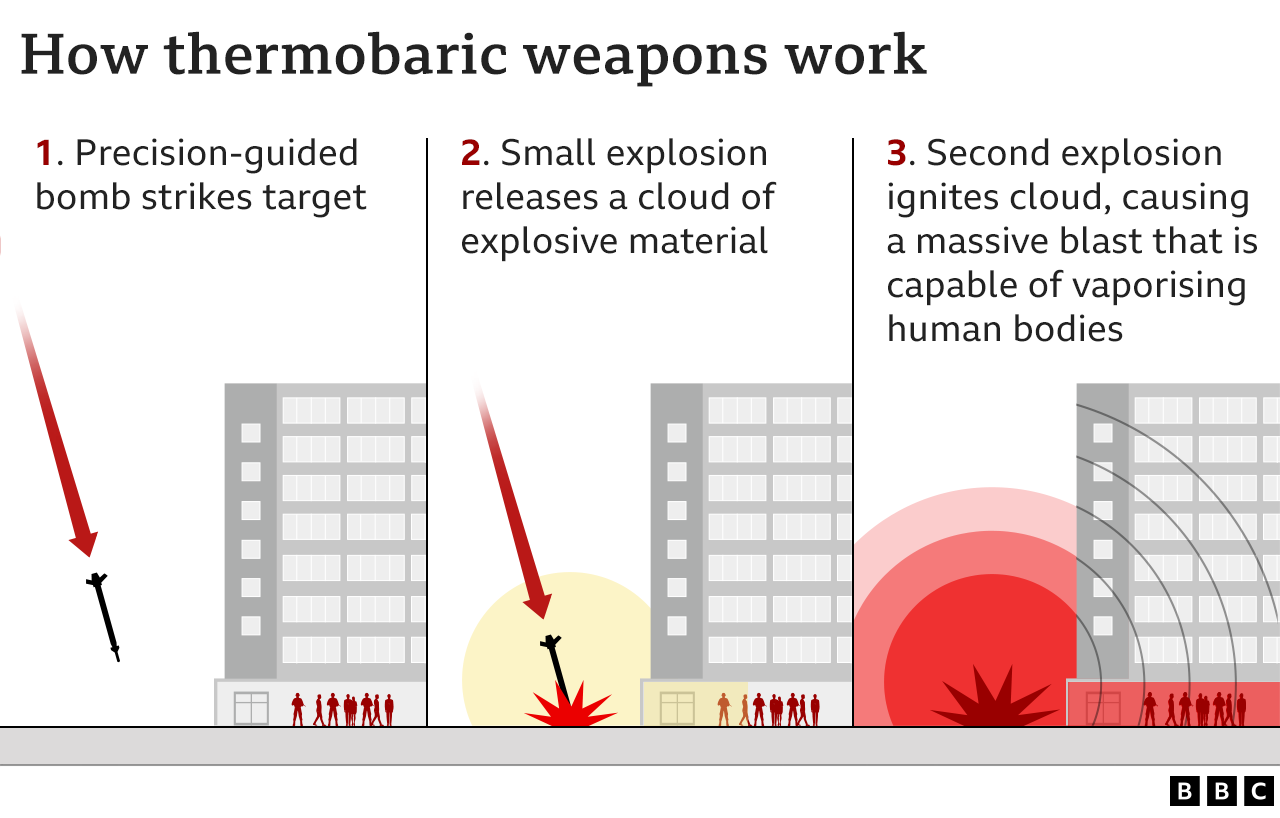
Russia has been accused of planning to use thermobaric weapons - also known as vacuum bombs - in its invasion of Ukraine. These are controversial because they are much more devastating than conventional explosives of similar size, and have a terrible impact on anyone caught in their blast radius.
How does a vacuum bomb work?
A vacuum bomb, also called an aerosol bomb or fuel air explosive, consists of a fuel container with two separate explosive charges. This can be launched as a rocket or dropped as a bomb from aircraft. When it hits its target, the first explosive charge opens the container and widely scatters fuel mixture as a cloud.
This cloud can penetrate any building openings or defences that are not totally sealed. A second charge then detonates the cloud, resulting in a huge fireball, a massive blast wave and a vacuum which sucks up all surrounding oxygen. The weapon can destroy reinforced buildings, equipment and kill or injure people.

They are used for a variety of purposes and come in a range of sizes - including weapons for use by individual soldiers such as grenades and hand-held rocket launchers. Huge air-launched versions have also been designed, specifically to kill defenders in caves and tunnel complexes - the effects of this weapon are at their most severe in enclosed spaces.
In 2003, the US tested a 9,800kg bomb, nicknamed the "Mother of all bombs". Four years later, Russia developed a similar device, the Father of all bombs". This created an explosion equivalent to a 44-tonne conventional bomb - making it the biggest non-nuclear explosive device in the world. READ MORE...
Oil Prices Rise
The cost of oil surged on Wednesday, as traders snapped up non-Russian oil, increasing the chance of further price rises at UK forecourts. Brent crude - the global benchmark for oil prices - passed $113 a barrel, its highest level since June 2014. Traders are struggling to sell Russian oil, even at a discount, because of the new difficulties in shipping and payments amid its invasion of Ukraine.
Gas prices also doubled, which could feed through to energy bills. Almost 70% of Russian crude oil exports do not have a buyer according to UK-based research consultancy, Energy Aspects. On Tuesday, oil trader Trafigura offered a cargo load of Russian crude oil at a record discount of $18.60 per barrel below the market rate for Brent, but could not find a buyer willing to take the risk.
Amrita Sen, its founding partner told the BBC World Service that buyers are concerned that they could run afoul of Western sanctions and "lawyers are poring through the language" of the new rules. The RAC said if the higher oil price is sustained, the cost of filling up a car in the UK will increase with it.
"The sudden $10 jump in the oil price is likely to take the average price of petrol towards 155p a litre and diesel to 160p, particularly as it's looking like this price isn't just a market blip caused by the US and allies deciding to dip into the strategic oil reserve. "If oil does stay at this level, the journey to an average unleaded price of 155p may be far too quick." said RAC fuel spokesperson Simon Williams.
The average price of petrol across UK forecourts on Tuesday was 151.6p per litre, according to the RAC.
Energy price cap
Household gas and electricity bills are set to rise after the annual energy price cap increases to £1,971 in April, but the rise in wholesale prices amid the war in Ukraine may mean the price cap ratchets up to £3,000 by the end of the year, according to one energy analyst.
"Wholesale prices make up between 40-50% of household bills," said independent energy analyst David Cox. "If these high prices stay around 400p per therm we may see the price cap head closer to £3,000 per year, which is terrifying."
Energy analysts at Cornwall Insights also predicted a jump in the energy price cap in October, based on turmoil in the European wholesale gas prices, to over £2,900. READ MORE...
Thursday, March 3
Replacing Gas Turbines
Tesla has now deployed and unveiled a big 37-Megapack project in Alaska that will help replace gas turbines with a more sustainable solution.
Homer Electric, a member-owned electric utility cooperative based in Alaska, announced the project based in Kenai Peninsula back in 2019 – shortly after Tesla first unveiled the Megapack.
The Megapack is Tesla’s latest and biggest energy storage product, following the Powerpack and the Powerwall. It is meant as an even bigger option targeting electric utility projects.
According to Tesla, a single Megapack has up to 3 MWh of storage capacity and a 1.5 MW inverter.
With a capacity of 93 MWh, the project in Kenai Peninsula was one of the biggest announced at the time, but Tesla has since delivered bigger 1 GWh Megapack systems.
Homer Electric said that the project would replace gas turbines and enable better deployment of renewable energy:
The BESS also provides a great side benefit of opening the door to renewable intermittent energy projects that would have otherwise stretched current thermal generation assets.
The project has now been deployed, and Tesla wrote about it:
Alaska’s Kenai Peninsula has historically relied on gas turbines to distribute power to the community up to four months out of the year. To reduce the community’s reliance on fossil fuels to power the turbines, Homer Electric installed 37 Tesla Megapacks, providing grid stability even in freezing temperatures.
Tesla also released a new video about the project:
Tesla has now deployed and unveiled a big 37-Megapack project in Alaska that will help replace gas turbines with a more sustainable solution. READ MORE...
Challenge For China
Hours before Russian President Vladimir Putin announced a military operation in eastern Ukraine, the US accused Moscow and Beijing of combining to create a "profoundly illiberal" world order.
Significantly, Mr Putin waited until just after the Games were over to recognise the two breakaway regions of Ukraine and send in troops to back them.
In its public pronouncements, the Chinese government has urged all sides to de-escalate tensions in Ukraine.
But now that Russia has dispensed with all such restraint, where does that leave China's official position as clashes escalate?
The Chinese government thinks it cannot be seen to support war in Europe but also wants to strengthen military and strategic ties with Moscow.
Ukraine's number one trading partner is China and Beijing would ideally like to maintain good relations with Kyiv but this could be difficult to sustain when it is clearly so closely aligned with the government which is sending its troops into Ukrainian territory.
There is also the potential for trade blowback on China from Western Europe if it is judged to be backing Russia's aggression.
But last week, in a surprising move, China abstained from a UN Security Council vote condemning the invasion of Ukraine.
Some analysts had expected Beijing to join Russia in voting against the motion, but the fact that it did not has been described as a "win for the west" - and is a sign of Beijing's non-interference.
China however, is still far from condemning the situation, with Foreign Ministry spokesman Wang Wenbin refusing to refer to what is happening there as an "invasion".
There are also unconfirmed reports that Beijing had been aware of the situation and had deliberately turned a blind eye.
According to a New York Times report citing unidentified US officials, the US had over the past months repeatedly urged China to intervene and tell Russia not to invade Ukraine.
However, the report adds that officials later found out that Beijing had shared this information with Moscow, saying the US was trying to sow discord and that China would not try to impede Russian plans. READ MORE...
Kamala Harris Says...
Vice President Kamala Harris was blasted by critics Monday for claiming during a speech at the White House that American voters "got what they asked for" when they elected her and President Biden.
Harris made the claim during a celebration for Black History month when she took a moment to celebrate Biden's nomination of Judge Ketanji Jackson to be the first Black woman to sit on the Supreme Court.
"I felt such pride and such hope this past Friday when President Joe Biden nominated Judge Ketanji Brown Jackson," Harris told those gathered for the event. "Because as we all know, elections matter. And when folks vote, they order what they want, and in this case they got what they asked for."
"I went off script a little bit," Harris added, laughing.
Critics jumped to social media to blast Harris, with some listing what they saw as the administration's numerous failures, and others predicting a defeat for Democrats in the November midterm elections.
"The American people didn’t ask for any of this: Record Inflation, Record border crisis, Closed schools. A war on American energy, Afghanistan disaster, Russia invasion of Ukraine," wrote Sen. Ted Cruz, R-Texas, while former White House press secretary and Arkansas gubernatorial candidate Sarah Sanders called the Biden administration a "complete and total failure." READ MORE...
Wednesday, March 2
Hallucinogens Used As A Tactic
Excavation at a site in the southern Peruvian town of Quilcapampa (a place where the Wari people settled in the Sihuas Valley) uncovered artifacts related to hallucinogenic beverages, in an area with buildings that were likely used for feasting. The findings included 16 vilca seeds and remains of a fermented fruit drink referred to as “chicha de molle.” As the team of researchers wrote in a paper published by the journal Antiquity, the drink would have created a strong psychotropic effect, and: “The resulting psychotropic experience reinforced the power of the Wari state.”
The hallucinogenic powers of the vilca seeds, amplified by delivery within chicha de molle, would have been taken as a spiritual experience by the consumer. Researchers label this discover as particularly significant, because it helps contextualize the social practices of the Wari with respect to the use of hallucinogens during the Formative period (900–300 BCE) — associated with political strategies defined as “exclusionary” — versus during the Late Horizon (approximately 1450–1532 CE), when Inca leaders implemented “corporate” strategies via the mass consumption of alcohol.
“Almost certainly, it would have been a spiritual experience,” wrote study co-author Justin Jennings, a curator of new world archaeology at the Royal Ontario Museum, as quoted in Live Science. Since vilca seeds were not naturally proximate to Quilcapampa, a certain amount of effort must have been expended to gather them, indicating their importance to the social fabric. READ MORE...
Higher Emotional Awareness
Abstract
The tendency to reflect on the emotions of self and others is a key aspect of emotional awareness (EA)—a trait widely recognized as relevant to mental health. However, the degree to which EA draws on general reflective cognition vs. specialized socio-emotional mechanisms remains unclear. Based on a synthesis of work in neuroscience and psychology, we recently proposed that EA is best understood as a learned application of domain-general cognitive processes to socio-emotional information. In this paper, we report a study in which we tested this hypothesis in 448 (125 male) individuals who completed measures of EA and both general reflective cognition and socio-emotional performance. As predicted, we observed a significant relationship between EA measures and both general reflectiveness and socio-emotional measures, with the strongest contribution from measures of the general tendency to engage in effortful, reflective cognition. This is consistent with the hypothesis that EA corresponds to the application of general reflective cognitive processes to socio-emotional signals.
Introduction
Trait differences in emotional awareness (EA) have been the topic of a growing body of empirical work in psychology and psychiatry. Individuals with high EA report granular emotional experiences and perceive similar experiences in others, often promoting more adaptive social and emotional functioning (for a review, see1; for related work, see2). Current theoretical models posit that the tendency to consciously reflect on the emotions of self and others (e.g., their causes, associated sensations, and how they can be regulated) is a key aspect of EA3, as well as of related constructs such as emotional intelligence4,5,6,7 and alexithymia8,9,10. As measured by the Levels of Emotional Awareness Scale (LEAS;11,12), multiple studies suggest that EA is an important determinant of adaptive emotional functioning. High EA has been linked to emotion recognition abilities and openness to experience, among other adaptive skills11,13,14,15,16,17,18,19. Low EA has also been associated with multiple affective disorders20,21,22,23,24,25. The neurocognitive basis of EA is also an important question within both basic science and clinical research, with a growing number of studies on its developmental basis16,26,27 and neural correlates (e.g., for a review, see28; for more recent studies, see23,29,30,31,32,33,34,35,36,37).
One important unanswered question pertains to the degree to which the tendency to reflect on emotion in EA depends on domain-general reflective cognitive processes vs. specialized socio-emotional mechanisms. Some models make strong distinctions between emotional and cognitive processes and suggest that the brain contains specialized emotional mechanisms38,39; and some neuroscientific studies also suggest the presence of brain regions selectively engaged by social cognition40,41,42,43,44. In contrast, other cognitive and neural models suggest less separability between socio-emotional and cognitive process1,45,46,47,48,49. In a recent review50, we drew on work within evolutionary, developmental, and cognitive neuroscience to argue that EA may have an important dependence on domain-general cognitive processes.
Controlling the Moon
Photo Illustration by Elizabeth Brockway and Luis G. Rendon/The Daily Beast/Getty
In 1961, U.S. President John F. Kennedy declared that his nation would be the first to land a man on the moon. That ambitious goal would later be fulfilled as two NASA astronauts took wobbly steps across the lunar surface on July 20, 1969, much to the dismay of Russia’s own space program leaders.
More than 60 years later, a new space race to the moon has begun, albeit with much higher stakes and brand new players ready to make the 238,855-mile journey. This time, the race to the moon is about much more than just planting a flag on its dusty surface. Getting to the moon first could also mean calling dibs on its limited resources, and controlling a permanent gateway to take humans to Mars—and beyond.
Whether it’s NASA, China, Russia, or a consortium of private companies that end up dominating the moon, laying claim to the lunar surface isn’t really about the moon anyway—it’s about who gets easier access to the rest of the solar system.
James Rice, a senior scientist at the School of Earth and Space Exploration at Arizona State University, remembers growing up with the Apollo program and getting bitten by the space bug as he watched the 1969 moon landing unfold on television.
“As a kid, I saw that happening and I wanted to be a part of it,” Rice told The Daily Beast. “That’s basically why I’m in this career today.”
As Rice reflected on the current space race, he recognized some key differences. “Things have really changed dramatically in terms of the technology and the players that are out there,” he said. “This is not the moon we thought of during the Apollo days.” Scientists have learned so much more about the moon through more detailed analysis of lunar samples, as well as several missions that have probed exactly what might be sitting on the moon’s surface and remain hidden deep underground. READ MORE...