Thursday, April 14

Is the Thylacine Extinct or Not?


In March 1982, parked in a remote area of swamp forest in north-western Tasmania, wildlife ranger Hans Naarding was asleep in his vehicle. When he woke up at 2am, it was dark and raining heavily. Out of habit, he switched on his torch and scanned the surrounding area.

“As I swept the beam around, it came to rest on a large thylacine, standing side-on some 6-7m distant,” he later wrote. “I decided to examine the animal carefully before risking movement. It was an adult male in excellent condition with 12 black stripes on a sandy coat. Eye reflection was pale yellow. It moved only once, opening its jaw and showing its teeth.”

When Naarding reached for his camera bag after several minutes, the movement spooked the creature, and it slunk away into the undergrowth.

The encounter was kept secret while an intense search for thylacines was initiated in the surrounding area, but nothing was ever discovered. Naarding’s thylacine, it seemed, had vanished into the night. There was just one problem with this remarkable sighting.

According to the International Union for Conservation of Nature (IUCN), the world authority on rare and threatened species, the thylacine – a dog-sized predatory marsupial also known as the Tasmanian tiger – was extinct in 1982. The last known individual died in 1936 in Hobart Zoo; the last reliable sighting of a wild one dates back to 1933. The species died out some time after the mid-1960s.

Why were thylacines hunted to extinction?
Thylacines had long since disappeared from mainland Australia when British colonists arrived in the late 18th century, with an estimated 2,000-4,000 remaining on the island of Tasmania.

But, as a perceived threat to livestock, their days were numbered. The introduction of commercial sheep farming in the 1820s triggered a brutal persecution programme, culminating in a government bounty payment scheme that ran from 1888 to 1909. This probably reduced thylacine numbers to the point of no return.  READ MORE...

Horses


Medieval Manuscripts


'Le Régime du corps' described a variety of ways to maintain health by keeping the body in balance. The Bute Painter, circa 1285, MS Arsenal 2510. Credit: Bibliothèque nationale de France


What type of images come to mind when you think of medieval art? Knights and ladies? Biblical scenes? Cathedrals? It's probably not some unfortunate man in the throes of vomiting.

It might surprise you to learn this scene is found in a luxurious book from the Middle Ages made with the highest-quality materials, including abundant gold leaf. Known as an illustrated manuscript, it was made entirely by hand, as virtually all books were before the adoption of the printing press.

Why would such an opulent art form depict such a mundane topic?

Scholars believe that around 1256, a French countess commissioned the creation of a health manual to share with her four daughters just as they were forming their own households. Known as the "Régime du corps," or "regimen of the body," the book was widely copied and became extremely popular across Europe in the late Middle Ages, specifically between the 13th and 15th centuries. Over 70 unique manuscripts survive today. They offer a window into many aspects of everyday medieval life—from sleeping, bathing and preparing food to bloodletting, leeching and purging.

I'm an art historian who recently published a book called "Visualizing Household Health: Medieval Women, Art, and Knowledge in the Régime du corps" about these magnificent illustrated copies. What's fascinating to me about the "Régime du corps" is how it depicts the responsibilities of women in wealthy medieval households—and how domestic management advice was passed down among them.


In a chapter on caring for one's complexion, two women exchange a remedy. 'Le Régime du corps,' circa 1265-70. British Library, MS Sloane 2435. Credit: The British Library Board


Glimpsing relationships

The illustrations, which are usually located at the start of each chapter, convey information not often found in other historical records. Even if the images are idealized, they reveal an extraordinary amount about the clothes, objects and furnishings of the period. They also show interactions among people that reflect the culture and society in which these books were made.  READ MORE...

Small Black Cat


Expansion of Universe Nearing End

The universe is not only expanding, but accelerating that expansion, leading most scientists to anticipate it will keep on growing for a very long time, if not forever. However, a trio of Princeton physicists have challenged this view, presenting a model of the universe in which this expansion is nearly at its end. The universe will start to contract in on itself, they claim, and that could happen surprisingly soon. This is a cosmologist’s “soon”, however, of the order of 100 million years, not something most people would recognize as imminent.

The discovery of acceleration in the expansion of the universe has shaken up cosmology perhaps more than anything else this century. Beforehand the primary debate was whether the universe would expand forever, albeit more slowly, or be dragged back into a “big crunch” as gravity overcame the movement apart.

Acceleration, and the Dark Energy used to explain it, appeared to end the possibility the universe would ever contract again, but a minority of physicists aren't ready to let the idea go. Professor Paul Steinhardt, in particular, has proposed “bouncing” models of the universe. Now Steinhardt and co-authors claim in Proceedings of the National Academy of Sciences that the turning point from expansion to contraction could be close without us being able to tell.

The authors do not assert certainty. They refer to three models of Dark Energy's nature. One of these would see the universe continue to expand faster and faster forever, while a second would see it slow at an unpredictable point, probably far in the future.  READ MORE...

Boba


Wednesday, April 13

Drash


Life Flashes Before the Eyes

A new study suggests that life flashes before the eyes upon death (via Wikimedia Commons)


It’s been an age-old trope in works of literature, poetry, and art for ages, but now science confirms it’s true: Life does indeed flash before your eyes when you die.

When an 87-year-old epilepsy patient unexpectedly passed away during a brain scan, the scan found that his brain seemed to replay memories in the 30 seconds before and after his heart stopped beating, according to a recent study published in Frontiers in Aging Neuroscience.

The patient, whose name was kept private, suffered a heart attack, and due to his do-not-resuscitate status, the scientists were able to track his brain waves throughout the final moments of his life. The scan was conducted by an international team of 13 neuroscientists led by Raul Vicente of the University of Tartu in Estonia.

The scientists were originally conducting electroencephalography (EEG) scans on the patient to detect and treat seizures. When he unexpectedly died, the EEG machine kept running, providing the scientists a first-of-its-kind glimpse into the brain activity of a dying human.

“This is why it’s so rare, because you can’t plan this,” Ajmal Zemmar, one of the co-authors of the study, told Insider. “No healthy human is gonna go and have an EEG before they die, and in no sick patient are we going to know when they’re gonna die to record these signals.”

The EEG brain scan found an oscillatory brain wave pattern in which activity in the brain’s alpha, beta, and theta bands relatively decreased and activity in the gamma band relatively increased. It’s thought that these oscillatory patterns, and an increase in gamma waves, suggest memory recall (the gamma band decreases external interference, allowing for deep inward concentration like recalling memories). Similar brain oscillations occur during meditation and dreaming.

This is the first time this has been proven in a human, although the concept looms large in our collective imagination. It comes back to us from people who have experienced near-death experiences, defined as when the brain has transitioned into preparing for death. Research into these experiences has reported intense memory recall and a panoramic review of one’s life. They have also reported a hallucinatory and meditative state and a sense of transcendence and bliss. These accounts cross cultures and religionsREAD MORE...

Car Jump


Blood and Mental Disorders


Mental health disorders including depression, schizophrenia, and anorexia show links to biological markers detected in routine blood tests, according to our new study of genetic, biochemical and psychiatric data from almost a million people.

The research will increase our understanding of what causes mental illness and may help to identify new treatments.

Healthy body, healthy mind
People often consider mental health as separate from the health of the rest of the body. This is far from true: there is clear evidence many biochemical substances involved in diseases such as diabetes and autoimmune conditions directly impact the function of our brain.

Many studies have tried to address this by focusing on substances called biomarkers that can be readily measured in blood.

A biomarker is simply something in the body that is a sign of a particular disease or process. These often relate to the kind of things reported in a blood test ordered by your doctor, such as cholesterol, blood sugar, liver enzymes, vitamins, or markers of inflammation.

Biomarkers found in routine blood tests are useful as they are often affected by diet and lifestyle, or by treatment with a drug.

The complex role of genetics in mental health
It's often difficult to study the role of these blood biomarkers in mental health conditions. Many studies in this area are often not large enough to make strong conclusions.

One solution is to look at genetic influences on both mental illness and substances measured in blood. Genetics is useful as we now have data from millions of individuals who have volunteered in research studies.  READ MORE...

Tank


Living to 150


Humans could live until the ripe old age of 150 years according to recent research – and scientists are racing to work out how.

Harvard geniuses, biohackers and internet billionaires are all looking for ways that humans can crack the code on aging.

WaitButWhy blogger Tim Urban writes “the human body seems programmed to shut itself down somewhere around the century mark, if it hasn’t already”.

And Urban is right! There are no verified cases of a person living to be older than 122, though the oldest living person is on their way at age 119.

Researchers at GERO.AI concluded the “absolute limit” of the human lifespan to be between 100 and 150 – they came to this conclusion by analyzing 70,000 participants up to age 85 based on their ability to fight disease, risk of heart conditions and cognitive impairment.

The Conversation reported that not a single participant showed the biological resiliency to live to 150 – but notes the study is limited by today’s medical standards.

Will improvements in medicine, environment and technology to drastically lengthen the average lifespan and make 150 a reality?

Humans could live until the age of 150, according to a new study.  Shutterstock  Brutal biology

The human body is made up of about 30 trillion cells. Cells are constantly dying and being replaced by replicants.

Within the cell body there are chromosomes – these are DNA strands with the code written for humans within them.

At the end of a DNA strand is a microscopic bundle of non-crucial DNA, so that none of the important stuff gets snipped off when the cell divides.

A cell can divide itself about 50 times before it’s lost its ability to replicate.

As more and more cells become ineffective and die, the signs of aging start to show in gray hair, weaker bones and vision loss.

Some theorize this process can be stopped or reversed.  READ MORE...

Baby Yoda


Tuesday, April 12

Washington DC

Here's an INTERESTING OBSERVATION

1. The sport of choice for the urban poor is BASKETBALL.

2. The sport of choice for maintenance level employees is BOWLING.

3. The sport of choice for front-line workers is FOOTBALL.

4. The sport of choice for supervisors is BASEBALL.

5. The sport of choice for middle management is TENNIS.
And...

6. The sport of choice for corporate executives and officers is GOLF

THE amazing fact is, the more you move up in the hierarchy, the smaller your balls become.

There must be a shit load of people in Washington D C playing marbles...

Holding On


AVARS With Ancient DNA

Reconstruction of an Avar-period armoured horseman based on Grave 1341/1503 of the Derecske-Bikás-dűlő site (Déri Museum, Debrecen). Credit: © Ilona C. Kiss


Less known than Attila's Huns, the Avars were their more successful successors. They ruled much of Central and Eastern Europe for almost 250 years. We know that they came from Central Asia in the sixth century CE, but ancient authors as well as modern historians have long debated their provenance.


Now, a multidisciplinary research team of geneticists, archeologists and historians, including researchers from the Max Planck Institute for Evolutionary Anthropology in Leipzig, Germany, obtained and studied the first ancient genomes from the most important Avar elite sites discovered in contemporary Hungary. This study traces the genetic origin of the Avar elite to a faraway region of East Central Asia. It provides direct genetic evidence for one of the largest and most rapid long-distance migrations in ancient human history.

ila
In the 560s, the Avars established an empire that lasted more than 200 years, centered in the Carpathian Basin. Despite much scholarly debate their initial homeland and origin has remained unclear. They are primarily known from historical sources of their enemies, the Byzantines, who wondered about the origin of the fearsome Avar warriors after their sudden appearance in Europe. Had they come from the Rouran empire in the Mongolian steppe (which had just been destroyed by the Turks), or should one believe the Turks who strongly disputed such a legacy?


Historians have wondered whether that was a well-organized migrant group or a mixed band of fugitives. Archeological research has pointed to many parallels between the Carpathian Basin and Eurasian nomadic artifacts (weapons, vessels, horse harnesses), for instance a lunula-shaped pectoral of gold used as a symbol of power. We also know that the Avars introduced the stirrup in Europe. Yet we have so far not been able to trace their origin in the wide Eurasian steppes.  READ MORE...

Street Drawing


Hiding in the Lungs

Researchers have discovered a new never-before-seen cell in the human lungs, which plays a vital role in the functioning of the respiratory system. (Image credit: Shutterstock)(opens in new tab)


Scientists have discovered a brand-new type of cell hiding inside the delicate, branching passageways of human lungs. The newfound cells play a vital role in keeping the respiratory system functioning properly and could even inspire new treatments to reverse the effects of certain smoking-related diseases, according to a new study.

The cells, known as respiratory airway secretory (RAS) cells, are found in tiny, branching passages known as bronchioles, which are tipped with alveoli, the teensy air sacs that exchange oxygen and carbon dioxide with the bloodstream. The new RAS cells are similar to stem cells — "blank canvas" cells that can differentiate into any other type of cell in the body — and are capable of repairing damaged alveoli cells and transforming into new ones.

Researchers discovered the RAS cells after becoming increasingly frustrated by the limitations of relying on the lungs of mice as models for the human respiratory system. However, because of certain differences between the two, scientists have struggled to fill some knowledge gaps about human lungs. To get a better understanding of these differences on a cellular level, the team took lung tissue samples from healthy human donors and analyzed the genes within individual cells, which revealed the previously unknown RAS cells.  READ MORE...

Payback


4 Day Workweek

KNOXVILLE, Tenn. (WATE) — Not everyone is an expert in human resources or business management and there are terms used among professionals in these industries that could be useful to others whom are employed; emerging data on the four-day workweek calls attention to some terms used among management experts and the history of the American workweek.

Academics and business industry professionals are talking more about the four-day workweek and discussions have been happening for years. Tim Munyon, associate professor of management at UT Haslam College of Business, offered both a history lesson on the topic as well as what some of the terms used actually mean. Munyon also touched on some recent studies and academic literature aimed at not only employee productivity but also the historical effects.

Recently, the shortened American workweek became a trending topic among international media and on social media when a study out of Iceland called the four-day workweek a success and a California congressman introduced legislation to modify the workweek last summer that was endorsed by the Congressional Progressive Caucus in December.

Terms defined
Business researchers are finding that more companies are considering or switching to a results-only work environment, or ROWE that focuses on complete autonomy and accountability for outcomes only.

A broader approach to ROWE some companies are taking includes flexible work practices or FWP, which have seen positive effects according to research prior to the coronavirus pandemic – and after – but meta-analyses (“studies of studies, as Munyon put it) on these practices are still being developed that aim to reduce or and bias.

A peer-reviewed business research study published in late 2017 explored the different avenues of FWP and how companies attract potential employees – and keep them – utilizing FWPs. Overall, FWPs produce positive results, according to the meta-analyses, and Munyon summarizes this when asked about FWPs and ROWEs.  READ MORE...
Blue Stone

Monday, April 11

Bite of Cake

Boosting the Immune System


Understanding which vitamins boost the immune system is imperative. After all, our world is not sterile. Every day, we are exposed to a myriad of harmful microbes that are constantly evolving to get better at infecting us.


Knowing the risks, we often try to do everything in our power to protect ourselves from falling ill. We might put on a jacket, drink some hot tea and head to a pharmacy for some reinforcements. 

But do we know which vitamins boost the immune system? And is it even possible to fight off a cold with certain nutrients, or is it just a marketing gimmick?

It’s hard to understate the role that nutrition plays in maintaining our health and wellbeing. Studies(opens in new tab) have shown that a diet that consists mostly of wholefoods and provides a sufficient amount of good quality protein (our guide to the best protein powder can help if you’re struggling to meet your intake) is key to longevity and improved quality of life. 

However, our immune system is arguably the most complex part of the human body apart from the brain and it may require more than getting few specific nutrients to keep it in peak condition.

Here, we’ll look at whether vitamins can really boost the immune system and which of these nutrients are important for helping you to stay healthy.  READ MORE...

Are You Kidding Me?


Powerful Space Laser


Powerful, radio-wavelength laser light has been detected emanating from the greatest distance across deep space yet.

It's a type of massless cosmic object called a megamaser, and its light has traveled for a jaw-dropping 5 billion light-years to reach us here on Earth. The astronomers who discovered it using the MeerKAT radio telescope in South Africa have named it Nkalakatha – an isiZulu word meaning "big boss".

The discovery has been accepted into The Astrophysical Journal Letters and is available on preprint server arXiv.

"It's impressive that, with just a single night of observations, we've already found a record-breaking megamaser," said astronomer Marcin Glowacki of the Curtin University node of the International Centre for Radio Astronomy Research (ICRAR) in Australia.

"It shows just how good the telescope is."

A maser is the microwave equivalent of a laser (light amplification by stimulated emission of radiation). Rather than emitting visible light, a maser emits microwave and radio wavelengths that are stimulated and amplified. For an astrophysical maser, the processes that amplify the light are cosmic; planets, comets, clouds, and stars can all produce masers.

As you may have guessed it, a megamaser is therefore a maser with some serious oomph. Generally these emissions are produced by an object that is going absolutely ham in some way; for instance, active supermassive black holes can produce megamasers.

When the data came in from the first night of a survey planned for 3,000 hours, Glowacki and team found the signature of a very specific type of megamaser, bright in wavelengths amplified by stimulated hydroxyl molecules, consisting of one hydrogen atom and one oxygen atom.  READ MORE...

Bandit Cat


Communicating Fungi


A new study has identified patterns of nerve-like electrical activity being produced by fungi. What's more, patterns within the activity appear to be comparable to similar structures in humans speech.


Assuming the impulses might be influencing other cellular activities in a network of fungi, it's a finding that could shed new light on communication in mycological organisms.

Computer scientist Andrew Adamatzky, from the University of the West of England in the UK, was able to spot up to 50 different 'words' or groups of spikes of activity produced by the fungi networks that were studied.

Electrical buzzes in fungi have been known about for years, but analyzing this activity as if it were a language could stand to reveal many things we don't know about what this fungi phenomena represents.

"Assuming that spikes of electrical activity are used by fungi to communicate and process information in mycelium networks, we group spikes into words and provide a linguistic and information complexity analysis of the fungal spiking activity," writes Adamatzky in his new paper.

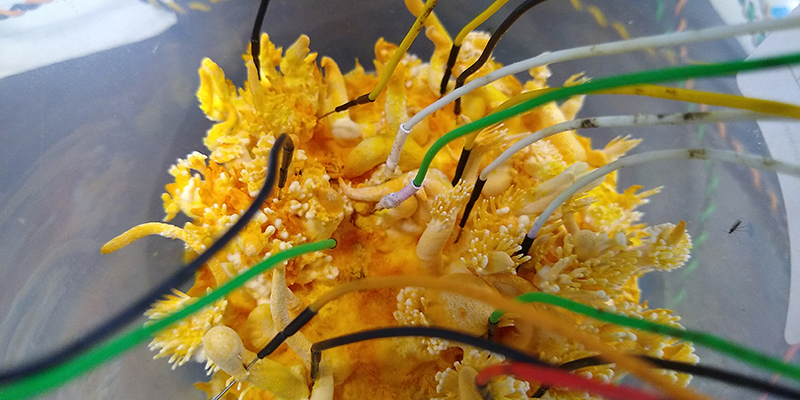
Caterpillar fungi being analyzed. (Andy Adamatzky)

Adamatzky looked at electrical activity across four types of fungi, looking for patterns in ghost fungi (Omphalotus nidiformis), Enoki fungi (Flammulina velutipes), split gill fungi (Schizophyllum commune), and caterpillar fungi (Cordyceps militaris).

Electrical activity was detected and recorded using tiny microelectrodes inserted across areas where the fungi had colonized, and spikes in activity were then organized into groups. Each type of fungi varied in terms of its spike duration and length, with some spikes lasting up to 21 hours.  READ MORE...

Crystal

Sunday, April 10

Tiger Friend

Solar Emergy


A team of engineers at Stanford University have developed a solar cell that can generate some electricity at night.
ne
The research comes at a moment when the number of solar jobs and residential installations are rising.

While standard solar panels can provide electricity during the day, this device can serve as a "continuous renewable power source for both day- and nighttime," according to the study published this week in the journal Applied Physics Letters.

The device incorporates a thermoelectric generator, which can pull electricity from the small difference in temperature between the ambient air and the solar cell itself.


"Our approach can provide nighttime standby lighting and power in off-grid and mini-grid applications, where [solar] cell installations are gaining popularity," the study said.

Mini-grid applications refer to independent electricity networks. These can be used when a population is too small or too far away to extend the grid.

It wasn't until recently that solar energy declined in price and became much more affordable. Some companies have bought into the program, and California has even incentivized the shift to solar.  READ MORE...