Monday, November 15
Quantum Physics and Interacting Particles
Researchers at the University of Cambridge's Cavendish Laboratory have recently introduced a new approach for measuring the spin states of a nuclear ensemble, a system comprised of many interacting particles with long-lived quantum properties. This method, presented in a paper published in Nature Physics, works by exploiting the response of this system to collective spin excitations.
"For a dense ensemble of quantum objects, such as spins, it isn't possible to measure each individually, to learn how they interacted with each other," Claire Le Gall and Mete Atatüre, two of the researchers who carried out the study, told Phys.org. "Instead, one can look for tell-tale signals in the collective response of the ensemble; a bit like the behavior of a flock of birds might say something about how the birds engage with each other. Our system of interest is a large flock, or ensemble, of nuclear spins in a semiconductor quantum dot."
In 2002, three Harvard University physicists figured out that large ensembles of nuclear spins in a semiconductor quantum dot could be potential hosts for solid-state quantum memories, then published their work a year later. 19 years later, Le Gall, Atatüre, and their colleagues probed this type of nuclear ensemble using a 'proxy' quantum bit, an electron spin that simultaneously couples to all nuclear spins, as reported in their latest paper. READ MORE...
Americans Quit Jobs
Workers are quitting in search for better pay or better jobs, representing a fundamental shift in America's labor market.
"Labor now has the initiative, and the era of paying individuals less than a livable wage has ended," said Joseph Brusuelas, chief economist at RSM US.
"This strongly suggests that rising wages are going to be part and parcel of the economic landscape going forward."
The nation had 10.4 million open jobs that month as the worker shortage crisis continues, data from the Bureau of Labor Statistics showed Friday. It was a modest decrease from the 10.6 million open jobs in August.
Jobs particularly increased in the health care and sector and in state and local government. "The Delta variant is still visible in the September JOLTS report," said Nick Bunker, director of economic research at the Indeed Hiring Lab, in emailed comments.
But he noted "we do know from the October jobs report that the labor market did get on more stable ground."The slowing demand for workers in the leisure and hospitality industry was the cause of the modest decline in available jobs in September. READ MORE...
Sunday, November 14
Cryptocurrency's Computing Problem
Here's the problem: The blockchain accounting technology that powers cryptocurrencies could be vulnerable to sophisticated attacks and forged transactions if quantum computing matures faster than efforts to future-proof digital money.
Cryptocurrencies are secured by a technology called public key cryptography. The system is ubiquitous, protecting your online purchases and scrambling your communications for anyone other than the intended recipient. The technology works by combining a public key, one that anyone can see, with a private key that's for your eyes only.
If current progress continues, quantum computers will be able to crack public key cryptography, potentially creating a serious threat to the crypto world, where some currencies are valued at hundreds of billions of dollars. If encryption is broken, attackers can impersonate the legitimate owners of cryptocurrency, NFTs or other such digital assets.
"Once quantum computing becomes powerful enough, then essentially all the security guarantees will go out of the window," Dawn Song, a computer security entrepreneur and professor at the University of California, Berkeley, told the Collective[i] Forecast forum in October. "When public key cryptography is broken, users could be losing their funds and the whole system will break."
Quantum computers get their power by manipulating data stored on qubits, elements like charged atoms that are subject to the peculiar physics governing the ultrasmall. To crack encryption, quantum computers will need to harness thousands of qubits, vastly more than the dozens corralled by today's machines. The machines will also need persistent qubits that can perform calculations much longer than the fleeting moments possible right now.
But makers of quantum computers are working hard to address those shortcomings. They're stuffing ever more qubits into machines and working on quantum error correction methods to help qubits perform more-sophisticated and longer calculations.
"We expect that within a few years, sufficiently powerful computers will be available" for cracking blockchains open, said Nir Minerbi, CEO of quantum software maker Classiq Technologies. READ MORE...
Rolls Royce and the Nuclear Reactor Business
Some of the money for this new nuclear venture comes from a big U.S. company: Exelon, the largest electric utility in the U.S. and a major producer of nuclear power, which will be partnering with French company BNF Resources to give $260 million to fund the venture over the next three years.
According to a press release issued by Rolls-Royce, one of the 16 reactors it’s planning to build will take up the space of two football fields—about a tenth of the size of a conventional reactor—while providing enough power for 1 million homes.
Dark Matter Creates Dark Matter From Regular Matter
The existence of a material described as dark matter has been proposed by physicists to explain certain behaviors observed by researchers—the way light bends as it makes its way from far away places to telescopes here on Earth, is just one example.
The theorists begin by citing prior research which suggests that some amount of dark matter was created as part of the 'thermal bath'—where primordial plasma made of regular matter begat dark matter particles—but not the amount that is believed to exist today.
Saturday, November 13
Beans... beans...
the magical fruit
the more you eat
the more you fart
the more you fart
the better you feel
so eat beans...
at every meal.
Artist unknown
Today, we are driving over to the Bush Beans Restaurant in Dandridge, TN as it has finally re-opened after being shut down due to COVID...
I am not sure what the others in our party are going to order for lunch but I know that as far as I am concerned, I will be ordering beans and cornbread...
It may seem strange to you that I am no longer interested in eating red meat that I now prefer white meat, fish, and beans... Of course, those of you who are interested in their health understand as well as those who have had a heart attack... and, as far as the rest of you are concerned, you will just have to find out for yourself.
I have no desire to see the family homestead, their dog DUKE, or buy anything from the General Store as a momento... I just want to eat a bowl of beans...
Lakes in Tennessee
Tennessee is a four-season vacation destination whose name came from the Yuchi Indian word “Tana-see”, meaning ‘meeting place’. Living to its name, this state has plenty of attractions to visit and it’s packed with history, nature, and culture. Previously, native Americans tribe inhabited the area, hence some of its places are still named after them. Tennessee also has both iconic natural and man-made attractions that make it a known state and a popular destination. It is the home of the Great Smoky Mountains National Park and the Mountain Dew drink. It is also where Oak Ridge, the energy capital of the world, is located. Moreover, Tennessee has plenty of lakes with green spaces, offering you outdoor and water activities. Here’s a list of the 10 beautiful lakes in Tennessee, USA.
1. Norris Lake

Source: Photo by Wikimedia Commons user Brian Stansberry used under CC BY 3.0
Norris Lake
Address: Ext. 122, Norris, TN 37828
Website: Norris Lake
2. Cherokee Lake

Source: Photo by Wikimedia Commons user Portraitlady4306 used under PUBLIC DOMAIN
Situated in the foothills of the Clinch Mountains, Cherokee Lake was named after the Native American tribe who previously lived in the area. A dam built in the 1940s can also be seen in this lake. Along its shoreline are campgrounds, boat docks, resorts, parks, picnic areas, playground, and paved trails. There is also a swimming beach, should you want to take a dip. Other popular activities here include lake fishing and birdwatching.
Cherokee Lake
Address: Cherokee Lake, Knoxville, TN 37849
Website: Cherokee Lake
3. Boone Lake
Source: Photo by Wikimedia Commons user Jakec used under CC BY-SA 3.0
Boone Lake is one of the small lakes in Tennessee. It has a shoreline of 139 miles. It features a swimming area and a boat ramp. Activities popular here are fishing, waterskiing, and other water-based recreation. Through the summer season, the lake has a stable water level. The lake serves as an aquatic ecology to fishes like crappie, bass, and bluegill.
Boone Lake
Address: Sullivan / Washington counties, Tennessee, United States
Falsifying Navy Steel Results
Elaine Marie Thomas, 67, of Auburn, Washington, was the director of metallurgy at a foundry in Tacoma that supplied steel castings used by Navy contractors Electric Boat and Newport News Shipbuilding to make submarine hulls.
From 1985 through 2017, Thomas falsified the results of strength and toughness tests for at least 240 productions of steel — about half the steel the foundry produced for the Navy, according to her plea agreement, filed Monday in U.S. District Court in Tacoma. The tests were intended to show that the steel would not fail in a collision or in certain "wartime scenarios," the Justice Department said.

The United States Navy's nuclear-powered attack submarine USS Vermont is christenedat Electric Boat in Groton, Conn. in October 2018. (Sean D. Elliot/The Day via AP, File)
There was no allegation that any submarine hulls failed, but authorities said the Navy had incurred increased costs and maintenance to ensure they remain seaworthy. The government did not disclose which subs were affected.
Thomas faces up to 10 years in prison and a $1 million fine when she is sentenced in February. However, the Justice Department said it would recommend a prison term at the low end of whatever the court determines is the standard sentencing range in her case.
In a statement filed in U.S. District Court on her behalf Monday, her attorney, John Carpenter, said Thomas "took shortcuts."
"Ms. Thomas never intended to compromise the integrity of any material and is gratified that the government’s testing does not suggest that the structural integrity of any submarine was in fact compromised," Carpenter wrote. "This offense is unique in that it was neither motivated by greed nor any desire for personal enrichment. She regrets that she failed to follow her moral compass – admitting to false statements is hardly how she envisioned living out her retirement years."
Thomas' conduct came to light in 2017, when a metallurgist being groomed to replace her noticed suspicious test results and alerted their company, Kansas City-based Bradken Inc., which acquired the foundry in 2008.
Bradken fired Thomas and initially disclosed its findings to the Navy, but then wrongfully suggested that the discrepancies were not the result of fraud. That hindered the Navy’s investigation into the scope of the problem as well as its efforts to remediate the risks to its sailors, prosecutors said. READ MORE...
We Need Mythologies
The primary villain of this story was Plato, whom Nietzsche accused of setting philosophy on its rationalist track. Plato’s immortalisation of his teacher, Socrates, amounted to nothing less than a morbid obsession with intellectual martyrdom. His Theory of the Forms taught generations of philosophers to seek truth in metaphysical abstractions, while devaluing lived experiences in the physical world. Plato’s intellectual revolution, in particular, was born out of the destruction of myth. In his wake, philosophy had been left ‘stripped of myth’ and starved of cultural roots. Modern culture, for Nietzsche, continued to languish in the shadow of Plato’s legacy, still grappling with its ‘loss of myth, the loss of a mythical home, a mythical, maternal womb’.
Seven decades later, at the end of the Second World War, Karl Popper mounted what would become, after Nietzsche, the second-most famous attack on Plato in modern philosophy. In The Open Society and Its Enemies (1945), Popper suggested that Plato had provided Western thought with its first blueprint of the ‘closed society’. In the Republic, Plato envisioned an ideal city that prioritises the harmony of the collective over the freedom of individuals, the preservation of the status quo over innovation, and the authority of intellectual gatekeepers over democracy and truth. The toxic influence of Plato’s political vision, Popper argued, could be traced through the history of philosophy, all the way to Nazi Germany and other forms of contemporary totalitarianism.
Like Nietzsche, Popper blamed Plato for setting Western philosophy on the wrong course. He did so, however, for precisely the opposite reason. Popper’s Plato was no rationalist. Rather, Popper boiled down the difference between open and closed societies to the difference between a culture of criticism and a culture of myth. Plato, as the first and the greatest of the enemies of the open society, had advocated the suppression of free criticism in order to establish an ‘arrested state’, sustained by myths and deception. Pointing to the Republic’s controversial foundation narrative, the Myth of Metals, Popper credited Plato with writing an ‘exact counterpart’ to ‘the modern myth of Blood and Soil’.
Who was right? Was Plato a short-sighted rationalist, who led philosophy astray by unmooring it from a more authentic, mythic past? Or was he a devious mythmaker, who introduced an uneasy current of irrationalism into the citadel of reason? How could he be both? Put differently: was Plato to blame for steering philosophy away from myth, or for bringing it closer to myth?
Neither The Birth of Tragedy nor The Open Society is celebrated today for its author’s fidelity to historical accuracy. Nonetheless, both remain iconic because Nietzsche and Popper were each on to something resonant about the relationship between myth and philosophy, and the curious symbolic role of Plato in our inherited understandings of that relationship. READ MORE...
Friday, November 12
Ancient Hangover Prevention
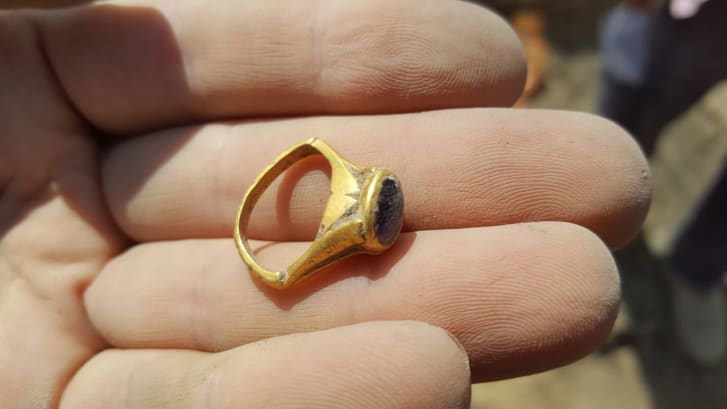
Raw eggs and Bloody Marys may be among today's hangover cures, but archaeologists in Israel have discovered an altogether different solution from the past: A gold and purple amethyst ring.
Excavated in the city of Yavne, the ancient jewel was uncovered from the site of the Byzantine era's largest known winery, according to the Israel Antiquities Authority. In an accompanying press release, archaeologists Amir Golani said that amethyst may have been worn to prevent the ill-effects of drinking too much alcohol.
"Many virtues have been attached to this gem," he is quoted as saying, "including the prevention of the side effect of drinking, the hangover."

The ring as it was discovered during the excavation in Yavne, a city in central Israel. Credit: Eliahu Valdaman/Israel Antiquities Authority
The ring was found just 150 meters (492 feet) away from the remains of a warehouse containing amphorae, a type of jar used to store wine. The excavation site has been dated to approximately the 7th century -- around the end of the Byzantine era and the start of the Early Islamic period -- though officials said the ring could be even older.
"Gold rings inlaid with amethyst stone are known in the Roman world, and it is possible that the ring's find belongs to the elites who lived in the city as early as the 3rd century CE," the press release said.
Golani said that amethyst was believed to have many other "virtues" and has religious associations, having been mentioned in the Bible. He also speculated that the ring, which weighs 5.11 grams (less than 0.2 ounces), once belonged to an "affluent" person.
"The wearing of the jewel indicated their status and wealth," he added. "Such rings could be worn by both men and women." READ MORE...
Be More Confident
But there’s an effective solution: Swap out weak words and phrases for ones that will make you come across as more professional and capable.
Here’s what psychologists, linguists, recruiters and CEOs say you should avoid using if you want to get ahead, along with simple replacements that will make a big difference in how you are perceived:
What to say instead: “What are your thoughts?” or “I’d like your input on this.”
If you ask “Does that make any sense?” after you’ve finished sharing a thought, you’re immediately giving the impression that you’re not convinced yourself, that your idea might be incomplete.
Rather than seeking validation or approval, you should be asking the listener or reader for their opinions on your idea.
What to say instead: “Let’s try…” or “It’s a good idea to try…”
Up until the mid-19th century, “maybe” was written as two words — “may” and “be” — which makes it clear that it literally refers to something that might happen, but might not.
That’s pretty wishy-washy when you apply it to your own ideas or suggestions. Either you believe in what you’re talking about, or you don’t.
What to say instead: “I believe this would …”
This is a minor distinction, but a valid one: “I think” sounds weaker than “I believe,” and is a little more doubtful, as if you’re saying something might work, but you’re not sure.
“I believe” puts you in charge of the thought and conveys a calm surety. And even if you’re not so sure at all, no one needs to know that!
What to say instead: Whatever you were going to say after the “but”
You don’t need to add disclaimers. Similarly, if you start your sentence with “I know this might be a stupid question, but …” or “I don’t want to sound pushy, but …,” you’re undermining yourself.
It’s an easy rule that bears repeating: Don’t put yourself down. Ever.
What to say instead: “I wanted to touch base ...”
How many times have you started an email with “Just wanted to ask you if …”? The problem in this case is that the “just” is a softener — almost an apology, as if you’re saying, “I hate to bother you, but …”
There’s a time and a place for that, but business communication generally isn’t. READ MORE...
Inside a Cargo Ship
A merchant marine gave a tour of a 958-foot cargo ship in 2019 that showed the intricacies of hulking freighters that haul 90% of the world's goods.
In the video, second mate Bryan Boyle records the vast array of machinery that keeps the ship moving, as well as the crew's and officers' living quarters on the Maersk ship, which was built in 2006.

In the ship's voyage, it sets out from Norfolk, Virginia, making several stops in the US before heading toward Belgium, Germany, and the Netherlands, to name a few destinations.
"I've had the opportunity to work on some interesting vessels," Boyle told Insider. "I've gotten to go to places that the average person wouldn't even know about. It's one of the most appealing aspects of the job."
Boyle said that there's a thrill to arrive at new destinations, remembering how he spent over a month in Africa on one trip. But the amount of time that crews get to explore new destinations has dwindled over the years, he said, as ships rush to get in and out of ports as fast as possible and early COVID-19 restrictions set limits to crew excursions.
The video shows Boyle's living quarters, as well as a movie locker that holds hundreds of titles. READ MORE...
Thursday, November 11
Quantum Immortalilty Theory

The quirky, time-twisting, death-looping comedy series landed on Netflix back in 2019, and was so odd and out there that it was hard to firmly define its genre. It’s a comedy, yes, and clearly sci-fi – with inspiration from the world of game mechanics as well as quantum theory – but the wisecracking cocaine enthusiast found in lead character Nadia (played by Natasha Lyonne) means Russian Doll feels nothing like the likes of Star Trek.
However, the mind-bending show rests on some notable assumptions about the nature of the universe, or rather multiverse, and how our lives are tied up with it – and with a second season expected in the near future, it feels like a good time to revisit Russian Doll, and the scientific concepts underpinning it.
In Russian Doll, game developer Nadia Vulvokov finds herself in a classic Groundhog Day scenario – forced to repeat the same day over and over. Except, much like quantum mechanics breaking the mold of classical physics, Russian Doll gives this scenario a twist, killing off its main character again and again in various and very sudden ways – be they by car crashes, deep rivers, or deadly staircases – and always returning her to the same moment in her bathroom, looking at the mirror and realizing she has to relive her 36th birthday all over again. READ MORE...
Bill Gates' Nuclear Plants
![]() |
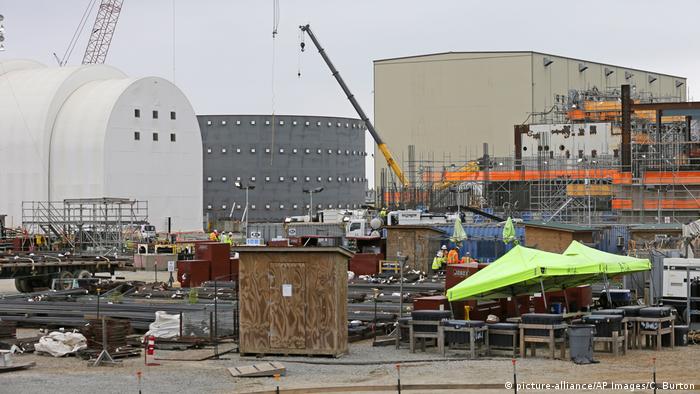
| Will smaller, modular reactors soon coexist with big ones like this here in Jenkinsville, South Carolina? |
Bill Gates' nuclear energy firm TerraPower and power company PacifiCorp — owned by Warren Buffett's holding company Berkshire Hathaway — teamed up in September 2020 to launch the Natrium project. It's about a small modular reactor they say will be commercially viable by 2030.
Many countries are weighing smaller, so-called modular, nuclear reactors as a way backing up low emission energy production during the transition from fossil fuel dependence to one based on renewable energy sources.
The reactor, to be built by Bechtel, will be in Wyoming, the United States top coal-producing state, Gates said. "We think Natrium will be a game-changer for the energy industry," he said.
The US Department of Energy has awarded TerraPower $80 million (€70 million) to develop its ideas.
TerraPower says the plant will cost $1 billion, including engineering, procurement and construction costs, and is expected to take seven years to build. In the US, the cost of building a conventional nuclear power plant is around $25 billion and can take far longer to build.
"Smaller, advanced reactors like those being developed under the funding from Bill Gates and others offer novel applications, approaches, and opportunities for one of the world’s largest sources of noncarbon emitting energy, nuclear energy," Brett Rampal, director of nuclear innovation at nonprofit Clean Air Task Force, told DW.
"They aren’t that small, this is 345 MW," Antony Froggatt, a research fellow at Chatham House, told DW. "While much smaller than existing reactors (1,000 MW), they are still large and may not be as modular as intended and this undermines the argument that they can be built in factories and then shipped out, which is how they are supposed to be cheaper," he warned.
But "the next generation of advanced reactors will make more efficient use of materials, be easier to site, and offer a great balance to increased reliance on renewables in the form of always available clean energy," Rampal insisted. "The Natrium concept also incorporates a thermal salt storage system which allows for the power plant to operate more flexibly and boost power output for portions of each day without having to make significant adjustments in the actual operation of the reactor," Rampal said. READ MORE...