Wednesday, January 11
Woman Who Joined ISIS Wants to Return to US
A woman who left Alabama to join the Islamic State in 2014 now says she regrets her actions and is hoping to return to the United States.
"If I need to sit in prison, and do my time, I will do it.… I won’t fight against it," Hoda Muthana, now 28, told The News Movement from the Roj detention camp in Syria, according to The Associated Press. "I’m hoping my government looks at me as someone young at the time and naive."
Muthana, who was born in New Jersey to Yemeni immigrants and was raised in Alabama, ran away from home at the age of 20 to join ISIS. Raised in a conservative Muslim household, she told her family she was going on a school trip but instead flew to Turkey and crossed into Syria using funds from secretly cashed tuition checks.
Once she arrived in Syria, Muthana says she was detained in a guest house reserved for unmarried women and children. READ MORE...
Tuesday, January 10
Republican Freedom Caucus
The Freedom Caucus, also known as the House Freedom Caucus, is a congressional caucus consisting of conservative Republican members of the United States House of Representatives. It is generally considered to be the most conservative and farthest-right bloc within the House Republican Conference.
The caucus is positioned right-wing to far-right on the political spectrum, with some members holding right-wing populist beliefs, such as opposition to immigration reform. The group takes hardline conservative positions and favors social conservativism and small government. The group sought dozens of times to repeal the Affordable Care Act.
Ten Tech Trends
Baidu will also showcase its latest tech innovations, including those that are on the top tech trends list for the year, at its annual AI developer conference Baidu Create on January 10, 2023.
"As the application threshold of AI core technologies continues to lower, and the application effectiveness continues to improve, the world is ready for historic change," said Dr. Haifeng Wang, CTO of Baidu and Head of Baidu Research. "This is the fourth consecutive year that Baidu Research has released its top 10 technology trends outlook. Over the past four years, AI has become a founding pillar of technological development."
"The future digital society will be built on advanced intelligent networks, the Internet of Things, blockchain, and other new forms of infrastructure, with natural human-computer interaction and AI serving as a key interaction platform. Virtual-real symbiosis technology will merge the physical and digital worlds, enhancing our experiences and capabilities in both realms," said Dr. Qinping Zhao, an academician of the Chinese Academy of Engineering and Honorary Chairman of the Industry of Virtual Reality Alliance.
"One of the most crucial fundamental technologies in the Fourth Industrial Revolution is AI. Synergized with autonomous driving, green computing, and life sciences, AI offers significant development opportunities," said Dr. Yaqin Zhang, Chair Professor of AI Science at Tsinghua University, and Dean of Institute for AI Industry Research of Tsinghua University (AIR).
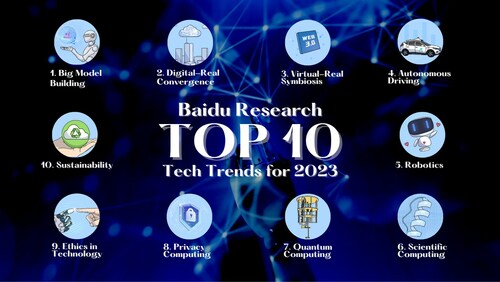
Here are Baidu Research's Top 10 Tech Trends for 2023. The full report is available here: http://research.baidu.com/Blog/index-view?id=178
Trend 1: Big Model Building – Big models for industries emerge, providing intelligent upgrades across a wide range of sectors.
Trend 2: Digital-Real Convergence - The increasing demand for AI infrastructure drives deeper integration of digital technology with the real economy.
Trend 3: Virtual-Real Symbiosis - Web 3.0 technology creates a new type of online space, leading to disruptive innovation in the metaverse industry.
Trend 4: Autonomous Driving - Autonomous driving sees new upgrades, leading progress in intelligent transportation.
Trend 5: Robotics - The use of industrial robotics accelerates, addressing labor shortages.
Trend 6: Scientific Computing - AI technology has become a valuable research aid, transforming the paradigm of multidisciplinary research.
Trend 7: Quantum Computing - Breakthroughs in core technologies continue to drive the industrialization of quantum computing.
Trend 8: Privacy Computing - Privacy computing platforms enable data interoperability while balancing value creation with security and trust
Trend 9: Ethics in Technology - Explainable AI technology promotes "mutual trust," making reliable and controllable technology a new competitive advantage.
Trend 10: Sustainability - The focus on green, low-carbon, and sustainable energy grows, with key breakthroughs in edge computing and advanced computing.
Republican Party Decline
As 2021 crashed to a close amid alarming new numbers of omicron cases in the US, we wanted to take a step back and ask, how healthy is America’s democracy? Now that the anniversary of the January 6 storming of the Capitol is close at hand, we wanted to take a look at the year in terms of how the Republican Party is living up to its own boastful moniker as the party of family values. This was, after all, the year when a Republican president urged his followers to march to the Capitol and “fight like hell”.
The oft-repeated phrase is that Republicans are pro-life only until birth. That accusation seemed justified when Republicans failed to vote in favour of the child tax credit and the child and dependent care tax credit in the stimulus package introduced by President Biden. This at a time when the United States ranks as one of the worst for child poverty among the world’s rich nations. American child poverty rates are worse than in Mexico and six times times those of Finland. Alas, Republicans seem more eager to act like children than to actually help them.
Family values, of course, have no real party affiliation and the majority of Americans believe that being good people, and treating people with dignity and kindness, still matters. Our children learn from our actions. So it has been particularly distressing to witness the many unseemly antics of many senior Republicans this year.
Representative Lauren Boebert, of Colorado, is a gun rights activist and adherent of Donald Trump. She has riffed on fellow Representative Ilhan Omar’s ethnicity — she was born in Mogadishu — and joked about a bomb in a backpack. For her part, Omar commented that Boebert “thinks bigotry gets her clout.” Boebert also refers to Covid vaccines as “Fauci Ouchies”, in a year where hundreds of thousands of Americans have died from Covid. Of course, the comment led to a whole line of “Fauci Ouchie” merchandise.
And can we ever forget Representative Marjorie Taylor Greene of Georgia (pictured above), and the video of her shouting harassing comments through the letter box of Alexandria Ocasio-Cortez’s Congressional office? Greene challenged her to a debate, shouting that Cortez should put her “big girl diapers on”. This was almost as dignified as Representative Paul Gosar of Arizona, who posted a cartoon video of himself wielding a sword at President Joe Biden, and killing Ocasio-Cortez. READ MORE...
Understanding 5G
The year 2019 will be remembered as the year that true cellular connectivity for the Internet of Things (IoT) finally got going. Nowadays not a week goes by without a new announcement of a new 4G NB-IoT / LTE-M network rollout. Yet the future for industry is already racing towards the fifth generation (5G) of wireless communication technology.
5G promises lightning-fast speed, barely noticeable latency (or communication response time) and vastly increased capacity. All four major U.S. carriers have green-lighted test networks and partial implementations in some cities.
The benefits of marrying the physical world with digital technologies have been discussed for what seems like a generation. Many industries could use the intelligence gleaned from connected systems to gain critical insights about their operations and how to make improvements that will make a genuine difference to their bottom line. While 4G is already creating dramatic improvements for industries around the world, it’s 5G that’s creating the greater buzz.
Jani Vilenius, Director of Research and Technology at Sandvik, says that data is already driving industry around the world: “Everyone is already collecting, and to a certain extent using data. But improved connectivity is needed to truly utilize the data and add business value. When we add more Artificial Intelligence (AI), machine learning, and voice/image recognition into everyday systems, the bandwidth requirements mean 5G is inevitable to leverage the new capabilities.”
Industry 4.0 was supposed to bring about these benefits, but up until now there’s been a crucial element missing. Turning the idea of a collaborative, adaptive, real-time industrial digital system into a reality needs a truly agile communications infrastructure.
You can be forgiven for thinking the move from 4G to 5G is merely about incremental speed improvements, with little need for all the hype. After all, the 4G/LTE (Long Term Evolution) communications architecture of today has hooked up approximately 3 billion mobile devices.
But in truth, the difference between 4G and 5G is not like comparing one iPhone model with the next, it’s more like comparing a horse and buggy to an electric race car.
Yes, 3G and 4G technology is most often equated with smartphones. That’s because the systems were designed for voice and mobile data respectively. And while it’s true that 5G’s dramatic speed increases will mean so much more than just higher-quality streaming and lightning quick downloads, the fact that it’s been designed from the ground up for data connectivity will be the game changer.
Faster connectivity and low-to-no latency will unlock operational benefits in every industry on the planet. Up until now there has been only talk, but with test systems now in place, those operational benefits are becoming clear.
In a market reliant on data-intensive machine applications, the higher speeds and low latency of 5G is required for the effective use of autonomous robotics technology, wearables and virtual reality.
Unlike previous jumps in levels of technology in industry, 5G won’t fundamentally redesign the production line. But what it will do is offer manufacturers an opportunity to build smart factories that can adapt to changing market conditions.
The increasing capabilities of smart devices and the factories that make them won’t just impact competition within a set industry. As competition shifts from product-based to system-based, formerly clear industry boundaries will be blurred. Traditional manufacturing companies may soon find they are competing as part of a much broader automation industry, for example.
The low latency of 5G is set to revolutionize the healthcare industry, most notably in the operating theater. Experienced surgeons can advise more junior colleagues via a video connection or could even operate the surgical device remotely. You could be forgiven for thinking this sounds unlikely, yet it’s already happened.
In early 2019, the world’s first live surgery via remote assistance took place successfully in China. An experienced surgeon inserted a stimulation device in the brain of a Parkinson's patient. The almost instantaneous latency of 2 milliseconds allowed the surgeon to accurately conduct the procedure as if they were right next to the patient, whereas in fact they were 3,000 kilometers away. The latency resembles surgery using a traditional cabled monitor solution.
Autonomous technology on the road and underground
The improvements to network latency will give applications and devices the ability to communicate in close-to real-time. This should ease the safety concerns of autonomous vehicles, providing them the ability to constantly communicate with the ever-changing environment around them.
This of course will have significant impact on mining operations, something Sandvik is aware of. Already, Sandvik has signed an agreement with Nokia to further develop solutions based on private LTE and 5G technology, much of which will take place at the Sandvik test mine in Tampere, Finland.
“Our focus to date has been on private LTE technology, which offers speed, latency, reliability and privacy benefits over Wi-Fi. It’s one of the technologies our customers are asking for now,” explains Vilenius. The benefit to Sandvik in focusing on LTE is simple. (LTE stands for Long-term Evolution and isn’t as much a technology as it is the path followed to achieve 4G speeds). Customer demand is there, and the hardware can easily be upgraded to 5G when the time comes. READ MORE...
Who Are The Republicans Trying to Fool???
All this has done is given more power to the Democrats and Mainstream Media that the GOP hasn't got the slightest idea how to govern or what is best for the American People.
Fighting for power is not a very good sign of UNITY... nor does it convey the fact that during the next two years, the GOP will spend more time fighting among itself than trying to pass legislation...
Two months from now when the House Freedom Caucus does not like what their party is doing in the House, are they going to play games again and pull off another power struggle or maybe propose that the Speaker should be replaced?
While I don't like the Democrat's plan of action... at least they have a plan of action and are united...
Monday, January 9
Marriage Equality in the USA
From gathering supporters in small towns across the country to rallying in front of the Supreme Court of the United States, we gave our all to ensure every person, regardless of whom they love, is recognized equally under the law.
Efforts to legalize same-sex marriage began to pop up across the country in the 1990s, and with it challenges on the state and national levels. Civil unions for same-sex couples existed in many states but created a separate but equal standard. At the federal level, couples were denied access to more than 1,100 federal rights and responsibilities associated with the institution, as well as those denied by their given state. The Defense of Marriage Act was signed into law in 1996 and defined marriage by the federal government as between a man and woman, thereby allowing states to deny marriage equality.
New Century & New Beginnings
As the Supreme Court decision in Lawrence v. Texas struck down sodomy laws in 2003, another victory was celebrated as Massachussetts became the first state to legalize same-sex marriage via a court ruling. On the federal level, however, efforts continued to prevent equality from becoming a reality. President Bush announced his opposition to same-sex marriage while the House introduced a constitutional amendment that would define marriage as between a man and a woman.
Rising Support Signals Hope
States from coast to coast began striking down past bans and enshrining marriage equality in new laws. California famously achieved marriage equality in 2008, only to have it dismantled again by the introduction and passage of Proposition 8, a ballot initiative that updated the state constitution to define marriage as between a man and a woman, that same year. The amendment later was disputed in lower level courts before making its way to the Supreme Court. READ MORE
Changing Your Gender
Gender transition is different for each person. There aren’t any specific steps required for someone to transition — it’s all about what feels right for you. It’s sort of like a buffet, where you can try everything, a few things, or nothing at all. Also, you may not want or have access to some kinds of transition.
What does it mean to transition?
Transitioning is about making changes so that you can live in your gender identity. These changes can include changing your name or getting gender-affirming medical care. People often transition to reduce gender dysphoria and/or increase gender euphoria.
How long does transitioning take?
Transitioning isn’t necessarily a straight line or direct route. Transitioning can be a long and ongoing process, or it can happen over a short period of time. You might try out different things as you learn what’s best for you.
The transition process is about becoming more fully yourself — in body, mind, and relationships. So, people sometimes call transitioning “congruence.”
You can start by learning about the different areas of transition, or ways to affirm your gender:
- internal
- social
- legal
- physical (medical and non-medical)
- Internal transition changes the way you see yourself.
You might try dressing differently when you’re by yourself, calling yourself by a different name only in your head, or practice using your voice differently.
Social transitioning may include things like:
- coming out to your friends and family as transgender or nonbinary;
- asking people to use pronouns that feel right for you;
- going by a different name;
- dressing/grooming in ways that feel right for you when other people can see you; and
- using your voice differently when talking to other people.
While the laws vary in different states, you might legally change your name and/or gender marker on formal records, like:
- your driver’s license, state ID, or passport;
- your birth certificate;
- your social security number;
- your immigration documents, permanent resident card, or naturalization certificate; with your school or employer; and
- with your doctor or health insurance.
Some kinds of legal transition require paperwork and can be expensive. Some can be free and pretty easy. It depends on where you live and what you want to change.
Learn how to change your name and/or gender marker on legal documents at the National Center for Transgender Equality. READ MORE...
The Rise of Interracial Marriages
Here's one of the biggest statistical changes in American opinion: Approval of interracial marriage in the U.S. is at a new high of 94%, according to Gallup polling.
Why it matters: When Gallup first asked the question in 1958, just 4% of Americans approved of interracial couples.
That approval rating is sky-high no matter how you slice the data:
- Age: 98% of 18- to 29-year-olds approve; 97%, 30–49; 91%, 50+
- Race: 96% of non-white Americans; 93%, white
- Region: 94%, East; 93%, Midwest; 93%, South; 97%, West
The prevalence of intermarriage has also increased.Back in 1967, just 3% of married couples were interracial. Now it's 20%, according to Pew Research Center.
The big picture: There are many reasons contributing to the rise of interracial dating and marriages in the U.S., The Guardian reports:
- Acceptance of interracial couples has steadily grown — though unique challenges and stressors for these couples still exist. Many interracial couples in the U.S. are feeling anxiety, "with heated public debate on issues involving racial justice, immigration, and even direct attacks on minority groups," CBS News "Sunday Morning" reported.
- America is increasingly diverse — and is projected to have a majority minority population by 2045, increasing the diversity of potential romantic partners.
- Younger Americans are more educated than ever. There's a higher rate of interracial marriage among those with more education, studies show.
The bottom line: 55 years after the legalization of interracial marriage, Americans nearly unanimously approve of love across races.
Sunday, January 8
Flying Boats
The Pioneer of Belfast glides above the water, quiet and smooth, leaving little wake behind it.
"Even in big waves and wind, we can see the benefits of flying above the waves," says Katrina Thompson, programme director at Artemis Technologies.
The Pioneer, developed by Artemis Technologies, is the world's first electric foiling workboat to be brought to market.
The foil, a wing-like structure underneath the boat, lifts the hull out of the water, greatly reducing drag.
Combine with an electric motor and you have, according to Artemis, a vessel which reduces fuel costs by 90% and is emission-free.
"It's such a transformative technology," says Dr Thompson.
Dr Thompson grew up in Sailortown, Belfast, in amongst the bustle of heavy industry. She spent her childhood playing on the docks while her parents worked on the boats.
She left Belfast to become an aeronautical engineer, designing aircraft for Rolls-Royce and Bombardier. Then, she went back to her roots - taking her expertise with her. READ MORE...
Tech Trends for 2023
At 1:03am on Monday 5 December, the most powerful laser on the planet flashed into life at the Lawrence Livermore National Laboratory (LLNL) in California, in an experiment that sent shockwaves through the world of physics and beyond.
The laser targeted a fuel capsule, the size of a peppercorn, creating temperatures and pressures which sparked a fusion reaction - the reaction which powers the sun.
The National Ignition Facility (NIF) had done such experiments before, but this time the energy that came out of the reaction, was more than the laser power used to trigger it.
It was a landmark moment for fusion researchers and, while fusion reactors are still a long way from making electricity that we can use, it shows that the physics works.
"We have taken the first tentative steps towards a clean energy source that could revolutionise the world," said LLNL Director Kim Budil. READ MORE...
97% ARE STRAIGHT
LONDON – Around 3% of people in England and Wales aged 16 or over identify as lesbian, gay or bisexual, according to 2021 census data released on Friday.
The census in 2021 was the first in Britain to ask about people’s sexual orientation, and the results are broadly in line with previous, smaller-scale surveys.
The census, conducted by Britain’s Office for National Statistics (ONS), also asked about people’s gender identity for the first time. About 262,000 people – 0.5% of those aged 16 or over – replied that the gender they identified with was different from their sex registered at birth, the ONS said.
The questions about sexual orientation and gender identity were voluntary, and 7.5% of people declined to answer about their sexual orientation, while 6.0% did not answer the question on gender identity.
Overall, 43.4 million people in England and Wales said they were “straight or heterosexual”, while 1.5 million – 3.2% of the population aged 16 or over – identified as gay or lesbian, bisexual, or other.
Some 1.5% of people said they were gay or lesbian and 1.3% were bisexual. Another 0.3% ticked a box for “other sexual orientation”, two thirds of whom called themselves pansexual.
On gender identity, 262,000 people aged 16 or over answered that they were a different gender to the sex they were registered as at birth, the ONS said.
Of those, 48,000 said they now identified as a trans man, 48,000 identified as a trans woman, 30,000 said they were non-binary and 18,000 said they had another gender identity, the ONS added.
The ONS defines a trans man as someone who identifies as a man but was registered female at birth, while trans women were registered as male at birth, but now identify as women.
Census figures for Britain as a whole are not yet available, as Scotland delayed carrying out its census for a year due to the COVID-19 pandemic.
A previous, annual UK-wide survey conducted by the ONS showed that in 2020 3.8% of people identified as gay or lesbian, bisexual or other, up from 1.9% in 2014 when same-sex marriage was first allowed in England and Wales.
That survey also gave breakdowns of sexual orientation by age, gender and ethnicity – showing, among other things, that younger people are much more likely to identify as lesbian, gay or bisexual.
Sex between men aged 21 or over was legalised in England and Wales in 1967. The age of consent was lowered to 18 in 1994 and reduced to 16 – the same as for heterosexual relationships – in 2000.
Census data on sexual orientation by age will be published on Jan. 25, and further details will come later in the year.
Saturday, January 7
Crowded Tokyo
Japan is upping the ante on its cash incentives to get people to move out of its overcrowded capital, Tokyo, which is home to about 37 million people. For scale, Canada’s population in 2021 was just over 38 million.
Starting in April, families in the greater Tokyo area will be eligible to receive 1 million yen, or just under $10,200, per child if they move to the countryside, in an effort to revitalize less-populated areas, according to reports from CNN and the Guardian.
Previous incentives saw the Japanese government offering 300,000 yen, about $3,000, per child if families relocated. This new measure certainly sweetens the pot, tripling their previous offer.
Tokyo is host to many of Japan’s largest companies and is the centre of its economy, meaning it’s an attractive place to move, especially for young people living in rural areas. This migration pattern has left small towns with fewer and older residents, and millions of unoccupied homes.
According to 2021 government statistics, the number of people moving into Tokyo outnumbered those leaving the city by around 80,000.
The concentration of the Japanese population in Tokyo also poses a problem for the country’s demographic crisis, marked by declining birth rates and an aging population.
Saving the Rain Forest
Francisco Elle is haunted by the faces of children he could not save.
It's what drives him deep into the dense rainforests of the vast Sierra Madre mountain range day after day, carrying a heavy wicker bag full of fresh saplings on his shoulders.
His lean figure ducks under a thick ceiling of leaves. Even with his glasses falling to the end of his nose, he manages to avoid being tripped by exposed tree roots as he hurries along a faint trail to his latest tree planting site.
Following him is tough going, especially as clouds roll down the hillside brushing the tips of the branches with a fresh mist of rain.
He once made a living chopping down these trees which had taken centuries to grow. Now in his 50s, he has turned from illegal logger to forest ranger after witnessing what he describes as "nature's revenge".
More than 1,000 people were killed when Francisco's village, along with several others, was washed away by a landslide in December 2004.
"I saw lifeless children all lined up on the street while the houses were all destroyed. There weren't any houses left, even ours was gone. When I remember the things we did, I feel helpless," he said during one of the few breaks he was willing to take that day.
Does he feel guilty about his past? He turns away in tears. After several minutes, he answers: "I blame myself. Maybe if I didn't cut trees, maybe it wouldn't have happened." READ MORE...