Thursday, October 21
US Debt On Its Way UP...
The American debt is out of control, but America can afford it
because of the American dollar.
Image: Adobe StockThe US debt will reach $30T in the coming months. This is a certainty. While this seemed hardly imaginable only ten years ago when the US debt was still “only” $14.3T in 2011, it is now unavoidable as it reaches $28.8T at the time of writing.
In only ten years, the US debt has thus increased by +101%.
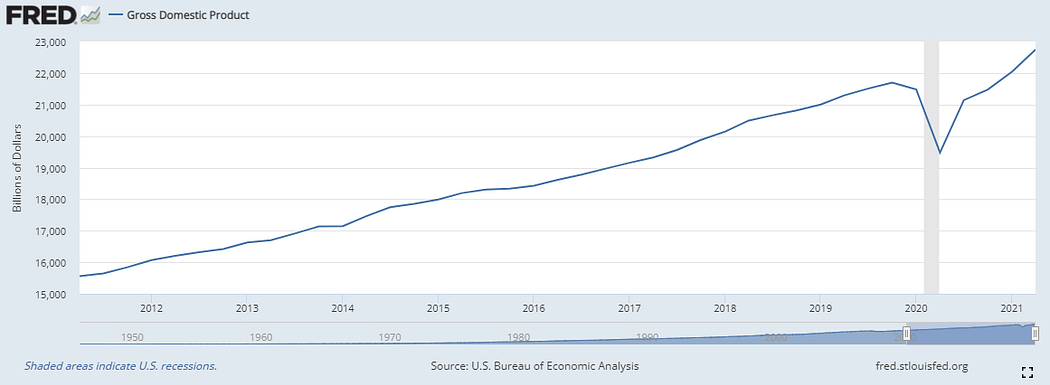
This would not be so serious if America’s GDP had grown at the same rate over this period. However, this is not the case, since the US GDP has stalled. Over the same period the US GDP grew by “only” +46.5%.
America Gross Domestic Product — Source: The FedUnder these conditions, it is not surprising that America’s debt-to-GDP ratio has risen well above 100% and currently stands at 127%. The time when having a debt-to-GDP ratio above 100% was taboo is over.
Among the world’s major economic powers, it has even become the norm.
The American debt is divided into two main categories
The US debt is managed by the US Treasury Department through the Bureau of Public Debt. The debt is divided into two broad categories: intra-governmental holdings and debt held by the public.
Intra-governmental debt is debt that the U.S. Treasury owes to other federal agencies. Some agencies, like the Social Security Trust Fund, collect more tax revenue than they need. Instead of putting this money under a giant mattress, these agencies invest in U.S. Treasury bonds.
Currently, this intra-governmental debt is about $6.4T. TO KNOW MORE ABOUT OUR DEBT... CLICK HERE...
Media Making Mistake
Jon Stewart says media making 'mistake' casting Trump as
'incredible supervillain'
'I think we make a mistake focusing this all on Donald Trump, as if he's ... some incredible supervillain that has changed the very nature and temperature of the US'
Comedian Jon Stewart said the media's hyperfocus on former President Trump is a mistake and that casting him as an "incredible supervillain" distracts from other threats.
The former "Daily Show" host told CNN's Jake Tapper in an interview airing Sunday that political pundits are "making a mistake" blaming Trump for the country's divisive discourse, arguing they should turn their focus to the threat posed by much larger institutions that have dangerously embraced "the idea that power is its own reward."
"I think we make a mistake focusing this all on Donald Trump, as if he's … Magneto and some incredible supervillain that has changed the very nature and temperature of the U.S.," Stewart said. "He's just been an effective vessel, but he's not singing new songs. … I think it's a mistake to focus it all on this one individual and not to focus it more on the idea that power is its own reward whether it be in the financial industry or government. Power doesn't cede itself, and unless we can figure out a better way to balance out that power … we'll be vulnerable." TO READ MORE ON STEWART"S THINKING, CLICK HERE...
What is VoIP?
Voice over Internet Protocol (VoIP) is a proven technology that lets anyone place phone calls over an internet connection. With the rise of broadband, VoIP has become the definitive choice for phone service for consumers and businesses alike.
People enjoy using VoIP phone service over traditional phone lines. Why? It offers many more capabilities than analog phones. And it can do it all for less than half the cost.
Cloud phone service providers include powerful features not found with standard phone service. Auto attendants, call recording, custom caller ID, voicemail to email, and so much more. Plus, you can take calls and work from anywhere.
What is VoIP?
How does VoIP work?
Pros and cons of Voice over IP
Is it easy to use VoIP?
How much does VoIP cost?
Top VoIP phone system features
Do I need a VoIP phone?
What to look for in a VoIP provider
We've expanded this guide to take a closer look at what you need to know about Voice over Internet Protocol. We'll cover everything you need to know, including the benefits of VoIP phone service.
What is VoIP?
VoIP is an acronym for Voice over Internet Protocol that describes the method to place and receive phone calls over the internet. Most people consider VoIP the alternative to the local telephone company.
If you've heard of an IP address, that's your Internet Protocol address. An IP address is how computers and devices communicate with each other on the internet.
VoIP isn't actually all that new. Telephony has relied on digital lines to carry phone calls since the late 90s. VoIP is a cost-effective way to handle an unlimited number of calls.
So, what does this mean for you? TO READ ABOUT IT... CLICK HERE...
People enjoy using VoIP phone service over traditional phone lines. Why? It offers many more capabilities than analog phones. And it can do it all for less than half the cost.
Cloud phone service providers include powerful features not found with standard phone service. Auto attendants, call recording, custom caller ID, voicemail to email, and so much more. Plus, you can take calls and work from anywhere.
What is VoIP?
How does VoIP work?
Pros and cons of Voice over IP
Is it easy to use VoIP?
How much does VoIP cost?
Top VoIP phone system features
Do I need a VoIP phone?
What to look for in a VoIP provider
We've expanded this guide to take a closer look at what you need to know about Voice over Internet Protocol. We'll cover everything you need to know, including the benefits of VoIP phone service.
What is VoIP?
VoIP is an acronym for Voice over Internet Protocol that describes the method to place and receive phone calls over the internet. Most people consider VoIP the alternative to the local telephone company.
If you've heard of an IP address, that's your Internet Protocol address. An IP address is how computers and devices communicate with each other on the internet.
VoIP isn't actually all that new. Telephony has relied on digital lines to carry phone calls since the late 90s. VoIP is a cost-effective way to handle an unlimited number of calls.
So, what does this mean for you? TO READ ABOUT IT... CLICK HERE...
Wednesday, October 20
Spain's Liquid Gold
For centuries, people have tapped pine trees to extract resin. But in one Spanish province, locals believe this age-old practice could save rural towns while also helping the planet.
Stretching north from Madrid, north-west Spain's autonomous Castilla y León region is a patchwork of vast mountain ranges, high plateaus and medieval towns. While most visitors come to marvel at the castillo castles that lend the region its name or admire the enchanting cathedrals in León and Burgos, much of the area is blanketed in scrubby sierra and high-altitude meseta plains that extend as far as the eye can see.
But in the provinces of Segovia, Ávila and Valladolid, a drastically different landscape emerges. Here, amid the Tierra de Pinares and Sierra de Gredos mountain ranges, a thick, 400,000-hectare protected forest of fragrant resin pines stretches up into the mountainous folds. Shielded from the hot Spanish sun and lined with trails and, this forested frontier is a popular hiking destination for locals and tourists. And, if you visit at the right time of year and look closely, you may see workers crouched next to the tree trunks, continuing a centuries-old tradition of collecting the pine's "liquid gold".
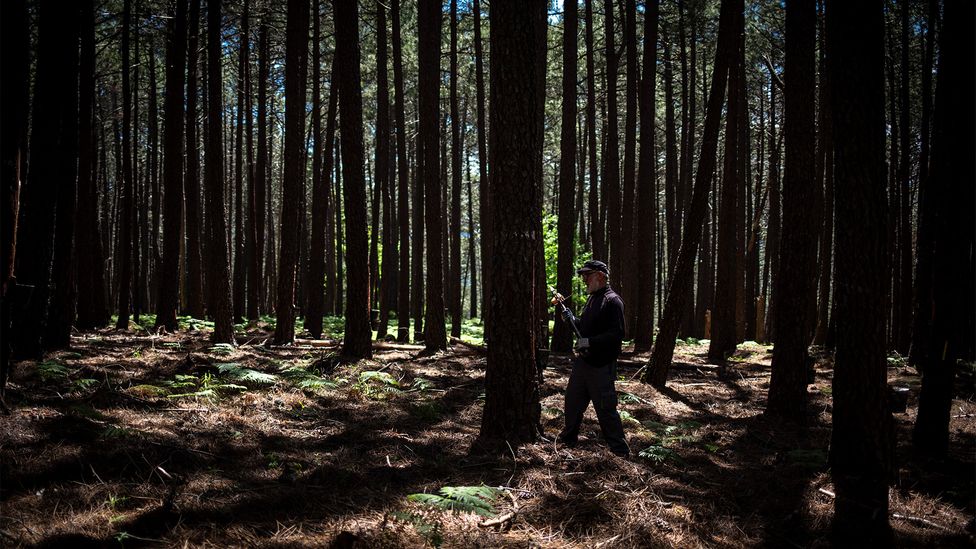
Deep in the forests of Spain's autonomous Castilla y León province, workers carry out the age-old practice of resin tapping (Credit: Susan GiróA booming market
Pine resin has been used by different civilisations for thousands of years. In Spain and across much of the Mediterranean, it was used to waterproof ships, treat burns and light torches, among other things. But according to Alejandro Chozas, a professor in the forestry engineering department at Madrid Polytechnic University, it wasn't until the 19th and 20th Centuries that the extraction of pine resin became truly profitable in the Castilla y León region.
As technology and industrialisation helped turn the thick, milky sap into things like plastics, varnishes, glues, tyres, rubber, turpentine and even food additives in the mid-19th Century, the owners of Castilla y León's dense Pinus pinaster forests saw an opportunity. Soon, workers were hacking into the bark of resin pines across the region in order to collect the valuable sap. And while this time-consuming process has now ceased across much of the world, in the past decade it has experienced something of a rebirth in Castilla y León, which is home to more resin manufacturers than anywhere else in Europe and one of the last places on the continent where the practice persists. TO READ MORE ABOUT SPAIN'S LIQUID GOLD, CLICK HERE...
Stretching north from Madrid, north-west Spain's autonomous Castilla y León region is a patchwork of vast mountain ranges, high plateaus and medieval towns. While most visitors come to marvel at the castillo castles that lend the region its name or admire the enchanting cathedrals in León and Burgos, much of the area is blanketed in scrubby sierra and high-altitude meseta plains that extend as far as the eye can see.
But in the provinces of Segovia, Ávila and Valladolid, a drastically different landscape emerges. Here, amid the Tierra de Pinares and Sierra de Gredos mountain ranges, a thick, 400,000-hectare protected forest of fragrant resin pines stretches up into the mountainous folds. Shielded from the hot Spanish sun and lined with trails and, this forested frontier is a popular hiking destination for locals and tourists. And, if you visit at the right time of year and look closely, you may see workers crouched next to the tree trunks, continuing a centuries-old tradition of collecting the pine's "liquid gold".

Deep in the forests of Spain's autonomous Castilla y León province, workers carry out the age-old practice of resin tapping (Credit: Susan GiróA booming market
Pine resin has been used by different civilisations for thousands of years. In Spain and across much of the Mediterranean, it was used to waterproof ships, treat burns and light torches, among other things. But according to Alejandro Chozas, a professor in the forestry engineering department at Madrid Polytechnic University, it wasn't until the 19th and 20th Centuries that the extraction of pine resin became truly profitable in the Castilla y León region.
As technology and industrialisation helped turn the thick, milky sap into things like plastics, varnishes, glues, tyres, rubber, turpentine and even food additives in the mid-19th Century, the owners of Castilla y León's dense Pinus pinaster forests saw an opportunity. Soon, workers were hacking into the bark of resin pines across the region in order to collect the valuable sap. And while this time-consuming process has now ceased across much of the world, in the past decade it has experienced something of a rebirth in Castilla y León, which is home to more resin manufacturers than anywhere else in Europe and one of the last places on the continent where the practice persists. TO READ MORE ABOUT SPAIN'S LIQUID GOLD, CLICK HERE...
African Tech Giant JUMIA
It could not have got off to a much better start for Jumia's historic stock market listing. The hoopla on the day it became the first Africa-focussed tech firm to list on the New York Stock Exchange was massive.
International media took note and investors piled in, its share price rose more than 70% in value on the day but the excitement would prove to be short-lived.
"In our countries where we operate there are 700 million people and last year we served more than four million consumers" co-chief executive officer Sacha Poignonnec told the BBC on the floor of the stock exchange.
When I sat down to speak with his co-CEO, Jeremy Hodara, in September the firm had had a humbling few years. Share prices plummeted and came back, backers had bailed out, and it had withdrawn from trading in three of the fourteen countries it was operating in - and that's not to mention reports of fraud lawsuits in New York courts and a public relations disaster over its identity.
But the promise of millions of consumers newly connected to the internet has not gone away and neither has interest in Jumia which is still by far the largest e-commerce company focussed on the African continent - although its management and much of technical expertise is based outside of Africa.
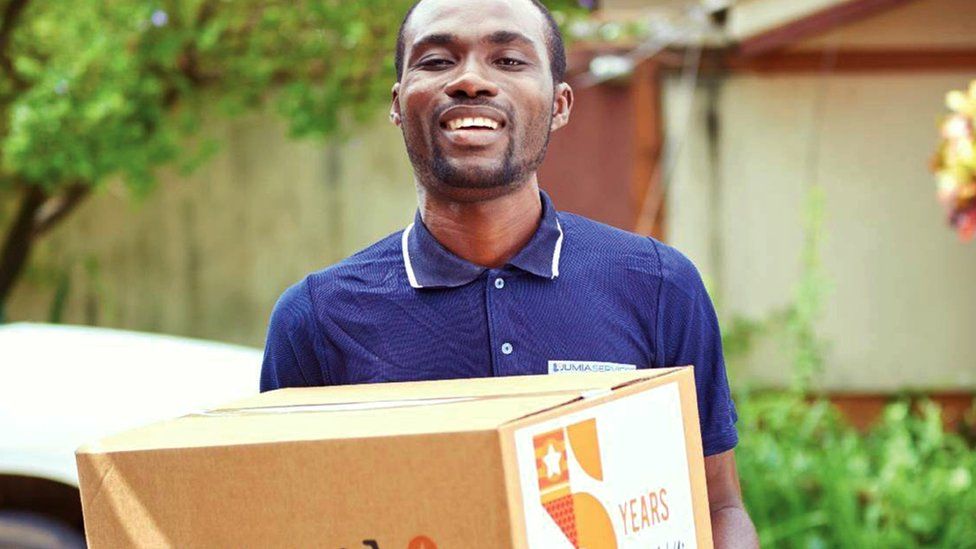
IMAGE SOURCE,JUMIAImage caption,The promise of deliveries to more than a billion consumers in Africa drove interest in Jumia
By 2030, consumer spending across Africa is expected to reach $2.5tn. Jumia still sells goods in 11 of those countries. It operates a marketplace where thousands of other businesses sell goods on its platform and has a finance arm, Jumia pay, so customers can go about their shopping, pay utility bills and order pizza, all without leaving the Jumia's platforms. TO READ MORE ABOUT JUMIA, CLICK HERE...
International media took note and investors piled in, its share price rose more than 70% in value on the day but the excitement would prove to be short-lived.
"In our countries where we operate there are 700 million people and last year we served more than four million consumers" co-chief executive officer Sacha Poignonnec told the BBC on the floor of the stock exchange.
When I sat down to speak with his co-CEO, Jeremy Hodara, in September the firm had had a humbling few years. Share prices plummeted and came back, backers had bailed out, and it had withdrawn from trading in three of the fourteen countries it was operating in - and that's not to mention reports of fraud lawsuits in New York courts and a public relations disaster over its identity.
But the promise of millions of consumers newly connected to the internet has not gone away and neither has interest in Jumia which is still by far the largest e-commerce company focussed on the African continent - although its management and much of technical expertise is based outside of Africa.
IMAGE SOURCE,JUMIAImage caption,The promise of deliveries to more than a billion consumers in Africa drove interest in JumiaBy 2030, consumer spending across Africa is expected to reach $2.5tn. Jumia still sells goods in 11 of those countries. It operates a marketplace where thousands of other businesses sell goods on its platform and has a finance arm, Jumia pay, so customers can go about their shopping, pay utility bills and order pizza, all without leaving the Jumia's platforms. TO READ MORE ABOUT JUMIA, CLICK HERE...
Higher Heating Bills
US heating bills are set to surge this winter as energy prices soar, the US Energy Information Administration says.
About half of households use natural gas for heating and will see their bills jump by 30% in October-March compared to last year, the EIA it said.
Those who use heating oil or propane - around 10% - could see their costs jump by 54% and 43% respectively.
For the remainder that use electricity for heating, costs should rise by a more modest 6%, it said. Energy prices have soared globally, amid a shortage that has hit firms and households in Europe and Asia.
The US has not seen the same chaos, but fuel costs have risen to multi-year highs which is likely to hit household finances as the weather gets colder.
"As we have moved beyond what we expect to be the deepest part of the pandemic-related economic downturn, growth in energy demand has generally outpaced growth in supply," said Steve Nalley, acting administrator of the Energy Information Administration (EIA).
"These dynamics are raising energy prices around the world."
Soaring gas prices
Natural gas is plentiful in the US, but prices have doubled this year from pandemic-era lows in-part because the country failed to stockpile enough last winter.
According to the EIA's baseline scenario, heating bills between October and March for gas users will hit $746, a third more than the same winter period last year.
But it said this would rise to a 50% increase if the winter was colder than average, hitting cities such as Chicago which rely heavily on central heating in colder months. READ MORE...
Tuesday, October 19
India's Deadly Floods
More than 20 people have been killed in floods in southern India after heavy rains caused rivers to overflow, cutting off towns and villages.
Several houses were washed away and people became trapped in the district of Kottayam in Kerala state. Video from the area showed bus passengers being rescued after their vehicle was inundated with floodwater.
Days of heavy rainfall in Kerala has caused deadly landslides and the Indian military has joined rescue efforts.
Helicopters have been used to fly in supplies and personnel to areas where people have been trapped under debris by the landslides, officials said on Sunday.
In one tragic incident, a family of six - including a 75-year-old grandmother and three children - were confirmed dead after their home in Kottayam was swept away, news agency PTI reported.
The bodies of another three children - aged eight, seven and four - were also found buried under the debris in Idukki district, where the search continued for at least five other missing people, the agency said.
Fishing boats are being used to evacuate survivors trapped in Kollam and other coastal towns, as sections of road have been swept away and trees uprooted. TO READ MORE ABOUT THESE FLOODS, CLICK HERE...
Security for Global Politicians
The killing of British MP Sir David Amess has highlighted the dilemma facing politicians worldwide.
How can you be an open, accessible people's representative and yet still protect your personal safety?
We asked our correspondents around the world to tells us how lawmakers cope where they are.
Brazil
By Katy Watson. BBC South America correspondent
IMAGE SOURCE,EPAImage caption,Jair Bolsonaro was stabbed during his presidential campaign in 2018In such a vast country as Brazil, there are many different political realities.
In remote areas like the Amazon, expect to find little or no security for the average politician. That's not to say there aren't legitimate safety concerns - with powerful economic players vying for control, threats to politicians' security aren't uncommon. But rallies are community affairs, politicians are often a familiar face - and being part of the fabric is crucial.
Down south in big cities like São Paulo and Rio de Janeiro you're more likely to see politicians flanked by bodyguards and large entourages. Wealth here is extreme - and so are the inequalities. Richer politicians, like those in the corporate world, protect themselves.
Brazil is deeply divided politically and that has become clearer during Jair Bolsonaro's leadership. He was stabbed during his presidential campaign and has used this as a justification to liberalise gun laws. TO READ MORE ABOUT THIS, CLICK HERE...
Subscribe to:
Comments (Atom)