Tuesday, August 24

Mini Brains Grow Eyes
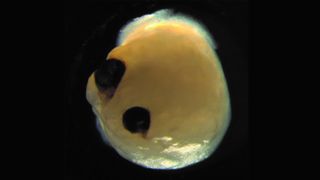
Scientists grew brain organoids with optic cups. (Image credit: Elke Gabriel)
Scientists recently grew mini brains with their own sets of "eyes," according to a new study.
Organoids are miniature versions of organs that scientists can grow in the lab from stem cells, or cells that can mature into any type of cell in the body. Previously, scientists have developed tiny beating hearts and tear ducts that could cry like humans do. Scientists have even grown mini brains that produce brain waves like those of preterm babies.
Now, a group of scientists has grown mini brains that have something their real counterparts do not: a set of eye-like structures called "optic cups" that give rise to the retina — the tissue that sits in the back of the eye and contains light-sensing cells, according to a statement.
In the human body, the retina sends signals to the brain via the optic nerve, allowing us to see images. "In the mammalian brain, nerve fibers of retinal ganglion cells reach out to connect with their brain targets, an aspect that has never before been shown in an in vitro system," senior author Jay Gopalakrishnan, a researcher at University Hospital Düsseldorf, said in the statement. (Ganglion cells are neurons located in the inner surface of the retina that communicate directly with the brain.)
Previously, researchers had grown optic cups individually in labs, but this is the first study that integrated optic cups into brain organoids, according to the statement.
Gopalakrishnan and his team adapted a technique they previously developed for turning stem cells into neural tissue in order to create the mini brains with optic cups. Once the stem cells had developed into mini brains, the organoids formed optic cups. The optic cups appeared as early as 30 days and matured within 50 days, a timeframe similar to how the retina develops in a human embryo, according to the statement.READ MORE
Scientists recently grew mini brains with their own sets of "eyes," according to a new study.
Organoids are miniature versions of organs that scientists can grow in the lab from stem cells, or cells that can mature into any type of cell in the body. Previously, scientists have developed tiny beating hearts and tear ducts that could cry like humans do. Scientists have even grown mini brains that produce brain waves like those of preterm babies.
Now, a group of scientists has grown mini brains that have something their real counterparts do not: a set of eye-like structures called "optic cups" that give rise to the retina — the tissue that sits in the back of the eye and contains light-sensing cells, according to a statement.
In the human body, the retina sends signals to the brain via the optic nerve, allowing us to see images. "In the mammalian brain, nerve fibers of retinal ganglion cells reach out to connect with their brain targets, an aspect that has never before been shown in an in vitro system," senior author Jay Gopalakrishnan, a researcher at University Hospital Düsseldorf, said in the statement. (Ganglion cells are neurons located in the inner surface of the retina that communicate directly with the brain.)
Previously, researchers had grown optic cups individually in labs, but this is the first study that integrated optic cups into brain organoids, according to the statement.
Gopalakrishnan and his team adapted a technique they previously developed for turning stem cells into neural tissue in order to create the mini brains with optic cups. Once the stem cells had developed into mini brains, the organoids formed optic cups. The optic cups appeared as early as 30 days and matured within 50 days, a timeframe similar to how the retina develops in a human embryo, according to the statement.READ MORE
Treated Violins

As it turns out, it's not just the quality of the craftsmanship that creates the superior sound of these classic violins – called Cremonese violins after the area where they were produced – but also the way the wood was processed.
This latest study focussed particularly on the soundboard of the violin, the part that's most crucial to the acoustic output of the instrument. Stradivari and Guarneri soundboards are relatively thin and light by modern day standards, and it's here that the chemicals would have originally been applied.
"This new study reveals that Stradivari and Guarneri had their own individual proprietary method of wood processing, to which they could have attributed a considerable significance," says biochemist Joseph Nagyvary, from Texas A&M University.
"They could have come to realize that the special salts they used for impregnation of the wood also imparted to it some beneficial mechanical strength and acoustical advantages."
The idea that chemical processing is the reason Stradivari and Guarneri violins stand out has been explored by Nagyvary and colleagues before, but this new work goes further into identifying the sort of substances that were probably used by the master violin makers. READ MORE
Tuesday 1

Supersonic flight is arriving—in a hurry. In the last 18 months, Boom has successfully tested its XB-1 demonstrator aircraft and pre-sold 15 of its still-in-development 30-seat Overture models to United Airlines. Virgin Galactic and Rolls Royce rolled out a partnership to develop a 19-seater. Even the Russian Federation revealed plans to build a supersonic jet for commercial use.
Then there’s the Hermeus Quarterhorse. Think supersonic or Mach 1—the speed of sound—multiply by five and you have the hypersonic Quarterhorse.
Last week, the Atlanta-based company announced a $60 million award from the US Air Force to finance testing of the aircraft. Like the Greek god Hermes, this Hermeus is designed to travel seamlessly between worlds, with a projected top speed of Mach 5.5—or 4,219 mph. That makes it the fastest reusable aircraft on the planet, so a New York-to-London flight will take less than an hour. READ MORE

Monday, August 23


Boiling Frog Phenomenon

Not fully, scientists say. New research demonstrates a terrifying adaptability of 21st century human beings: in the face of unprecedented climate change, we are normalising the weather temperatures, and not realising how truly bad things have become.
There's a famous analogue for this phenomenon; one that's both fitting and frightening. It's called the boiling frog effect – the notion that a frog immersed in gradually heating water will fail to notice the creeping change in its circumstances, even as it's literally being boiled alive.
Contemporary scientists no longer subscribe to this now discredited observation, but as a metaphor for the way in which humans are sailing unfazed into a dire-looking future of irreversible climate change, it's perfectly apt.
"This is a true boiling-frog effect," says climate scientist Frances C. Moore from the University of California, Davis.
"People seem to be getting used to changes they'd prefer to avoid. But just because they're not talking about it doesn't mean it's not making them worse off."
Moore and her team sampled over two billion geo-located tweets between March 2014 and November 2016, measuring the sentiment in public posts about weather, and cross-referencing them with localised temperatures, and comparing them against a baseline reference of weather data from 1981 to 1990.
Basically, they were looking for how people reacted to significant changes in localised weather conditions, to determine what kinds of weather people find normal or unusual. READ MORE
TSA Masks Extended

Facing criticism for his disastrous pullout of U.S. military forces from Afghanistan, President Joe Biden has instead turned his sights to fighting another war: the pandemic.
On Tuesday, the administration’s Transportation Security Administration announced that it would be extending Biden’s mask mandate through next year — until at least January 18, 2022. As one of his first acts in office, Biden enacted the federal mask mandate covering air, train, and bus transportation in the United States.
“The purpose of TSA’s mask directive is to minimize the spread of COVID-19 on public transportation,” a TSA spokesperson said, Reuters reported.
“The mask mandate has been controversial and has led to many encounters between passengers who don’t want to wear a mask and flight attendants asked to enforce the rule. The Federal Aviation Administration said Tuesday that airlines have reported 3,889 incidents involving unruly passengers this year, and 2,867 — or 74% — involved refusing to wear a mask,” reported the Associated Press.
The agency’s mask mandate fell out of line with recommendations from the Centers for Disease Control and Prevention earlier this year, when the health agency stated that vaccinated people no longer needed to wear masks except on rare occasions. However, those guidelines were later revised, putting back in place more restrictions and urging fully vaccinated people to wear a mask indoors.
Regulations by the CDC and TSA have not been without their detractors. Republicans in Congress have pushed back on the guidance and regulations, with Sens. Ted Cruz and Kevin Cramer introducing legislation last week to ban mandatory masking and vaccine regulations.
Cruz wrote in a statement:
Thanks to vaccinations and the natural immunity of Americans who have recovered from COVID-19, America is reopening. America is recovering, our kids are going back to school, and small businesses are returning as our nation’s economic heartbeat. At the same time, President Biden is imposing unscientific and burdensome mandates to control Americans’ lives.
We as a country have taken extraordinary steps to defeat this disease, and I’m proud we’ve taken these steps. Unfortunately, we have also imposed enormous harms on our economy and people’s lives and livelihoods, and we need to balance all of this appropriately. My view on vaccines is simple. I got the vaccine because it was the right choice for me. But I also believe in individual freedom. No one should force anyone to take the vaccine-including the federal government or an employer. Americans should have the choice to make their own medical decisions in consultation with their doctor.
To protect the rights and privacy of Americans, I’ve introduced legislation that would prohibit federal COVID mandates. This means no mask mandates, no vaccine mandates, and no vaccine passports. My legislation also provides civil rights protections for employees from their employers, to stop discrimination based on vaccination status. The American people must have the freedom to exercise personal choice when it comes to protecting their health and the health of their families.
Shria Law

What have the Taliban said?
In the first press briefing after taking power, a Taliban spokesman said issues such as the media and women's rights would be respected "within the framework of Islamic law", but the group has not yet provided any details of what that will mean in practice.
The Taliban have been known for their strict interpretation of Sharia, including punishments such as public executions of convicted murderers and adulterers.
Who are the Taliban?
Taliban: Women to have rights within Islamic law
Uncertain times ahead for Afghan women
What is Sharia?
Sharia is Islam's legal system. It is derived from the Quran, Islam's holy book, as well as the Sunnah and Hadith - the deeds and sayings of the Prophet Muhammad.
Where an answer cannot be derived directly from these, religious scholars may give rulings as guidance on a particular topic or question. In Arabic, Sharia literally means "the clear, well-trodden path to water".
Sharia acts as a code for living that all Muslims should adhere to, including prayers, fasting and donations to the poor. It aims to help Muslims understand how they should lead every aspect of their lives according to God's wishes. READ MORE ABOUT SHARIA LAW
Sunday, August 22

Underground Societies

From ancient catacombs to modern subways, humans have always traveled underground for brief amounts of time. But have entire societies of people ever lived underground?
Yes, but historically only during emergencies and when they have had no other option. In recent decades, however, that has begun to change.
"The thing that is important to know about the underground is that we do not belong there. Biologically, physiologically, our bodies are just not designed for life underground," said Will Hunt, author of the book "Underground: A Human History of the Worlds Beneath Our Feet" (Random House, 2019). "And yet there are moments when we have retreated underground."
People throughout history have temporarily lived below the surface for various reasons. If there were no materials to build houses with, they dug subterranean homes, Hunt told Live Science.
In places with extreme climates, people went beneath the earth in the summer to stay cool and in the winter to stay warm.
Underground was also a safe place to hide from enemies. For example, ancient people built the famous underground cities of Cappadocia in what is now Turkey, for protection against both weather and war. "They were geographically in a very strategic place," Hunt said. "They were constantly being attacked."
The inhabitants retreated belowground during emergencies, but they didn't stay there for a long time, perhaps for weeks at a time. READ MORE


Galactic History
Scientists have found a strange "break" in the spiral arms our Milky Way galaxy that could tell us more about its galactic history.
The grouping of young stars and gassy regions is described by NASA's Jet Propulsion Laboratory (JPL) as looking like "a splinter poking out from a plank of wood" from the plane of the spiral Milky Way's arms.
Finding the feature was a feat in itself, because Earth is inside the Milky Way. In a statement, JPL officials said the difficulty of performing such research is somewhat like standing in Times Square while trying to draw a map of the island of Manhattan.
Researchers tracked the feature down using the infrared or heat-seeking eyes of NASA's Spitzer Space Telescope (before the observatory retired in January 2020) and the European Space Agency's Gaia mission, which measures stellar distances and motions. Gaia's latest major data release was in July.
The new study focused on a nearby region of one of the Milky Way's arms, called the Sagittarius Arm — home of the famous "Pillars of Creation" stacks of stars that form part of the Eagle Nebula (Messier 16.) Between Spitzer and Gaia, the combined data showed Sagittarius is full of young stars that move in space, at nearly the same velocity and direction. READ MORE

A Nuclear Fusion Breakthrough

Nuclear scientists using lasers the size of three football fields said Tuesday they had generated a huge amount of energy from fusion, possibly offering hope for the development of a new clean energy source.
Experts focused their giant array of almost 200 laser beams onto a tiny spot to create a mega blast of energy – eight times more than they had ever done in the past.
Although the energy only lasted for a very short time – just 100 trillionths of a second – it took scientists closer to the holy grail of fusion ignition, the moment when they are creating more energy than they are using.
"This result is a historic advance for inertial confinement fusion research," said Kim Budil, the director of Lawrence Livermore National Laboratory, which operates the National Ignition Facility in California, where the experiment took place this month.
Nuclear fusion is considered by some scientists to be a potential energy of the future, particularly because it produces little waste and no greenhouse gases.
It differs from fission, a technique currently used in nuclear power plants, where the bonds of heavy atomic nuclei are broken to release energy.
In the fusion process, two light atomic nuclei are "married" to create a heavy one. In this experiment, scientists used two isotopes of hydrogen, giving rise to helium. READ MORE

Saturday, August 21
Live & Let Live

- Immigration
- Inflation
- Economy
- Racism
- Military
- Homeland security
- Critical Race Theory
- National Debt
- COVID
- Education
These are the issues with which we should be concerned...
It is going to be very difficult for our enemies to conquer us unless we invite them to do so... It is hard for me to believe that AMERICANS will give up their:
- illegal drugs
- alochol
- extramarital affairs
- coning the public
- professional sports
- NASCAR
- muscle cars
- television sitcoms
- recreational activities
- big screen movies
- broadway plays
- musical varieties
- credit cards
- vacations
- obesity
Personally, I am retired and I want to enjoy my retirement as I have already enjoyed it... before COVID, my wife and I traveled around Europe, went on numerous cruises, vacationed in Alaska and Hawaii... we don't need to go anywhere anymore... we've done that and got that T-shirt...
I don't even care about CENSORSHIP as it really does not matter anymore... not to me... if my conservative liberal voice is censored, I'll simply spend more time writing my novels and doing research of GOOGLE...
IT'S ALL GOOD...


Greeks in Pompeii Skeletons

Archaeologists in the ancient city of Pompeii have discovered a remarkably well-preserved skeleton during excavations of a tomb that also shed light on the cultural life of the city before it was destroyed by a volcanic eruption in AD 79.
A skull bearing tufts of white hair and part of an ear, as well as bones and fabric fragments, were found in the tomb in the necropolis of Porta Sarno, an area not yet open to the public that is located in the east of Pompeii's urban center. The discovery is unusual since most adults were cremated at the time.
An inscription of the tomb suggested that its owner, a freed slave named Marcus Venerius Secundio, helped organize performances in Greek in Pompeii. Experts said it was the first confirmation that Greek, the language of culture in the Mediterranean, was used alongside Latin.
"That performances in Greek were organized is evidence of the lively and open cultural climate which characterized ancient Pompeii," the director of the Archaeological Park of Pompeii, Gabriel Zuchtriegel, said in a statement announcing the discovery.
In an interview with The Associated Press, Zuchtriegel said Marcus Venerius clearly had been able to make a living for himself after he was freed as a slave, given the "monumental" size of his burial tomb. "He didn't become super rich, but certainly he reached a considerable level of wealth," Zuchtriegel said. READ MORE

Seeing Galaxies

Astronomers have captured some of the most detailed images ever seen of galaxies in deep space. They are in much higher definition than normal and reveal the inner workings of galaxies in unprecedented detail.
Many of the images could yield insights into the role of black holes in star and planet formation. The researchers say that the pictures will transform our understanding of how galaxies evolve.
The images are of the radio waves emitted by the galaxies. Researchers often study the radio waves from astronomical objects rather than the visible light they give off because it enables them to see things that would otherwise be blocked by the Earth's atmosphere or dust and gas in faraway galaxies.
Many regions of space that are dark to our eyes, actually burn brightly in the radio waves they give off. This allows astronomers to peer into star-forming regions or into the heart of galaxies. READ MORE
Subscribe to:
Comments (Atom)