
Friday, February 24


An Aviation Milestone

An artificial intelligence algorithm developed by DARPA’s Air Combat Evolution (ACE) program flew a modified F-16 fighter jet for over 17 hours in December, officials announced this week.
The jet, a Variable In-flight Simulation Test Aircraft (VISTA), took off from Edwards Air Force Base in California, marking the first time that artificial intelligence has been used to fly a tactical aircraft.
"We conducted multiple sorties [takeoffs and landings] with numerous test points performed on each sortie to test the algorithms under varying starting conditions, against various simulated adversaries, and with simulated weapons capabilities," Air Force Lt. Col. Ryan "Hal" Hefron, the DARPA program manager for ACE, said in a statement.
"We didn’t run into any major issues but did encounter some differences compared to simulation-based results, which is to be expected when transitioning from virtual to live."
US AIR FORCE'S NEW F-15EX BREAKS KEY RECORD AS THREATS AGAINST AMERICA GROW
VISTA was developed by Lockheed Martin Skunk Works and the Calspan Corporation for the U.S. Air Force's Test Pilot School. READ MORE...
Thursday, February 23
Nuclear Fusion Basics
Nuclear energy can also be released by fusion of two light elements (elements with low atomic numbers). The power that fuels the sun and the stars is nuclear fusion.
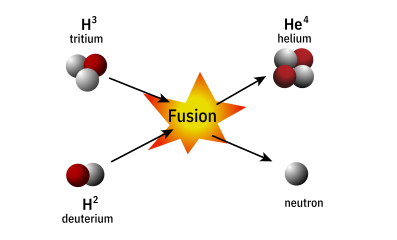 Nuclear Fission
In a hydrogen bomb, two isotopes of hydrogen, deuterium and tritium are fused to form a nucleus of helium and a neutron. This fusion releases 17.6 MeV of energy. Unlike nuclear fission, there is no limit on the amount of the fusion that can occur.
A fission bomb, called the primary, produces a flood of radiation including a large number of neutrons. This radiation impinges on the thermonuclear portion of the bomb, known as the secondary. The secondary consists largely of lithium deuteride. The neutrons react with the lithium in this chemical compound, producing tritium and helium. The production of tritium from lithium deuteride
This reaction produces the tritium on the spot, so there is no need to include tritium in the bomb itself. In the extreme heat which exists in the bomb, the tritium fuses with the deuterium in the lithium deuteride.
The question facing designers was "How do you build a bomb that will maintain the high temperatures required for thermonuclear reactions to occur?" The shock waves produced by the primary (A-bomb) would propagate too slowly to permit assembly of the thermonuclear stage (the secondary) before the bomb blew itself apart. This problem was solved by Edward Teller and Stanislaw Ulam.
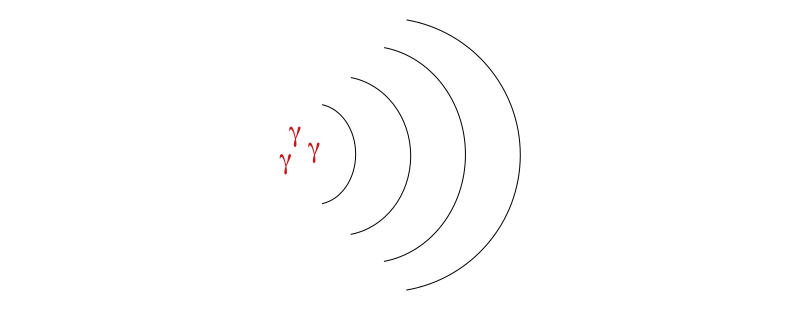 Gamma Radiation
To do this, they introduced a high energy gamma ray absorbing material (styrofoam) to capture the energy of the radiation. As high energy gamma radiation from the primary is absorbed, radial compression forces are exerted along the entire cylinder at almost the same instant. This produces the compression of the lithium deuteride. Additional neutrons are also produced by various components and reflected towards the lithium deuteride. With the compressed lithium deuteride core now bombarded with neutrons, tritium is formed and the fusion process begins. READ MORE...
Nuclear FissionIn a hydrogen bomb, two isotopes of hydrogen, deuterium and tritium are fused to form a nucleus of helium and a neutron. This fusion releases 17.6 MeV of energy. Unlike nuclear fission, there is no limit on the amount of the fusion that can occur.
A fission bomb, called the primary, produces a flood of radiation including a large number of neutrons. This radiation impinges on the thermonuclear portion of the bomb, known as the secondary. The secondary consists largely of lithium deuteride. The neutrons react with the lithium in this chemical compound, producing tritium and helium.
The production of tritium from lithium deuterideThis reaction produces the tritium on the spot, so there is no need to include tritium in the bomb itself. In the extreme heat which exists in the bomb, the tritium fuses with the deuterium in the lithium deuteride.
The question facing designers was "How do you build a bomb that will maintain the high temperatures required for thermonuclear reactions to occur?" The shock waves produced by the primary (A-bomb) would propagate too slowly to permit assembly of the thermonuclear stage (the secondary) before the bomb blew itself apart. This problem was solved by Edward Teller and Stanislaw Ulam.
Gamma RadiationTo do this, they introduced a high energy gamma ray absorbing material (styrofoam) to capture the energy of the radiation. As high energy gamma radiation from the primary is absorbed, radial compression forces are exerted along the entire cylinder at almost the same instant. This produces the compression of the lithium deuteride. Additional neutrons are also produced by various components and reflected towards the lithium deuteride. With the compressed lithium deuteride core now bombarded with neutrons, tritium is formed and the fusion process begins. READ MORE...


The World is at a Crossroads

- China
- Russia
- Iran
- North Korea
- India
- Brazil
- South Africa
It is also obvious that if the USA and other NATO countries support Ukraine in its war with Russia that our enemies will support Russia...
It is also obvious that if China invades taiwan, and the USA supports Taiwan that our enemies will come to the aid of China...
These two potential conflicts taking place at relatively the same time, could put the world into a situation where we are getting very, very close to a WORLD WAR III...
The question on everyone's mind is will this war be CONVENTIONAL or NUCLEAR...
If it is conventional, the USA is no match for China with either the Navy, Air Force or Army...
If it is nuclear, then China is no match for the USA with all our nuclear weapons...
With either type of war, the economies of every single country will be impacted and our highly tecnological world will no longer have the financial means to maintain its technology as all our resources will be invested into wartime technologies which have little to do with the advancement of society.
People will be drafted into the military to fight the war. Resources will be diverted from public consumption to military consumptions. factories will abandoned their products to produce military products. Farmers and farmlands will be devoted exclusively to the military. Gasoline supplies will have a military priority first and a public priority second. All this focus on the military will cause a shortage and an increase in prices.
The US of A could turn into a THIRD WORLD COUNTRY overnight with the general public not understanding what the hell just happened.
A global war will be devastating and will set economies back dozens of years...
Given the power breakdown, it is pretty damn certain that no one will win a global war whether it is fought with conventional weapons or with nuclear weapons...
This war will hurt us all...


Green Hydrogen

Decarbonising the planet is one of the goals that countries around the world have set for 2050. To achieve this, decarbonising the production of an element like hydrogen, giving rise to green hydrogen, is one of the keys as this is currently responsible for more than 2 % of total global CO2 emissions.
Decarbonising the planet is one of the goals that countries around the world have set for 2050. To achieve this, decarbonising the production of an element like hydrogen, giving rise to green hydrogen, is one of the keys as this is currently responsible for more than 2 % of total global CO2 emissions. Find out how this is achieved and what its impact will be in the coming decades.
Green hydrogen is efficient and 100 % sustainable, with some experts predicting that it will be the fuel of the future. Our way of life needs an increasing amount of watts to function. The latest estimates by the International Energy Agency (IEA), published at the end of 2019, predict that global energy demand will increase by between 25 % and 30 % by 2040, which in an economy dependent on coal and oil would mean more CO2, exacerbating climate change. However, decarbonising the planet suggests a different world in 2050: one that is more accessible, efficient and sustainable, and driven by clean energies such as green hydrogen.
WHAT IS GREEN HYDROGEN AND HOW IS IT OBTAINED?
This technology is based on the generation of hydrogen — a universal, light and highly reactive fuel — through a chemical process known as electrolysis. This method uses an electrical current to separate the hydrogen from the oxygen in water. If this electricity is obtained from renewable sources we will, therefore, produce energy without emitting carbon dioxide into the atmosphere.
As the IEA points out, this method of obtaining green hydrogen would save the 830 million tonnes of CO2 that are emitted annually when this gas is produced using fossil fuels. Likewise, replacing all grey hydrogen in the world would require 3,000 TWh/year from new renewables — equivalent to current demand of Europe. However, there are some questions about the viability of green hydrogen because of its high production cost; reasonable doubts that will disappear as the decarbonisation of the earth progresses and, consequently, the generation of renewable energy becomes cheaper. READ MORE...
Wednesday, February 22
Diversity Behind the Camera

Actress Michelle Yeoh, seen here at the 28th annual Critics Choice Awards in Los Angeles on January 15, 2023, is the only non-white actor in the best actress category at the Academy Awards [Jordan Strauss/Invision/AP]
It’s awards season, that time of the year when the moving image is celebrated in all its forms. The world’s most prolific actors, directors, writers, producers, cinematographers, musicians, editors, costume designers, animators and other creatives are feted with shiny statuettes, critical acclaim and, most importantly, cultural and professional currency.
In recent years, this season has also led to increased scrutiny of the lack of representation of women and minorities in the film and television industries. Last year, the Golden Globes went on a hiatus amid criticism of the Hollywood Foreign Press Association — which bestows those awards — over poor diversity.
Yet for all the talk and hashtags, the reality remains grim. Michelle Yeoh is the only non-white actor in the best actress category at the Academy Awards, and the Oscars are courting controversy for ignoring Viola Davis in The Woman King and Danielle Deadwyler in Till. The best actor category only includes white men, and the best director segment doesn’t feature any women or Black filmmakers.
In fact, things are getting worse. While there is at least significant media attention on the need to increase representation on screen, the numbers tell an even more sorry tale when it comes to diversity off screen.
A recent USC Annenberg study, which looked at the gender, race and ethnicity of directors behind the 100 highest-grossing movies of 2022, found only 9 percent were women, down from 12.7 percent in 2021. Only 20.7 percent of directors were Black, Asian, Hispanic, Latino or multiracial directors, down from 27.3 percent in 2021. Another study by San Diego State University (pdf) arrived at similar conclusions.
Of course, many prominent television and OTT series and movies have featured non-white characters in lead roles in recent years. The Academy of Motion Picture Arts and Sciences — which awards the Oscars — instituted diversity and inclusion standards in 2020. Under those rules, creatives from diverse ethnic and minority communities must be hired in major roles for films to have a shot at the best picture award from the 2024-25 season. READ MORE...


I suppose it is Just Part of the Aging Process

My mother was almost 96, when she died, spending her last days in hospice at a Retirement Community that she considered to be her home. My 89 year old father died at the hospital and was planning to return home that afternoon or the next day....
Hearing about Jimmy Carter got me thinking about my parents and how they spent their last days... it is an odd thing to think about but I suppose it is also normal after one passes the age of 70, 75, or 80. I am currently 75. My sister is 4 years older than me, my brother is 8 years younger. Not sure what they are thinking as we seldom communicate.
We were closer when our parents were alive, so I am sure they held us together from the standpoint of not wanting to disappoint them. So, now it no longer matters.
What we all have in common is GETTING OLDER but what we do not have in common is how we deal with GETTING OLDER.
My second cousin Butch was like Jimmy Carter, when his time came and hospice was there, he was a peace with the inevitability of his impending death. I went to see him while he was in hospice and he took me outside and showed me the new plants he was growing, giving off no signs at all to me that he was dying. A few days after that visit he died.
When we are young and younger, we don't really think about death or the fact that we are getting older and sometimes many years pass until that reality slaps us in the face.
I 60 years of age I got my first slap with a heart attack and cancer. At 74 years of age, I got my second slap when I had L2-L3-L4-L5-S1 fused together and just about had to learn to walk again. Seven months later, I was moving a bed into our spare room and trying to move that large mattress down the hallway took every bit of strength that I had. I also realized that much of the strength in my shoulders and upper arms that I thought I still had, I no longer had... not sure if that was a slap or not but it sure was a wake up call.
I am walking a mile and riding a bike for 2 miles, three times a week now and while that might help my heart, digestion, and sleep, it does not build muscle strength. BTW, when the warm weather returnes in about a month, I will walk 5/6 times a week outside and not inside at our local community center.
Eating habits also change as one gets older which in my case I started at age 40 when I quit smoking and drinking alcohol. I also stopped eating red meat, fried foods, and lots of desserts. Focused on veges, fruits, fish, chicken, turkey, and beans. My total cholesterol both good and bad is 84 which is rather remarkable.
I don't mind losing my hair. I don't mind putting on a little extra weight. I don't mind not being as physical as I used to be. I understand that is all part of the aging process. What I mind is how fast it is happening once the process started at 60. I thought I would be more physical a lot longer... especially when we went to Myrtle Beach because I like to bodysurf.


Gaming Capital of the World

Think of the cities of the world which are renowned as hotbeds of innovative technology and Helsinki might not be near the top of the list. However, the often snow-covered streets of this relatively quiet northern European capital are home to some of the most ambitious and successful games makers in the world.
The first Angry Bird was flicked across the screen of an iPad in Helsinki, it's home of major games studios like Clash of Clans maker Supercell, and is also the place Netflix has chosen to set up its first ever internal gaming studio. "Why Helsinki? It is home to some of the best game talent in the world," the streamer has said. As a result of all this, the Finnish capital is considered by many to be the capital of mobile gaming, an industry currently worth an estimated £120bn to the global economy.
Which leads to an obvious question, how did it develop this reputation? In the 1980s and 1990s, Finland wasn't considered to be one of the wealthiest countries in the world. Much of the population relied on computers that were far from top of the range. The restrictions that came with that would help fuel what was known as the "demoscene" - a subculture which saw programmers create art presentations, music and games that pushed the technology of the time to the limits of its power.
Finns became used to doing a lot with very little, and then along came Nokia. Sonja Ängeslevä, CEO of Phantom Gamelabs, which is based in Helsinki, says this foundation is a significant reason behind the success of the games industry in the city today: "Nokia showed an example that we could build something big from here," she explains.
As a games maker, board member of the successful console developer Remedy games and the founder of a new development studio, Sonja knows the Finnish games sector inside out. READ MORE...
Tuesday, February 21
My Backyard Vacation Area

We did this to have a backyard vacation area in case we did not want to drive down to Myrtle Beach and spend time at a resort. A week at Myrtle Beach for an ocean view efficiency apartment/condo is about $1,500 to $2,000 which includes the rental, gasoline there and back, and meals. This is in South Myrtle Beach below the main part where the ferris wheel is located and all the drugs are sold.
I get into the hot tub about 3-4 times a week and use the jets to relax my shoulder and back muscles and just chill out for a while. I am usually out there about 45 minutes which is probably too long but it is so damn relaxing.
My hot tub soakings are take place 12 months out of the year although if it is really cold out there in January, I will not go out now whereas for the first 12 years, I did not worry about the cold influencing my body negatively... I have been concerned about that for the last 2-3 years, so if it is below 30 degrees, I am not going to soak.
Needless to say, I suppose that our backyard vacation area was well worth the effort, even every 3 years when the damn thing needs to be restained. It usually takes us about a week to accomplish this task and about 10-12 gallons of stain. We buy two 5-gallon containers at one time, making sure we get the same lot numbers otherwise the colors will differ.
Our cost of maintenance over these 15 years has been another $5,000 including pool upkeep during the summer months of use which averages out to about $56 dollars a month over the 15 years of ownership or 180 months that also takes into consideration the purchase price. For me, that does not seem like a bad tradeoff... I think I would have been willing to pay $100/month for this or maybe $150 which would have been pushing it...
Robots That Learn Like Humans

In recent years, numerous reports have appeared in the media expressing concern and even fear about robots and artificial intelligence: fear that robots are going to steal our jobs (minister Asscher in 2014), and fear that artificial intelligence will eclipse and endanger human beings (physicist Stephen Hawking and entrepreneur Elon Musk). At the same time, we also witnessed impressive videos of robots, such as the one created by the American company Boston Dynamics: Big Dog robot walking up a slope in the snow, and the humanoid, two-legged robot Atlas that jumps over obstacles and does a back flip.
In the past decade, robots have indeed become better at learning new tasks, an essential part of intelligence. Robots are much better at perceiving their environment, which has led to smarter robot arms and which has also given the development of autonomous vehicles a powerful boost. It’s only when robots also manage to handle unstructured environments and unforeseen circumstances that we’ll be able to integrate them into all aspects of our daily lives.
Nevertheless, robots still have much less of a learning capacity of than humans. Humans are more flexible, learn from fewer examples and are able to learn a large number of tasks, from learning a new language to skiing.
It’s much more difficult teaching robots to learn than computers
But how has robotics actually evolved, and what are the most recent developments? Professor of Intelligent Control and Robotics at the Department of Cognitive Robotics at TU Delft’s 3mE Faculty is studying how robots can improve their learning ability.
‘Some robot videos are first and foremost PR videos,’ says Babuska. ‘What they show you is their robot performing a certain stunt once. But they don’t show all the times that the robot fell over. And that stunt will only succeed if the environment is carefully prepared. If you place a beam in a different position and dim the light a bit, then the robot will fall over. The videos will have you believe that a certain problem has been solved, but that’s nonsense. What you see can’t be generalised to other circumstances.’
What would need to happen to give the general public a more realistic impression?
‘As roboticists,’ says Babuska, ‘we have to be more honest about what robots can and cannot do. There’s too much overselling, often more so in the US than in Europe. Every time we speak to journalists or give a lecture, we have to clarify how complex it is to get a robot to operate well in the world. I also believe there’s too much fear. But drones can do so many useful things.’
‘The same is true for robots on the ground. There are so many challenges in society that robots can help to solve. There’s still so much boring, dirty and dangerous work that we’re better off giving to robots. Few labours who work in construction or scaffolding make it to retirement without wearing out their backs. Or look at people in the food industry who perform the same tasks all day long in a temperature of seven degrees. That sounds more like something from 1900 than 2020. I want to help ensure that robots can aid us with these kinds of tasks.’
‘My main focus is on robots that learn how to move efficiently,’ says Babuska. ‘It makes no difference to me whether it concerns walking, driving, sailing, flying or gripping and moving objects. I research fairly general techniques that can be used in several applications instead of just one specific application.’
When the deep learning revolution unfolded, it was soon apparent that roboticists weren’t going to be able to simply take an image recognition algorithm from a computer and transfer it to a robot and expect it to work well. A robot is more than a computer; it’s a computer linked to a physical body. A robot has physical interaction with its environment. ‘A moving robot keeps seeing the world a little differently. And it has to make real-time decisions that are also precise and reliable. If a robot makes a mistake, then it’s a lot more costly in the physical world than in the virtual world. These are all aspects that complicate efforts to teach robots to learn well.’ READ MORE...
Subscribe to:
Posts (Atom)