Monday, April 21


At A Glance

Meet the northern snakehead, the invasive land-walking fish.
See how much your state receives in federal funding.
Visualizing what makes Americans cry.
... and what we remember most about high school.
Predicting wine quality by the animal on the label.
Olympic legend demolishes other parents at school field day.
A fireball lights up the night sky above Mexico City (w/video).
Humans and robots face off in a Chinese half-marathon (w/video).
Clickbait: San Francisco's new "great big naked statue."


In The NEWS


The Kola Superdeep Borehole was a project in the 1970s to uncover the composition of Earth by boring deep into its crust. Driven by Cold War competition, the Soviets chose the remote north to reduce the temperatures the tools would encounter. The mission managed to go 7.6 miles into Earth’s crust, the deepest human-made hole on Earth. Watch here.
How they figured out plate tectonics
The now well-established theory of plate tectonics—which claims Earth’s continental crust has drifted over time—was laughed at as recently as the mid-20th century. This video explores the origins and evolution of the idea that the continents didn’t always look like that, explaining how technologies were deployed to figure it out. Watch here.
The overview effect: how seeing Earth from space changes you
Astronauts regularly report paradigm shifts after seeing Earth from space. This phenomenon, known as the “overview effect,” can prompt big philosophical changes. For astronaut Ron Garan, this effect made him realize the interconnectedness and fragility of life and revealed that humanity is a planetary species. Read more in this article.
What are the odds of life beyond Earth?
In 1961, Frank Drake, Carl Sagan, and several other scientists gathered to form the Search for Extra-Terrerestrial Intelligence initiative. Part of that process was Drake’s equation, a formula used to calculate the number of exoplanets able to sustain life. This article breaks down the different conditions that impact the probability of life forms evolving elsewhere in the cosmos.
Worldwide names for Earth
The word “Earth” is rooted in German and evolved via Middle English, meaning the ground. In English, “Earth” means both the planet and the land—but in many languages, there are distinct words. This map—oriented in an atypical but in some ways more accurate projection—showcases different names for Earth across the world. Check it out here.
Visible moments of Earth through satellite images
A lot is happening on the planet at any given time. This fascinating collection of space-based photos of Earth compiles shots of well-known locations and natural events to give a high-level view. For example, you can see how certain wildfires appeared from space or see the spread of a specific city over time. Get lost gazing at Earth here.
What Matters?
.jpg)
This is an interesting question that will be answered differently as one gain in age.
One might say what matters is
- Church
- Family
- Country
but, not necessarily in that order...
Others might say,
- Wealth
- Possessions
- Power
but not necessarily in that order either...
What matters to me is
- Freedom
- Integrity
- Honesty
- Loyalty
and I would say that freedom is the most important...
WHY would I say that?
Without FREEDOM, the one cannot have the other three...
I don't just mean freedom to vote or travel or make decisions, but freedom of communications, both written and verbal.
The next question is will we really ever have that kind of FREEDOM?
First there was our birth - no freedom there
Then,
- parents
- school
- military - for some
- employers
- laws
- spouses
Death is last and seldom do we have any freedom over that unless it is suicide.
So, if freedom does not matter, given my constraints, then what's left?
HOW WE LIVE...


"Hidden galaxies" discovery would upend our current understanding of the universe

A newly analyzed, deep-field universe photo, produced by stacking multiple infrared observations, points to elusive collections of dust-filled star systems. This intriguing view of ancient “hidden galaxies” could change how we understand the cosmos.
Researchers used cutting-edge imaging to map a far-infrared landscape brimming with nearly 2,000 galaxies.
Preliminary hints suggest there may be galaxies lurking just out of sight, influencing how energy is emitted across space.
Early calculations indicate that their collective light might explain the missing piece in the energy puzzle at long infrared wavelengths, an aspect that has puzzled astronomers for years.
Sunday, April 20

Robert Reich
Sunday thought
The contagion of courage
Friends,
Jo Ellen Grzyb, a member of this Substack community, noted in response to one of my posts that she’s seeing a lot of the phrase “courage is contagious.” She mentioned Bernie, AOC, Cory Booker, Tim Walz, Jasmine Crockett, and Elizabeth Warren.
She’s right. And in these darkening times, this contagion is critically important.
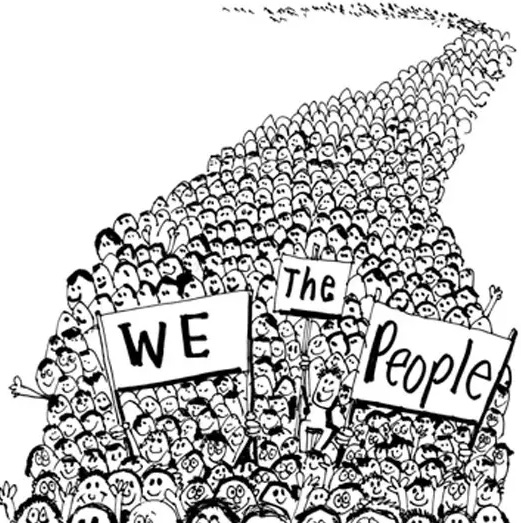
A staggering 36,000 people attended Bernie and AOC’s rally in Los Angeles; 34,000 attended their rally in Denver. These numbers are unprecedented.
Yesterday, hundreds of thousands of you turned out in your communities to condemn Trump and his regime. In front of the White House, protesters shouted “shame!”
This is the contagion of courage.
At A Glance

Society & Culture
> What is a Disney adult?
> A look at a NASCAR pit crew.
> How Coachella took the Woodstock look.
> Gutai: the Japanese precursor to Western performance art.
> Eighty artists on their favorite Bob Dylan songs.
World History
> What did gladiators do after they retired?
> How the ancient Egyptians created the first hour.
> The railroads that preceded the Panama Canal.
> Ancient Mayan dentistry, 101.
> What caused World War I?
Business & Finance
> The super wealthy who want to be taxed more.
> Retail investors and the GameStop short squeeze.
> Comparing the value of bitcoin and ether.
> The connections between Silicon Valley and Burning Man.
> How Amazon uses the "flywheel effect."
Health & Medicine
> Why common colds are as ubiquitous as they were a century ago.
> The overlooked physical causes of insomnia.
> The resurgence of Black Lung disease.
> What do we really know about near-death experiences?
> Visualizing the anatomy of a normal joint.
Science & Technology
> How the cosmic microwave background was confused with bird poop.
> What makes a computer, a computer?
> The best pictures of Mars from space.
> A timeline of Google's growth.
> The long history of the Cybertruck.
> What is a Disney adult?
> A look at a NASCAR pit crew.
> How Coachella took the Woodstock look.
> Gutai: the Japanese precursor to Western performance art.
> Eighty artists on their favorite Bob Dylan songs.
World History
> What did gladiators do after they retired?
> How the ancient Egyptians created the first hour.
> The railroads that preceded the Panama Canal.
> Ancient Mayan dentistry, 101.
> What caused World War I?
Business & Finance
> The super wealthy who want to be taxed more.
> Retail investors and the GameStop short squeeze.
> Comparing the value of bitcoin and ether.
> The connections between Silicon Valley and Burning Man.
> How Amazon uses the "flywheel effect."
Health & Medicine
> Why common colds are as ubiquitous as they were a century ago.
> The overlooked physical causes of insomnia.
> The resurgence of Black Lung disease.
> What do we really know about near-death experiences?
> Visualizing the anatomy of a normal joint.
Science & Technology
> How the cosmic microwave background was confused with bird poop.
> What makes a computer, a computer?
> The best pictures of Mars from space.
> A timeline of Google's growth.
> The long history of the Cybertruck.


In The NEWS

Deadly US airstrike on Yemeni oil port kills more than 70 people.
A US airstrike targeted the Houthi-controlled oil terminal in Yemen in an escalation aimed at cutting off a key source of fuel and revenue for the Iran-backed Houthis, who have been attacking ships in the Red Sea. The incident is one of the deadliest since the Trump administration began a bombing campaign in March and coincides with upcoming US-Iran nuclear talks.
Victims identified in Florida State University shooting.
The two men killed in Thursday's shooting at FSU's Tallahassee campus were identified as campus dining coordinator Robert Morales and Tiru Chabba, an executive for campus vendor Aramark. New details also emerged about the shooter, who was initially described by police as the son of a veteran Leon County sheriff's deputy; however, court documents say he is the sheriff's deputy's stepson. Records also show the 20-year-old shooter changed his name after his parents' custody battle.
National Archives releases 10,000 documents on RFK assassination.
The trove of records relates to the 1968 assassination of Robert F. Kennedy, fulfilling an order made by President Donald Trump to declassify national records on the assassinations of President John F. Kennedy, Sen. Robert F. Kennedy, and Dr. Martin Luther King Jr. The release includes roughly 229 files, some of which had not been digitized and were in storage for decades. Browse the digital files here.
Federal judge pauses US plans for mass layoffs at consumer bureau.
The federal judge temporarily blocked the Trump administration from laying off about 90% of the Consumer Financial Protection Bureau’s staff in order to consider whether such layoffs could violate a previous court order intended to preserve the agency’s operations and determine compliance with the law. The layoffs could affect up to 1,500 employees.
Genomic analysis finds all roses were once yellow.
Roses of all colors, such as white, red, pink, and peach, belong to the genus Rosa in the Rosaceae family. Reconstructing the ancestral traits through genomic analysis of 205 samples of over 80 different Rosa species revealed that all roses trace back to a common ancestor—a yellow, single-petal flower with seven leaflets.
Rare "Star Wars"-like planet orbits twin stars outside solar system.
Astronomers using the European Southern Observatory's Very Large Telescope have discovered an exoplanet, named 2M1510 (AB) b, orbiting at a 90-degree angle around a rare pair of brown dwarfs, also known as failed stars. The finding is the first confirmed case of a "polar planet" and reveals how a planet’s gravity can influence the orbits of two stars in what researchers describe as a celestial dance.
SORCE 1440 NEWS
Faith... Belief... Spiritual
.jpg)
I do not consider myself to be religious although I have been baptized twice and attended church services every Sunday until I was nineteen years old and continued intermittently for another 10-15 years. However, I would say I am spiritual because I believe in a superior being that might be considered to be our creator... although manipulator of genes and DNA is more likely.
There is a substantial amount of scientific data that creation took place from nothing... which seems impossible... yet, our entire universe had been shrunk to the size of one millionth of one grain of sand and because of all that pressure subsequently exploded, one could reasonably say something from nothing was created.
What pulls me away from religion is the fact that the BIBLE does not take into account that our universe grows in technology, nor does it take into consideration, the possibility of other living entities. Since our universe is so extensive, so say there are no other life forms but us is ILLOGICAL.
The other issue that has always bothered me is that there are currently 12 major religions, some of which are considered philosophies as well... now, Christianity has 12 disciples... but there is no coincidence there. Also, why is Christianity considered to be the ONLY VALID RELIGION of the 12 since they all have virgin birth stories, crucifixion stories, resurrection stories, a heaven and hell, and a great flood story.
IF one's belief in religion is so important, then why is only one religion correct?
Perhaps all these religions have been carefully designed for us to see that they are all similar in nature and concepts and instead of being used to separate us they should be used to unite us...
Finally, JESUS said: MY KINGDOM IS NOT OF THIS WORLD...
Does this mean that Jesus was an EXTRATERRESTRIAL???


A new dissipation-based method to probe quantum correlations

Quantum systems are known to be prone to dissipation, a process that entails the irreversible loss of energy and that is typically linked to decoherence. Decoherence, or the loss of coherence, occurs when interactions between a quantum system and its environment cause a loss of coherence, which is ultimately what allows quantum systems to exist in a, Super superposition of states.
While dissipation is generally viewed as a source of decoherence in quantum systems, researchers at Tsinghua University recently showed that it could also be leveraged to study strongly correlated quantum matter.
Saturday, April 19

Mayo Clinic on Osteoporosis

"No matter your age or bone health, you can take steps to prevent future breaks. The best time to start is now . . . this book can help." – Ann E. Kearns, M.D., Ph.D., Mayo Clinic
Around 54 million people in the United States are affected by osteoporosis or low bone mass; however, the disease is both treatable and preventable Today, thanks to advances here at Mayo and elsewhere, osteoporosis, the brittle bone disease that contributes to premature aging can be effectively managed or even avoided.
We no longer have to tolerate the pain and disability osteoporosis once caused.
That's just the start of the GOOD NEWS you'll find in Mayo Clinic on Osteoporosis.
This book brings you a take-charge approach to preventing, diagnosing and managing osteoporosis. You'll find detailed guidance to promote better bone health through diet, supplements, exercise, medications and more.
Around 54 million people in the United States are affected by osteoporosis or low bone mass; however, the disease is both treatable and preventable Today, thanks to advances here at Mayo and elsewhere, osteoporosis, the brittle bone disease that contributes to premature aging can be effectively managed or even avoided.
We no longer have to tolerate the pain and disability osteoporosis once caused.
That's just the start of the GOOD NEWS you'll find in Mayo Clinic on Osteoporosis.
This book brings you a take-charge approach to preventing, diagnosing and managing osteoporosis. You'll find detailed guidance to promote better bone health through diet, supplements, exercise, medications and more.
- Factors that affect your risk of osteoporosis
- Ways to reduce your risk of fractures and falls
- Bone density tests to detect weak bones before a break
- The best food and nutrients for strong bones
- Exercises for building bone — and some to avoid with low bone mass
- You'll discover the good news on the latest advances in medications for osteoporosis
- Plus you'll learn how to choose the treatment options that are best for you
- And more!
FOR MORE INFORMATION, CLICK HERE...


At A Glance

Bookkeeping
> $23.6B: The amount US shoppers are expected to spend on Easter this year.
> 3.3%: The year-over-year drop in global wine sales last year, bringing consumption to 214.2 million hectoliters, which marks the lowest level since 1961. (One hectoliter is equal to 100 liters.)
Browse
> Why Easter is called Easter.
> See 44 colorized photos from the Dust Bowl.
> ... and cute photos of donkeys carrying baby lambs.
> Buford the dog finds a missing toddler.
> What it's like to retire in Paris.
> Journey—and play your way—through Mesoamerica. (best on desktop)
Listen
> What if one DNA-based number could predict your income, education, or spouse?
Watch
> Parrot chirps to "Baby Shark."
> How to curb a destructive mindset.
> What would happen to Earth if the sun suddenly went out?
> How truck drivers in India navigate one of the world's most dangerous roads.
Long Read
> Porsche heir’s plan to build a private tunnel has his Alpine neighbors fuming.
> A passion for fruit: The archaeological record of berries, melons, and more.
Most Clicked This Week: The unique items in Uber's lost and found.
Subscribe to:
Comments (Atom)