Sunday, December 19

Classic Sunday Morning Newspaper Cartoons


Jailed for Praising Wrong Cricket Team

An Indian student has now spent nearly two months in jail for celebrating Pakistan’s victory in a cricket match. The BBC’s Rajini Vaidyanathan went to the northern Indian city of Agra to meet his family, and find out why lawyers are refusing to represent him. Produced by Shalu Yadav Filmed by Syed Shahryar & Ajay Bedi Edited by Aakriti Thapar.

Large Moon


PIcture Book of Heroines


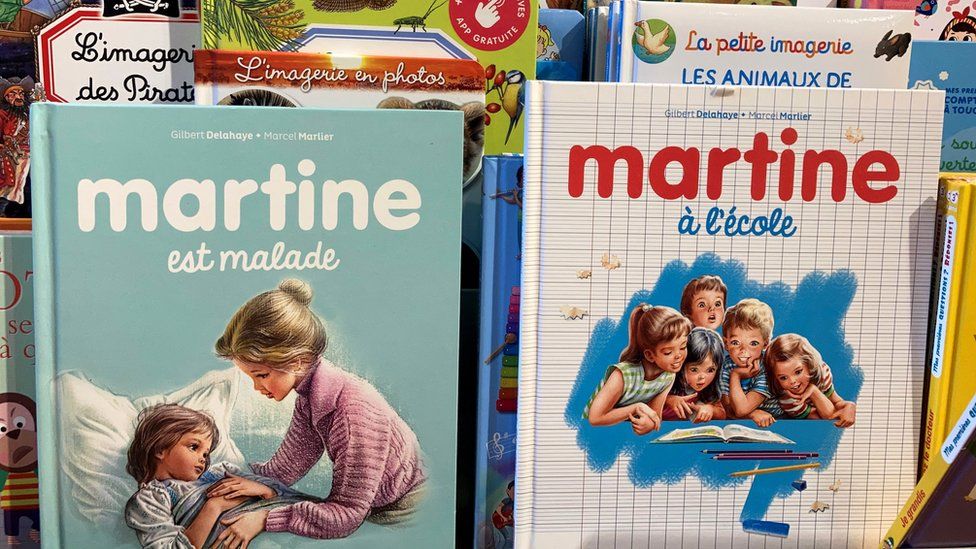
SIMONE PROBST COLLECTION,Caroline's adventures first hit the bookshops in 1953, closely followed by Martine


Do you like your childhood heroine to be the type that catches outlaws in the Wild West, can re-plumb and re-roof an entire country home, and once survived a biplane crash in the Arctic?


Or would you rather a girl who cooks biscuits with Mum, enjoys sewing lessons and the occasional game of marbles, and whose idea of an adventure is taking the train to visit cousins in Normandy?


For nearly 70 years, Caroline and Martine have been rivals for the hearts of French schoolchildren.


If you were a more outdoors-type you would have gone for Caroline. She was the first to appear in 1953 for publisher Hachette.


Created by artist Pierre Probst, she wore red dungarees and led an adult-free existence with a gang of eight animal friends: two cats, three dogs, a bear, a lion and a panther.


Such was her success that a year later rival publishing house Casterman dreamed up Martine with artist Marcel Marlier.

Martine books are still on sale in French bookshops in the run-up to Christmas


But while Caroline lived in a magical world where cats drive cars and 10-year old girls can travel the countryside at the head of their own circus, Martine was firmly attached to the domestic apron-strings.  READ MORE...


https://www.bbc.com/news/world-europe-59644739

Wayne's World


Saturday, December 18

Bear Cubs

Hypersonic Missiles


Imagine if a foreign country launched a nuclear attack on the continental United States and the Pentagon had only six minutes to respond. That’s the potential of a new generation of weapons on the horizon, according to a recent Rand Corp. report.

Rand is urging the United States, China, and Russia to form an agreement on how to handle hypersonic missiles, which travel at more than five thousand kilometers per hour (about 3,100 mph). Hypersonic weapons are more than five times faster than a regular cruise missile and would not be detected by U.S. air defense systems as early as ballistic missiles.

The United States, China, and Russia are all known to be close to achieving deployable hypersonic systems and are ahead of other countries, according to Rand.

“Hypersonic missile proliferation would increase the chances of strategic war,” said Richard Speier, lead author of Rand’s report, in a press release.

The speed forces quick military counter-decisions with potentially disastrous effect. “It would give nations an incentive to become trigger-happy,” he said.

The United States likely has less than a decade to counter the proliferation of hypersonic missiles, though they are not yet operational, according to the report. Current missile defense systems would not be effective at defending against hypersonic missiles, and Rand urges changes to the existing missile technology control regime to anticipate and address them.

Crunched for time with dire stakes, countries might adopt a so-called launch-on-warning doctrine, or they might just strike first. Without time to consult a traditional chain of command, nations might feel compelled to give the military command and control, increasing the likelihood of accidental war. Countries might also scatter their weapons in order to better respond, which would give terrorists greater opportunity to steal the weapons for themselves, the report said.

“None of these options is very good,” Speier said.  To Know More About Hypersonic Missiles and Possible War, CLICK HERE...

Passing Train


Sowellisms


THOMAS SOWELL

He's still alive at 87, but retired. So we don't hear much from him these days.

Sowell grew up in Harlem, served in the Marine Corps during the Korean War,

graduated Magna Cum Laude from Harvard, Masters from Columbia, economist,

social theorist, philosopher, author, Senior Fellow Hoover Institution,

Stanford University, National Humanities Medal, Francis Boyer award.


MANY COLLEGES & UNIVERSITIES ARE OPENLY OPPOSED TO PERMITTING

MR. SOWELL TO LECTURE THEIR STUDENTS AND FACULTY.

Renate


Forget it – we’re there now!!


“It’s amazing how much panic one honest man can spread among a multitude of hypocrites. ”
― Thomas Sowell

Birds


M. C. Escher

Maurits Cornelis Escher (Dutch pronunciation: [ˈmʌurɪt͡s kɔrˈneːlɪs ˈɛʃər]; 17 June 1898 – 27 March 1972) was a Dutch graphic artist who made mathematically inspired woodcuts, lithographs, and mezzotints. Despite wide popular interest, Escher was for most of his life neglected in the art world, even in his native Netherlands. He was 70 before a retrospective exhibition was held. In the late twentieth century, he became more widely appreciated, and in the twenty-first century he has been celebrated in exhibitions around the world.

His work features mathematical objects and operations including impossible objects, explorations of infinity, reflection, symmetry, perspective, truncated and stellated polyhedra, hyperbolic geometry, and tessellations. Although Escher believed he had no mathematical ability, he interacted with the mathematicians George Pólya, Roger Penrose, Harold Coxeter and crystallographer Friedrich Haag, and conducted his own research into tessellation.

Early in his career, he drew inspiration from nature, making studies of insects, landscapes, and plants such as lichens, all of which he used as details in his artworks. He traveled in Italy and Spain, sketching buildings, townscapes, architecture and the tilings of the Alhambra and the Mezquita of Cordoba, and became steadily more interested in their mathematical structure.

Escher's art became well known among scientists and mathematicians, and in popular culture, especially after it was featured by Martin Gardner in his April 1966 Mathematical Games column in Scientific American. Apart from being used in a variety of technical papers, his work has appeared on the covers of many books and albums. He was one of the major inspirations of Douglas Hofstadter's Pulitzer Prize-winning 1979 book Gödel, Escher, Bach.  SOURCE:  Wikipedia


Skull


Friday, December 17

Riddles

THESE ARE SOME OF THE BEST RIDDLES I HAVE SEEN... THE ANSWERS ARE AT THE BOTTOM.

RIDDLE 5 IS AMAZING. IT SHARPENS THOSE GENES IN YOUR BRAIN AND STALLS ALZHEIMER'S FOR YEARS ….

1. A murderer is condemned to death. He has to choose between three rooms. The first is full of raging fires, the second is full of assassins with loaded guns, and the third is full of lions that haven't eaten in 3 years. Which room is safest for him?

2. A woman shoots her husband. Then she holds him under water for over 5 minutes. Finally, she hangs him. But 5 minutes later they both go out together and enjoy a wonderful dinner together. How can this be?

3. What is black when you buy it, red when you use it, and gray when you throw it away ?

4. Can you name three consecutive days without using the words Wednesday, Friday, or Sunday?

5. This is an unusual paragraph. I'm curious as to just how quickly you can find out what is so unusual about it. It looks so ordinary and plain that you would think nothing was wrong with it. In fact, nothing is wrong with it! It is highly unusual though. Study it and think about it, but you still may not find anything odd. But if you work at it a bit, you might find out. Try to do so without any coaching!


THE ANSWERS TO ALL FIVE THE RIDDLES ARE BELOW:

Don’t cheat!!

Answers:
1. The third room. Lions that haven't eaten in three years are dead. That one was easy, right?

2. The woman was a photographer. She shot a picture of her husband, developed it, and hung it up to dry (shot; held under water; and hung).

3. Charcoal, as it is used in barbecuing.

4. Sure you can name three consecutive days, yesterday, today, and tomorrow!

5. The letter "e" which is the most common letter used in the English language, does not appear even once in the paragraph.

I’ll be getting Alzheimer’s any time now.
How did you do?