
Friday, December 17

Facial Recognition
 GETTY IMAGES
An Australian firm which claims to have a database of more than 10 billion facial images is facing a potential £17m fine over its handling of personal data in the UK.
The Information Commissioner's Office said it had significant concerns about Clearview AI, whose facial recognition software is used by police forces. It has told the firm to stop processing UK personal data and delete any it has. Clearview said the regulator's claims were "factually and legally incorrect".
The company - which has been inviooted to make representations - said it was considering an appeal and "further action". It has already been found to have broken Australian privacy law but is seeking a review of that ruling.
'Google search for faces'
Clearview AI's system allows a user - for example, a police officer seeking to identify a suspect - to upload a photo of a face and find matches in a database of billions of images it has collected from the internet and social media.
The system then provides links to where matching images appeared online.The firm has promoted its service to police as resembling a "Google search for faces".
But in a statement, the UK's Information Commissioner said that Clearview's database was likely to include "a substantial number of people from the UK" whose data may have been gathered without people's knowledge.
The firm's services are understood to have been trialled by a number of UK law enforcement agencies, but that was discontinued and Clearview AI does not have any UK customers. The ICO said its "preliminary view" was that the firm appeared to have failed to comply with UK data protection laws by:
- Failing to process the information of UK citizens fairly
- Failing to have a process in place to stop the data being retained indefinitely
- Failing to have a lawful reason for collecting the information
- And failing to inform people in the UK about what is happening to their data.
"UK data protection legislation does not stop the effective use of technology to fight crime. But to enjoy public trust and confidence in their products, technology providers must ensure people's legal protections are respected and complied with."
The decision is provisional and the ICO said any representations by Clearview AI will be carefully considered before a final ruling is made in the middle of next year. READ MORE...
A Trailblazing Aboriginal Actor
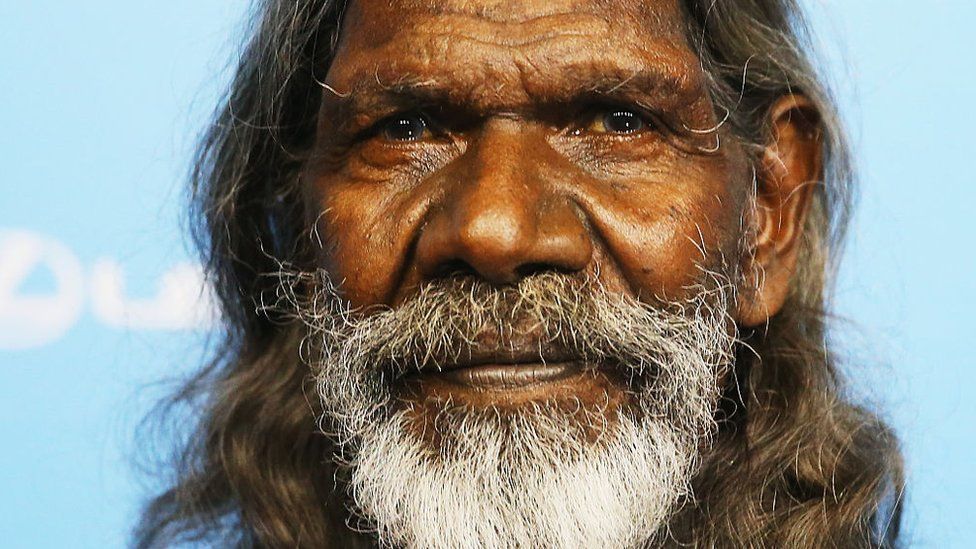 GETTY IMAGES...David Gulpilil's film career spanned 50 years
One of Australia's greatest actors, David Gulpilil (Kingfisher) Ridjimiraril Dalaithngu, died last week aged 68, following a battle with lung cancer. In accordance with custom he will be returned to the place of his birth, known to Aboriginal people as his Country, for ceremony.
The actor, dancer, storyteller, and cultural crusader was celebrated across the globe for his contribution to cinema and his role in improving representation of Indigenous peoples and culture.
A proud Yolŋu (Aboriginal group) man anchored in kinship, sharing and responsibility, he described his experience living in the two worlds of Yolŋu culture and the Western world of fame as: "Left side, my Country. Right side, white man's world. This one tiptoe in caviar and champagne, this one in the dirt of my Dreamtime."
Warning for Aboriginal and Torres Strait Islander readers: this article contains images of someone who has died. His family has given permission to use his name and image.
Born on his homeland of Marwuyu in Arnhem Land, the Northern Territory of the continent known as Australia, Gulpilil was from the Mandhalpuyngu clan. His name - his totem - Gulpilil represents the kingfisher.
Raised on Country following the Yolŋu knowledge system of connection and balance with the universe, he was a skilled hunter, tracker, musician, painter, ceremonial dancer and trustee of cultural structures and laws.
After the death of his mother and father he went to the Maningrida mission school. It was here that his phenomenal talent for ceremonial dancing was spotted by English film director Nicolas Roeg, who cast the teenager as a lead character in Walkabout (1971), a story acknowledging the role of Aboriginal man as the saviour of two white children stranded on foreign, black country.
Gulpilil's compelling performance was the first time in Australian film that an Aboriginal character was depicted as charismatic, powerful, and intrinsically sexy. He was miscredited in the credits as Gampilil.
The film flopped at the Australian box office but the elegance and raw masculinity of Gulpilil's performance made international headlines, and the film is now credited as 'one of the greats'. READ MORE...
Japan's Blue Hydrogen

Activists looking out over Tokyo Bay at a new coal-fired power station under construction
It's a glorious autumn afternoon and I'm standing on a hillside looking out over Tokyo Bay. Beside me is Takao Saiki, a usually mild-mannered gentleman in his 70s. But today Saiki-San is angry. "It's a total joke," he says, in perfect English. "Just ridiculous!"
The cause of his distress is a giant construction site blocking our view across the bay - a 1.3-gigawatt coal-fired power station in the making.
"I don't understand why we still have to burn coal to generate electricity," says Saiki-San's friend, Rikuro Suzuki. "This plant alone will emit more than seven million tonnes of carbon dioxide every year!"
Suzuki-San's point is a good one. Shouldn't Japan be cutting its coal consumption, not increasing it, at a time of great concern about coal's impact on the climate? So why the coal? The answer is the 2011 Fukushima nuclear disaster.
In 2010 about one third of Japan's electricity came from nuclear power, and there were plans to build a lot more. But then the 2011 disaster hit, and all Japan's nuclear power plants were shut down. Ten years later most remain closed - and there is a lot of resistance to restarting them. READ MORE...

Thursday, December 16


Camel Beauty Pageant
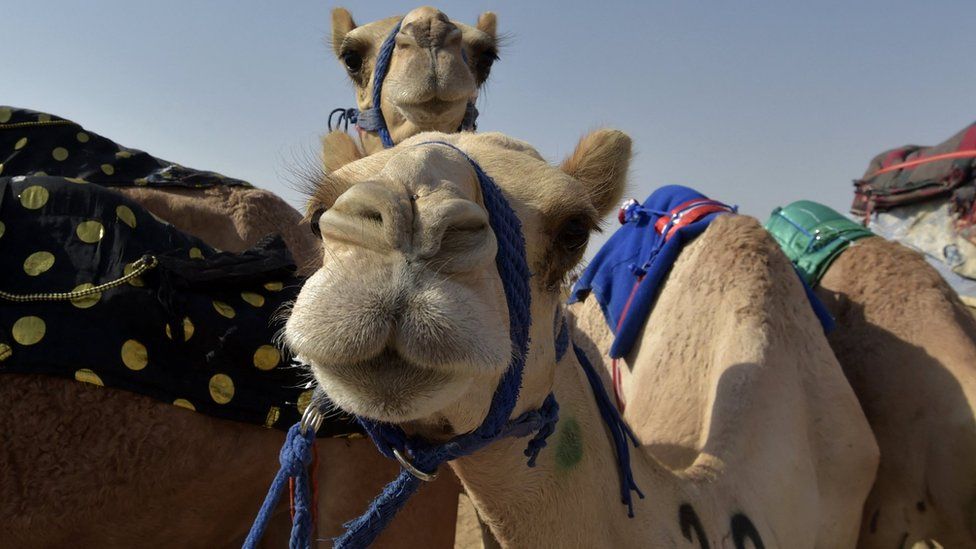
AFPImage...Judges used "advanced" technology to uncover tampering with contestants in the pageant
More than 40 camels have been disqualified from Saudi Arabia's beauty pageant for receiving Botox injections and other cosmetic enhancements.
The contest is a highlight of the King Abdulaziz Camel Festival, where $66m (£45m) in prize money is at stake.
Key attributes include long, droopy lips, a big nose and a shapely hump.
Judges used "advanced" technology to uncover tampering withcamels on a scale not seen before, the state-run Saudi Press Agency (SPA) reported.
All contestants were first led into a hall where their external appearance and movements were examined by specialists, it said.
Their heads, necks and torsos were then scanned with X-ray and 3D ultrasound machines, and samples were taken for genetic analysis and other tests.
Twenty-seven contestants in the cup for Majaheim camels alone were disqualified for having stretched body parts and 16 were ejected for having received injections, according to SPA.
The organisers of the pageant, the Camel Club, were cited as saying that they were "keen to halt all acts of tampering and deception in the beautification of camels" and promising to "impose strict penalties on manipulators". READ MORE...
Malta Legalizes Cannibus
REUTERS

Malta has become the first EU country to legalise the cultivation and personal use of cannabis.
Adults will be allowed to carry up to seven grams of cannabis, and grow no more than four plants at home.
But smoking it in public or in front of children will be illegal.
Several other nations have similar plans, such as Germany, Luxembourg and Switzerland. Countries like the Netherlands tolerate cannabis use in certain circumstances.
Malta's parliament voted in favour of the reform on Tuesday afternoon, with the bill winning 36 votes in favour and 27 against.
Equality Minister, Owen Bonnici, said the "historic" move would stop small-time cannabis users from facing the criminal justice system, and would "curb drug trafficking by making sure that [users] now have a safe and regularised way from where they can obtain cannabis".
However, Malta's opposition Nationalist Party voted against the change.
In October, its leader Bernard Grech - who initially supported the new law - warned it would "only lead to the strengthening of the illegal market, with organised crime taking advantage," according to The Times. READ MORE...
Diplomatic Boycott of Beijing
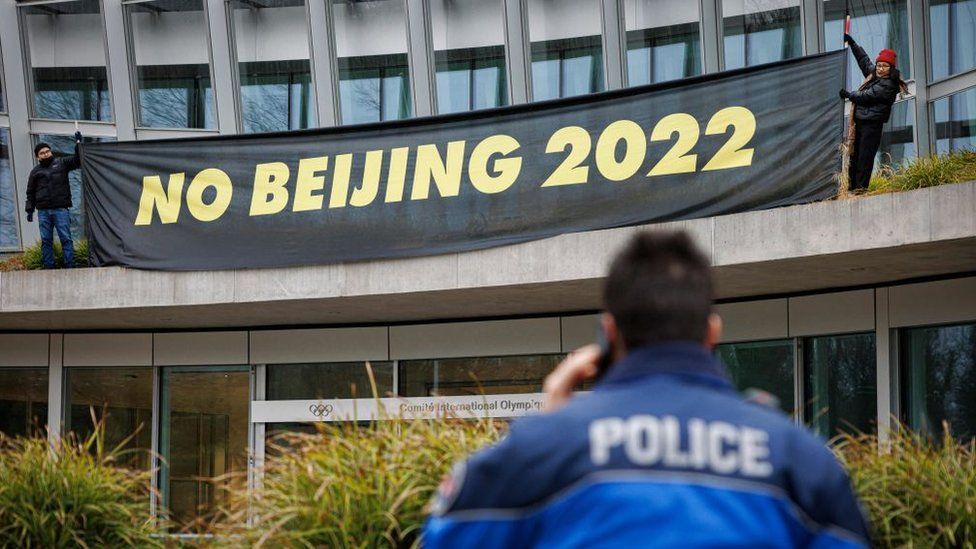 AFPImage - Protesters have targeted the International Olympic Committee (IOC) over the Games
While concern over human rights has become almost a constant theme in international sport in recent years, few hosts of major events have provoked quite as much controversy as Beijing.
The venue for the 2022 Winter Olympics has been hit by a flurry of diplomatic boycotts from countries including the US, Australia, and Britain, because of widespread allegations of Chinese atrocities against the Uyghur community.
Human rights groups and Western governments have accused China of genocide in the Xinjiang region. China denies this, saying its network of detention camps there is for "re-education" of the Uyghurs and other Muslims.
Relations are also strained over a crackdown on political freedoms and pro-democracy protesters in Hong Kong, and more recently concerns over tennis player Peng Shuai, who disappeared from public view after she accused a top Chinese government official of sexual assault. Although the Chinese authorities have criticised "malicious speculation" over her case, there remains significant concern about her.
For the few Western governments who have said their representatives will not attend, such a move is a relatively easy way to be seen to issue a rebuke, while avoiding the much more contentious step of preventing athletes from competing via a full boycott.
It is not a new tactic. Three years ago some European countries, including Britain, announced diplomatic boycotts of the Russian football World Cup after the Salisbury Novichok poisoning.
The risk with sending politicians to Beijing to attend the Games is that inevitably it would be viewed as offering tacit approval of the government of President Xi Jinping, for whom the event is a matter of significant prestige.
While China accused the US of using the Games for political manipulation and vowed "resolute counter-measures", it is unlikely to have been too dismayed, or indeed surprised, especially given the likes of Italy and France have declined to join the boycott, with President Macron describing it as "symbolic and insignificant". Certainly it will make very little difference to the spectacle of the event for those inside venues or watching from afar. READ MORE...

Wednesday, December 15

World's Largest Antenna in China

A representative antenna
China has been slowly but steadily working its way to the top. Frequently making headlines with its space-related developments, the country now claims to be operating the world's largest antenna for its submarine operations.
What's special about the antenna is the fact that it was designed to maintain underwater communications over 1,900 miles (3,000 km), enough to reach Guam, the biggest U.S. military base in the western Pacific Ocean, according to the project’s lead engineer Zha Ming and his colleagues from the Wuhan Maritime Communication Research Institute, reports South China Morning Post.
While the gigantic antenna's current location remains unknown, the team said it lies somewhere 620 miles (1,000 km) south of Beijing, 1,242 miles (2,000 km) southeast of Dunhuang in northwest China, and 620 miles (1,000 km) east of Mianyang in the southwestern province of Sichuan. READ MORE...
Meaning of Life

After Pew Research Center published its findings about what makes life meaningful in 17 developed economies, the answers from Korea startled many.
Korea was abuzz over the weekend about the results of a survey conducted by Pew Research Center in spring about what makes life "meaningful, fulfilling or satisfying" in 17 developed economies.
The findings came out on Nov. 18, and the answers from Korea were startling. It was the only country where "material well-being" was given as the top source of life's meaning. In fourteen other countries the first choice was family.
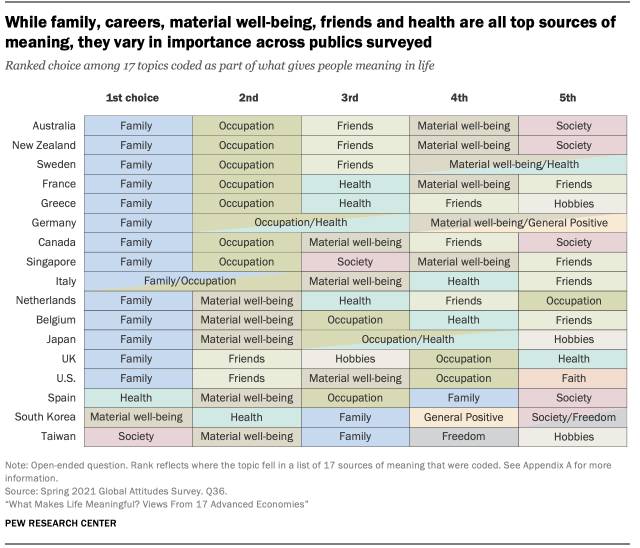
Predictably, the news prompted much handwringing across Korea's ideological spectrum as proof of the country's decay, but for different reasons. "Korea is the only country like this," wrote musician and prominent cultural critic Sohn Yisang on Facebook, implying that too many Koreans are focused on "don 돈" (money), as he translated "material well-being".
The conservative daily Chosun Ilbo blamed policymakers in the current center-left government for turning Koreans this way: "in the last few years this country's citizens went through experiences that shook the very foundation of how happiness is understood."
The paper obviously wants to argue that the out-of-control price of real estate has made "people who can't afford to buy an apartment even by scraping together everything they've got...unhappy because they hear how other people are getting manifold richer through stock or apartment or cryptocurrency purchases."
I don't really see a clear connection between what the Chosun Ilbo is saying and the Pew survey, but whichever way one interprets this survey result, there is an agreement: the choice of material well-being as the top source of meaning in life speaks to a problem in Korea. READ MORE...
Cause of Alzheimer's

Researchers at the University of California- Riverside (UCR) recently published results from a study that looked at a protein called tau. By studying the different forms tau proteins take, researchers discovered the difference between people who developed dementia and those who didn’t.
The tau protein was critical for researchers because they wanted to understand what the protein could reveal about the mechanism behind plaques and tangles, two critical indicators doctors look for when diagnosing people with Alzheimer’s.
By analyzing donated brain samples, researchers found that those with brain buildup, like plaques and tangles, but had no dementia had a normal form of tau. However, those who had a “different-handed” form of tau and developed plaques or tangles did have dementia.
Ryan Julian, a chemistry professor at UCR, said in a press release, “roughly 20% of people have the plaques, but no signs of dementia. This makes it seem as though the plaques themselves are not the cause.”
The amino acids that make up proteins like tau can either be right-handed or left-handed isomers, and normally proteins in living things are made from all left-handed amino acids, explained Julian.
However, most proteins only survive for less than 48 hours in the body, and if they hang around too long, certain amino acids can convert into the other-handed isomer. So that means a left-handed isomer could inadvertently convert into a right-handed isomer, which can lead to serious problems.
“If you try to put a right-handed glove on your left hand, it doesn’t work too well. It’s a similar problem in biology; molecules don’t work the way they’re supposed to after a while because a left-handed glove can actually convert into a right-handed glove that doesn’t fit,” said Julian. READ MORE...


Tuesday, December 14


Robot Writes Poetry

Using algorithms programmed with Dante’s epic, the robot integrated his speech patterns alongside her lexicon of vocabulary to produce her own deeply moving work.
The poetry debuted in conjunction with Eyes Wide Shut, an exhibit on surveillance, which was created by the robot as a response to an incident in Egypt when Ai-Da was detained by security.
“The Ai-Da project was developed to address the debate over the ethics of further developing AI to imitate humans and human behavior,” Miller says.
But in this undertaking, the creator realized that the project isn’t about finding the human in AI so much as locating how robotic humans are.
He continues, “Ai-Da allows us to gain a new insight into our own patterns and our own habits, as we see her imitate them right in front of us.” Read more this enlightening project at CNN.
The Roof of the World

If it wasn't for an extinct relative of modern humans known as the Denisovans, some researchers suspect our own species might never have made their home on the highest and largest plateau in the world.
The Tibetan Plateau, sometimes called the Himalayan Plateau, is nicknamed 'the roof of the world' because it sits, on average, 4,000 meters (13,000 feet) above sea level.
This vast sweep of elevated land, which covers most of Tibet, along with parts of China, India, Pakistan, and several other countries in the region, is usually considered one of the last places that Homo sapiens settled permanently. Studies suggest there have been periods of occupation by various ancestors taking place over the past 160,000 years, but gaps in the record are hard to interpret.
Have there always been people up on the roof of the world, or is each period a resettlement by a new community?
A geneticist and an archaeologist have now suggested another timeline that works just as well with the limited evidence we have on hand.
The researchers incorporated both archaeological and genetic evidence to develop two, contrasting models of occupation: one continuous and one divided up over time. Crucially, the two models can be tested, potentially telling us one day how far back modern populations stretch.
In the discontinuous model, humans visited on and off for tens of thousands of years, until finally staying put around 9,000 years ago.
Alternatively, current evidence could also support permanent colonization that began on the plateau between 30,000 and 40,000 years ago. If so, the long genetic lineage might have passed on some helpful tricks for living up where the air is thin.
According to recent DNA analyses, a single crossbreeding event between Denisovans and H. sapiens in East Asia, no sooner than 46,000 years ago, might have infused our species with the genes they needed to make their home in such a low oxygen environment. READ MORE...
Solar Flares Hitting Earth

In the Tom Hanks movie Finch, a massive solar flare destroys the ozone layer, annihilating almost all life on Earth (and leading to the invention of annoying robots). While a mass coronal ejection really could hit Earth at any time—a sun-like star 100 light years away called EK Draconis literally just launched one of these things—the good news is that even the worst solar storm probably wouldn’t be as terrible as Finch is (as a movie). The bad news: While it wouldn’t be “building annoying robots” bad, a coronal ejection could still be pretty awful.
Short of destroying the sun, there’s nothing humans can do to prevent solar flares—but you can still know what to expect, and prepare accordingly.
The Coronal Mass Ejection: A visually stunning catastrophe
According to NASA, Coronal Mass Ejections (CMEs) are “large clouds of solar plasma and embedded magnetic fields released into space after a solar eruption.” If the Earth happens to be in the path of one of these ejections, and the ejection is powerful enough, things could get very crazy, very quickly.
The charged particles from the sun entering Earth’s magnetic field would cause geomagnetic storms, lighting up the sky with a brilliant aurora borealis that would be visible all over the Earth. Beautiful, for sure. But massively disruptive to our power system.
How bad could it get?
In 1859, the largest geomagnetic storm ever recorded hit Earth. The Carrington Event lit up the sky so brightly that people thought dawn had come. The “Northern Lights” were visible as far south as Cuba, and the nascent telegraph system went down, with telegraph operators reporting being shocked by their machines, or being able to still send messages, even though their power supplies were disconnected. READ MORE...
In 1859, the largest geomagnetic storm ever recorded hit Earth. The Carrington Event lit up the sky so brightly that people thought dawn had come. The “Northern Lights” were visible as far south as Cuba, and the nascent telegraph system went down, with telegraph operators reporting being shocked by their machines, or being able to still send messages, even though their power supplies were disconnected. READ MORE...


Subscribe to:
Posts (Atom)