Tuesday, November 4

Monday, November 3


Headlines

Francis Scialabba
 Government shutdown enters fifth week, with more consequences. More than 65,000 children are at risk of losing access to Head Start, the national childcare and early childhood learning program for low-income families, as more funding lapses hit centers in multiple states. Local Head Start programs receive their annual funding at different times of the year. Those that receive their annual budget on Oct. 1 have already been disrupted. Now, those scheduled to receive funding on Nov. 1 have been impacted, as will those with Dec. 1 funding dates if the shutdown continues. And yesterday, on CBS’s Face the Nation, Transportation Secretary Sean Duffy said that he would not fire air traffic controllers who do not show up to work without pay during the government shutdown, and “We will slow traffic down, you’ll see delays, we’ll have flights canceled to make sure the system is safe” if there aren’t enough ATCs to cover shifts. And on CNN’s State of the Union, Treasury Secretary Scott Bessent said that the Trump administration “could” make SNAP payments by Wednesday. If the shutdown continues until Wednesday, it will be the longest ever.
 The Dodgers bested the Blue Jays to win the World Series. It all came down to Game 7 on Saturday night in Toronto. With a tie in the ninth inning, the Dodgers called in relief pitcher Yoshinobu Yamamoto, who had pitched six innings the day before and had never before pitched on consecutive days as a professional. Yamamoto proceeded to throw a perfect defensive inning in the 10th and helped clinch the final outs in the 11th inning to secure victory for Los Angeles, 5–4, and the title. Yamamoto was named World Series MVP. After the game, fellow Dodgers star Shohei Ohtani said of Yamamoto, “I have no idea how he pulled it off. I really believe he is the No. 1 pitcher in the whole world.” The Dodgers will bring the Commissioner’s Trophy to the victory parade today in Los Angeles. City officials are anticipating high levels of fan delirium: Hearings scheduled for Monday at downtown Los Angeles courthouses have been postponed due to street closures and expected crowd sizes.
 Las Vegas gets largest fleet of police Cybertrucks from billionaire tech donor. Investor Ben Horowitz, who co-founded Andreessen Horowitz, and his wife, Felicia, donated 10 black-and-white Cybertruck patrol vehicles to the Las Vegas Metropolitan Police Department. The couple is prominent in the area. Clark County Sheriff Kevin McMahill called the vehicles “the future of policing” at a press conference and said 400 officers had been trained to operate the truck, which will roll out onto the streets of Vegas within the next two weeks. McMahill said the vehicles have been updated with extended battery capacity, ladders, shields, and shotguns. The gesture by the philanthropists has raised concerns about private-interest donations in the public sphere.—HVL
Robert Reich

How we build a better future despite Trump and his Republican lapdogs (Part 1)
Friends,
We don’t have to rely on the federal government — which remains shuttered, whose Republican-controlled Congress remains dysfunctional, whose Supreme Court emits elusive mutterings from its shadow docket, and whose president is nuts — to advance a progressive agenda. Several states are taking up the baton.
Case in point: I recently joined with one of California’s most powerful unions (SEIU’s United Healthcare Workers West, whose members work in hospitals and clinics across the state) and one of the nation’s most respected economists (Berkeley’s Emmanuel Saez) to unveil a 2026 California state ballot measure that would establish the nation’s first wealth tax.
It’s an emergency tax on billionaires, to make up for the $100 million hit to California’s Medicaid program that Trump and his Republican Congress made in their One Big Beautiful (big ugly) bill. That bill, you’ll recall, cut taxes mainly for the wealthy and paid for it by reducing federal appropriations for Medicaid.
At A Glance

Nature's best science images from October.
The moon is as close as it can be in 2025 this week.
Ranking countries by how connected they are to nature.
Looking back at the $75M "Spider-Man" flop on Broadway.
See Heidi Klum's elaborate Medusa costume.
Sotheby's to auction solid gold toilet beginning at $10M.
German museum showcases 81 scents throughout history.
Furloughed IRS lawyer runs hot dog stand.
Clickbait: World's oldest Quarter Pounder turns 30.
Historybook: American sharpshooter Annie Oakley dies (1926); Journalist and fashion icon Dame Anna Wintour born (1949); The Soviet Union launches first animal into space (1957); US arms sale to Iran revealed (1986); One World Trade Center officially opens on former site of Twin Towers (2014).

In The NEWS

Scrapes with Death
Near-death experiences, 101
A near-death experience usually occurs in the wake of a traumatic physical event or a reversible clinical death, such as when someone is revived after a heart attack. While the experience varies, NDEs commonly feature a feeling of detachment from the body, visions of bright lights, a warped sense of time, or religious experiences.
Records of NDEs go back to the ancient Greeks and are found across cultures all over the world. The first known clinical observation was recorded in 18th-century France. In the 1970s, psychiatrist Raymond Moody pioneered the academic study of NDEs as medical events after an acquaintance relayed his own near-death experience.
Roughly 5% of the population is estimated to have a memory of an NDE, with common reports of a feeling of peacefulness (80%), followed by bright lights (69%) and encountering other people or spirits (64%).
... Read our full explainer on NDEs here.
Also, check out ...
> An avowed rationalist discusses his near-death experience. (More)
> A look at the connections between religious experience and NDEs. (More)
> The nation's premier NDE research institute is in Virginia. (More)
> "Terminal lucidity" describes the clarity experienced during NDEs. (More)
Preserving Assets
What are trusts?
Trusts are estate planning tools used to designate assets to specific beneficiaries (read 101). They can hold a wide range of assets, including cash, real estate, stocks, businesses, and more. If a trust holds cash, that pool of cash is often considered a “trust fund,” although the definition of “trust funds” in particular is nebulous. See the many kinds of trusts here.
The concept of trusts dates back to ancient Rome, though they were further developed in medieval England. During the Crusades, when crusaders left for battle, they would often leave their land and other assets behind to “trusted” friends.
Trusts are often associated with the ultrawealthy, though many personal finance experts argue that individuals of various net worths should consider establishing a trust. The median trust fund contains roughly $285K.
... Read our full write-up on trusts here.
Also, check out ...
> The pet owners leaving behind trusts for their pets. (More)
> Trusts can reduce tax liability on estates. (More)
> Social Security is handled through two trust funds. (More)
> Infamous scammer Anna Sorokin lied about having a $67M trust fund. (More)
SOURCE: 1440 NEWS
Becoming an Elder
.jpg)
Life as an elder is not always what they (the doctors) tell you it is going to be...
However, there are some elders who manage to reach 60-70-80+ and experience NO HEALTH CONCERNS... and their retirement years are FRIGGING WONDERFUL with family, friends, traveling, and grandchildren.
The data shows that a vast majority of ELDERS do not escape experiencing medical difficulties after they retire, preventing them from having a satisfying retirement.
What is it like being an elder?
- People no longer respect you
- People look down on your age
- Your physical abilities decline
- Your immune system weakens
- It takes longer to heal
- You are more prone to sickness
- Your digestive system changes
- Your reflexes are not as quick
- Your memory fades
Body builders like Arnold Schwarzenegger, unless they keep lifting weights, which gets harder and harder to do with age, will have their MUSCLES TURN TO FAT.
Can you imagine how unattractive that will be for a female bodybuilder?
In addition to contracting cancer which many of us will do, other issues happen to elders as they age:
- Heart Disease
- Arthritis
- Colon Issues
- Liver Disease for alcohol drinkers
- Lung Disease for cigarette smokers
- Hip Replacement
- Shoulder Replacement
- Knee Replacement
- COPD for cigarette smokers
- Obesity issues
The problem with most people is that they DONT GIVE A DAMN ABOUT OLD AGE until they reach old age...


New nuclear reactor spider robot triples weld inspection speed, claims Russia

Developed by Atommash, the company’s mechanical engineering division, the system is designed to perform ultrasonic inspections of welds up to 30 centimeters thick in nuclear power plant reactors and steam generators, an essential process to ensure critical equipment’s structural integrity and safety.
Ultrasonic testing, a widely used non-destructive technique, helps detect invisible internal defects during visual inspections. Traditionally, this process involves technicians manually moving scanners across the surface of the welds, a time-consuming and physically demanding task. The new robot automates this movement, allowing inspections to be completed far more quickly and with improved accuracy.
Ultrasonic testing, a widely used non-destructive technique, helps detect invisible internal defects during visual inspections. Traditionally, this process involves technicians manually moving scanners across the surface of the welds, a time-consuming and physically demanding task. The new robot automates this movement, allowing inspections to be completed far more quickly and with improved accuracy.
Sunday, November 2
Wonderings 30
.png)
- Were you able to answer these questions?
- Who am I?
- What do I know/not know?
- What is my purpose?
- Why am I who I am?
- Is there an afterlife?
- Is there just the Human Race?
- Do you believe in extraterrestrials?
- Do you ask questions?
- Have you learned to think?
Thinking - Pondering - Wondering
One of the tasks I used to ask my business students on the first day of class were these question...
- What did you learn from your previous business class?
- Who are you and what do you know/not know?
They had three hours to complete this in-class assignment and if they needed to take it home to complete, they could; in fact, they had until the end of the semester to turn it in if they needed the time. If they took it home it had to be typed.
For Homework on that first day of class, their assignment to create a list of bullet points on how to make a peanut butter and jelly sandwich, assuming the starting point was entering the kitchen. They had to have between 250 and 300 bullet points to receive a grade of "C".
Most, if not all of my students complained about both assignments; some went as far as complaining to the Dean causing the Dean to seek me out questioning the efficacy of my assignment for business students. What this told me was that the Dean had been promoted to his level of incompetence and would probably go no further.
The assignment stood and I continued to give that assignment to business students until I retired three years later.
THINKING...
That is what life is missing...


Headlines
PHILANTHROPY
Charities run on marathons

Marathoners receive reflective blankets that help regulate body heat after crossing the finish line, but many also get a warm fuzzy feeling from fundraising for a good cause.
Runners in the Boston, New York City, and Chicago Marathons collectively raised over $156 million for charitable causes last year, supporting a range of initiatives, from cancer research to local public media.
Bibs for bucks
The only way to snag a slot in the top marathons—aside from showing an awe-inspiring level of fitness in a qualifier or getting lucky with spots allocated via lottery—is by committing to fundraise for a nonprofit:Marathons allocate a limited number of runner bibs to hundreds of partner organizations, which then set a minimum fundraising requirement for each runner.
The New York City Marathon requires runners to raise a minimum of $3,000 to participate in the event through a charity.
But charity marathoning can get cutthroat: Some nonprofits involved in top-tier races request donations of $15,000 or more from aspiring participants, who vie for a limited number of slots.
Besides getting runners into races, some charities, like the American Heart Association, provide a training a training community and coaching to the runners raising money for them.
It’s not free money…as charities invest resources into their own administrative marathon of triaging applicants based on their cash-raising potential, ensuring runners stay on track to meet their fundraising goals, and dealing with “ghosting” from marathoners who run away from their charity commitment.—SK

Charities run on marathons

Jason Davis/Getty Images
Marathoners receive reflective blankets that help regulate body heat after crossing the finish line, but many also get a warm fuzzy feeling from fundraising for a good cause.
Runners in the Boston, New York City, and Chicago Marathons collectively raised over $156 million for charitable causes last year, supporting a range of initiatives, from cancer research to local public media.
Bibs for bucks
The only way to snag a slot in the top marathons—aside from showing an awe-inspiring level of fitness in a qualifier or getting lucky with spots allocated via lottery—is by committing to fundraise for a nonprofit:Marathons allocate a limited number of runner bibs to hundreds of partner organizations, which then set a minimum fundraising requirement for each runner.
The New York City Marathon requires runners to raise a minimum of $3,000 to participate in the event through a charity.
But charity marathoning can get cutthroat: Some nonprofits involved in top-tier races request donations of $15,000 or more from aspiring participants, who vie for a limited number of slots.
Besides getting runners into races, some charities, like the American Heart Association, provide a training a training community and coaching to the runners raising money for them.
It’s not free money…as charities invest resources into their own administrative marathon of triaging applicants based on their cash-raising potential, ensuring runners stay on track to meet their fundraising goals, and dealing with “ghosting” from marathoners who run away from their charity commitment.—SK

Robert Reich
Friends,
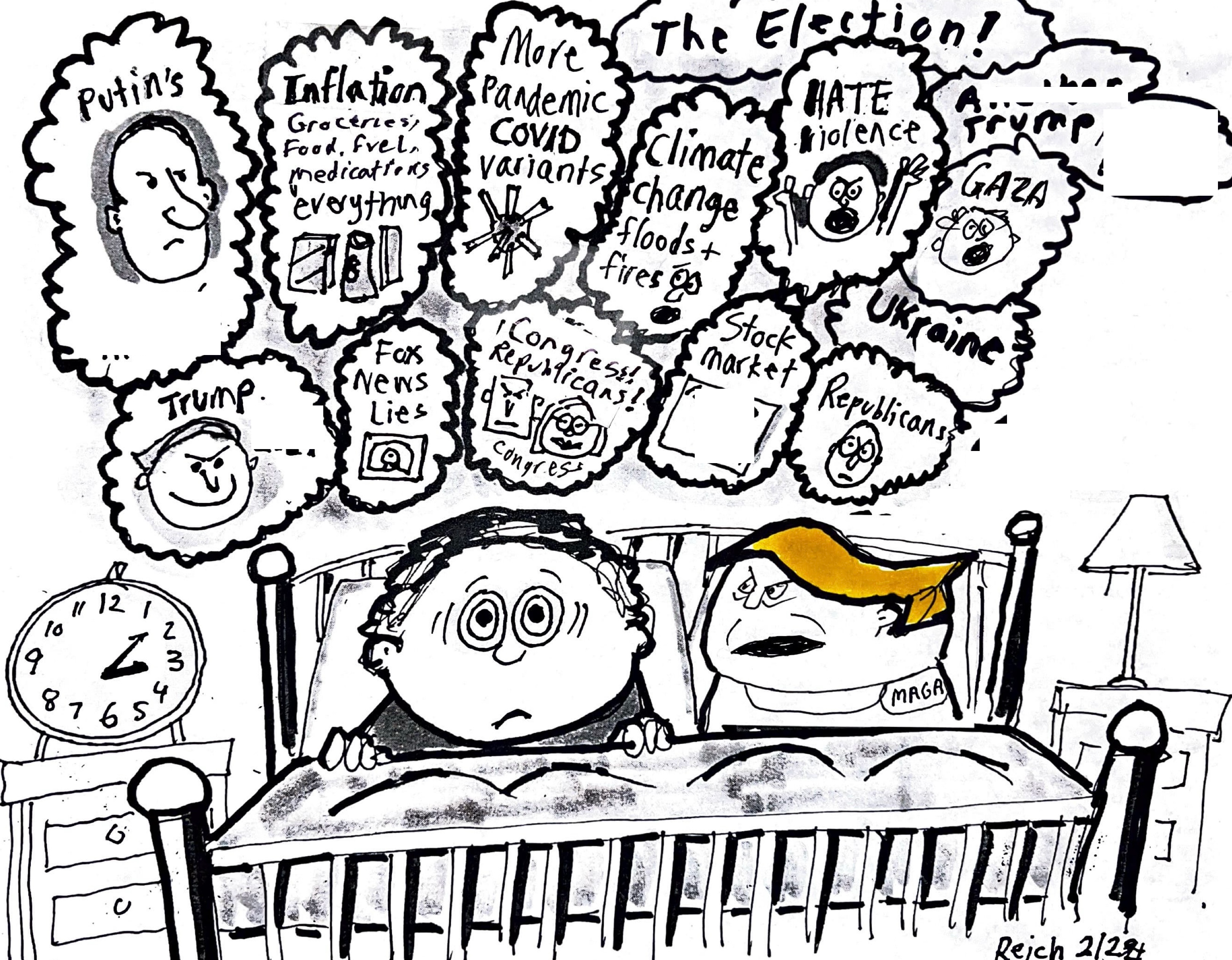
Trump is incapable of allowing tensions and stresses to ease without creating new ones.
Case in point: After meeting with China’s president Xi Jinping this past week, he announces that China and the United States — the largest and second-largest economies in the world — will de-escalate the trade war.
Sounds good, I suppose (until you realize that the two nations are now back to where they were before Trump created the trade war in the first place).
Not content to calm any waters, Trump also announces that the United States will immediately restart nuclear weapons testing, after not doing so for more than 30 years. Why? He doesn’t explain except to say “other nations” are doing so. (None of the world’s three major military powers has conducted a nuclear weapons test since 1996, but they will if the U.S. resumes.)
At A Glance

Explaining the absurdly straight line across Scotland's Great Glen.
Bioluminescence produces new light, while biofluorescence re-emits absorbed light.
Normal fevers help fight viruses and bacteria and support immune cells.
"Viscoelasticity" allows muscles to elongate briefly after stretching.
The British captured Philadelphia in 1777 (and took over Ben Franklin's house).
Mapping all 30,000 Transatlantic slave voyages.
Listen to this extended history of Berkshire Hathaway's origins.
Why horror is so fun for some viewers.
Visualizing the most challenging marathons in the world.
On the strange art of thinking about math without words.
Autograph hunters form secret networks to trade celebrity access tips.
Only 34% of Americans supported the Apollo program in 1967.
Over 100,000 art pieces are stolen each year, with less than 10% recovered.
Credit for inventing the laser was fought over for nearly three decades.
Subscribe to:
Posts (Atom)