Monday, August 11


Headlines

Andy Manis/Getty Images
 Milwaukee hit with flash floods as Midwest experiences major storms. The flash flooding on Saturday led to the city receiving 5.74 inches of rain within hours, prompting it to declare a state of emergency and forcing the Wisconsin State Fair to shut down a day and a half early. The chief of the Milwaukee fire department said dozens of people had been rescued from cars. Significant power outages and property damage were reported. Last night, the National Weather Service warned of “repeated rounds of heavy rain” across the Midwest, Central Plains, and Southwest throughout the day today.
 Netanyahu said new military offensive will be wider than first announced. Yesterday, the Israeli prime minister clarified that his security Cabinet authorized attacking “central camps,” which the UN says are housing 500,000 displaced people, and Muwasi, in addition to Gaza City, which was announced last week. He defended the action as necessary to “finish the job.” Also yesterday, five Al Jazeera journalists were killed in an Israeli strike near Gaza City’s Al-Shifa Hospital, including reporters Anas al-Sharif and Mohammed Qreiqeh and three cameramen, who were in a tent for journalists near the hospital’s main gate when it was struck. The Israel Defense Forces said it had targeted al-Sharif, whom it described as “the head of a terrorist cell in Hamas,” allegations that al-Sharif and Al Jazeera previously denied.
 Automakers are mostly footing tariff costs. President Trump’s new trade policies have had almost no impact on the price of new cars to date, the New York Times reported, but industry players and analysts are preparing for that to change. Lenny LaRoca, a partner at accounting firm KPMG, said that he believes carmakers will try to focus on cost-cutting for as long as possible, but that he expects prices will start to rise early next year. Tariffs affecting autos and auto parts have already led to losses of $12 billion for the global auto market, the worst since Covid. In response to the global pressure, Håkan Samuelsson, CEO of Volvo Cars, said earlier this year that he believed that the manufacturing of cars would become “a bit more regionalized.”—HVL
Robert Reich
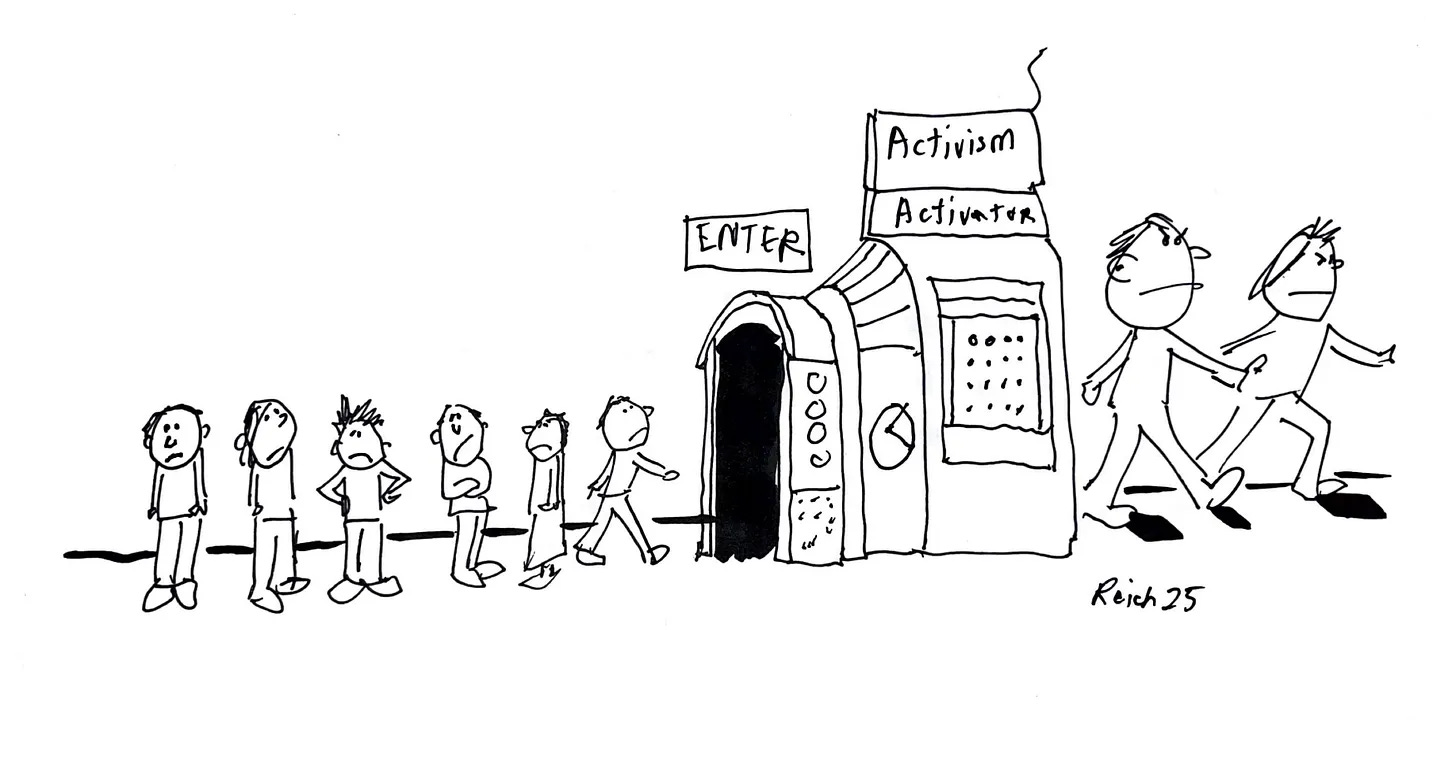
An important way to fight Trump fascism.
You can organize it.
Friends,
Many of you responded to my “What You Can Do Now” post last Thursday with additional initiatives and ideas.
Here’s a particularly important one.
As you’re painfully aware, Trump’s ICE is rapidly morphing into a national police-state — targeting legal immigrants as well as the undocumented, some of them awaiting their asylum hearings, others working with approved green cards. Many have been hardworking members of their communities for decades.
Soon, 10,000 more ICE agents will join the ranks of this federal police force — covering their faces with masks, wearing no identification badges, and driving unmarked cars — taking people from their homes and jobs and sending them to crowded and unsanitary prison camps like Florida’s new “Alligator Alcatraz” or to prisons in other countries.
At A Glance

Petunia is crowned world's ugliest dog.
Meteorite that crashed into Georgia is older than Earth.
Helsinki goes one year without traffic deaths.
Coral-shaped rock, billions of years old, discovered on Mars.
Humans' connection to nature is down 60% since 1800.
Thieves steal $7K in Labubu dolls from Los Angeles store.
Top Secret D-Day maps bought for $10.
Indiana man grows over 30-foot-tall sunflower.
Do animals get drunk?
Clickbait: Santa's elves begin cycling.
Historybook: Author and historian Alex Haley born (1921); Apple cofounder Steve Wozniak born (1950); Actress Viola Davis born (1965); Final US ground combat troops leave South Vietnam during Vietnam War (1972); Robin Williams dies by suicide (2014).

In The NEWS

Taxing Trade
What are tariffs?
A tariff—a word derived from the Arabic "arafa," meaning “to make known”—is a tax imposed by a government on goods that are imported or exported.
Economically, tariffs aim to protect domestic industries, generate government revenue, and influence trade policy. Tariffs can be specific (a fixed fee per unit) or ad valorem (a percentage of the item's value).
Historically, tariffs have served as a primary source of revenue and a means to protect domestic industries, as they make foreign products more expensive—encouraging consumers to purchase locally produced goods. The tools have a checkered history, famously bolstering US textiles, German steel, Japanese cars, South Korean technology, and more, while arguably contributing to major economic downturns like the Great Depression.
... Read our full explainer on tariffs here.
Also, check out ...
> The role of tariffs in ancient Rome. (More)
> Worldwide use of tariffs has trended downward for decades. (More)
> One of America's first acts implemented tariffs. (More)
Frigid Confections
Ice Cream, 101
Whether it’s in a sundae, a cone, or blended into a shake, ice cream is one of the United States’ favorite indulgences—97% of Americans say they like or love the chilly treat. US ice cream production hit 1.31 billion gallons in 2024, with the average American eating a whopping 19 pounds.
Ice cream is the final result of a complex process that blends several ingredients. As it’s being made, the ingredients change significantly throughout the production process, ultimately giving the dish its signature “scoopable” texture.
Ice cream’s celebratory nature brings people together, especially in the days before widespread home refrigeration. In the late 1600s, Paris’s Café Procope first began serving the sweet treat to the public; the trend quickly spread, particularly in Italy, where some parlors have been open since the 1700s.
... Read our full overview on ice cream here.
Also, check out ...
> America's ice cream obsession began under Prohibition. (More)
> George Washington spent thousands on ice cream one summer. (More)
> Visualizing Ben & Jerry's legendary flavors. (More)
SOURCE: 1440 NEWS
It's Just the South
.jpg)
I have always been a southern boy, born and bred and spent my working career down here as well. Not much money to be made when working in the south but the location offers other advantages, such as:
- low cost of living
- low cost of housing
- less traffic-congestion
- less smog-farmland
- recreational parks and lakes
- less crime and violence
The home that I purchased here for $200K would cost me twice that up north or even in certain places in Georgia or North Carolina and Florida.
But, it is the rural south... suburbia... not farms or farmland that is the ideal place to live. Large lots with enough space to plant a row of fence trees for privacy. Close enough to be neighbors but far enough away to where one cannot hear their voices.
We have crime in the south but only in large cities and I suppose that is the same for all states to a certain degree, but crime seems to be more prevalent up north than in the south.
I remember visiting NYC back in the 70s, left the bus station that brought me to town from the airport, and asked a passer by the time, his response (never forgotten) was: What the fuck do l look like a clock!?"
Politeness is what the south has over the north or what some call SOUTHERN HOSPITALITY. It is true, but that too is changing as more and more northerners move down here to escape crime and high taxes.


8 simple ways to live a happy life

We live in a world obsessed with opinions, validation, and the relentless pressure to care—about everything. From social media likes to career status, from family expectations to self-imposed perfection, the weight of “caring too much” can quietly suffocate our happiness.
But here’s the secret: happiness isn’t about doing more, achieving more, or caring more. It’s often about letting go. Letting go of what doesn’t serve you. Letting go of the noise. Letting go of trying to control the uncontrollable.
Sunday, August 10


Trends

Kanokwalee Pusitanun/Getty Images
Landscaping and plant businesses are scrambling to adapt to the anti-lawn movement, a once-fringe push to “re-wild” American backyards that’s taken off since gaining traction during the pandemic.
Not the same old yard and grass. The idea is simple: Rip up at least some of your grass-only lawn—which is like an empty buffet table for biodiversity—and replace it with an array of native plants, which creates a real smorgasbord. These plants need less watering and maintenance because they evolved with local climates, and pollinators love ’em, so it’s seen as a win-win…except among neighbors, who may not like the wildish sight.
These days, many drought-prone places from California to Maryland offer to pay you to rip up your grass. But amid a nationwide shortage of native seeds that stems from environmental restoration projects (like wildfire recovery), the anti-lawn movement is putting pressure on the landscaping industry:A nationwide shortage of native seeds is leading to delays, substitutions, and out-of-state imports in some landscaping projects as re-wilding demands rise faster than plant nurseries can nurse, Fast Company reported last week.
Lawn companies are rethinking their supply chains: One LA-based landscaping architecture firm even opened its own plant store in an attempt to boost the local supply of native flora, per Fast Company.
Room to grow: Less than half of US plant nurseries prioritize native species, according to Garden Center’s 2024 industry report. Some local governments are trying to help with availability—earlier this year, Ohio signed off on a new law that makes it easier for residents and grassroots groups collect and share native seeds, and New York greenlit a grant program to boost its own stash.—ML

Mel Melcon/Los Angeles Times via Getty Images
Death, taxes, and severely not chill homeowners associations: If you’re one of more than 75 million Americans living under an HOA, you may be caught between the rock and a hard place of neighborhood upkeep rules and local climate-conscious lawn ordinances.
One extreme case: Irena Green of Florida had to spend a week in jail in May after minor HOA violations snowballed into a lawsuit, then into a warrant for her arrest. Green was initially cited for brown grass patches, which she said stemmed from a drought last summer that led to watering restrictions in her county. Now, she’s facing thousands of dollars in legal fees and potential foreclosure.
Green’s exact situation is rare, but facing such contradictory requirements is becoming increasingly common. In Texas last summer, at least one resident was getting brown lawn warnings from her HOA while also receiving reminders from her utility company not to exceed water limits—both of which carried potential fines.
Homegrown efforts to redo lawns so they need less water also haven’t gone over well—even when local governments encourage it:A Long Island village recently tried to sue one of its residents for $2,000 after she used her town’s $350 native plants grant to re-wild her yard, which the village mayor called “hideous.” (They compromised with a 4-foot cap on the garden’s height.)
Clover and moss are becoming more popular as low-maintenance grass lawn alternatives, but HOAs usually categorize them as weeds that could warrant a fine.
Front yard “microfarms” are similarly gaining ground as a way to save money on water and groceries, but neighborhood associations typically don’t allow residents to have vegetable gardens at home.
Some states are getting involved: A new law in Texas this year will require HOAs to suspend green-lawn rules when residents are on mandatory drought watch. Colorado, Maryland, and several other states have also passed bills in recent years that force HOAs to let residents install more eco-friendly landscaping.—ML

Robert Reich

Friends,
Over the past several weeks, Trump and his MAGA stooges in Congress have passed legislation to strip health care from 10 million people; cut food stamp benefits for 40 million Americans, half of them children; slash $8 billion from lifesaving foreign aid programs; defund public radio and television stations nationwide; kill hundreds of thousands of clean energy jobs; and hand $4.5 trillion in tax breaks to Trump and his billionaire friends. And that’s not nearly all of the damage.
How do we respond to this catastrophe?
I think of Vaclav Havel, former president of the Czech Republic, whom I met in 2003, in Prague. What struck me about him was a warmth and optimism that radiated outward. When we walked into a small restaurant, all the diners stood and applauded, and sang.
Havel had become politically active as poet, playwright, and dissident after the Warsaw Pact invasion of Czechoslovakia in 1968 — which put him under the surveillance of the secret police. He was repeatedly jailed, the longest from 1979 to 1983. (In 1989, his Civic Forum party played a major part in the Velvet Revolution that ended Soviet dominance, and he was elected president shortly thereafter.)
At A Glance

The dupe economy: why Gen Z and millennials love a cheap, fake luxury item.
Steffen boarding: the quickest way to board a plane.
Ten spots in the US where the water is sparkling blue.
... and why is some water turquoise?
Examples of the realistic, emotional shift in Hellenistic sculpture.
Earwax, also known as cerumen, is actually good for you.
Gene editing could help stop the next potato famine.
How Queen Elizabeth embraced "color-blocking" ensembles late in life.
Seven incredible discoveries of long-lost art.
How do cashews grow, and why are they so expensive?
Visualizing the $5.6T dollar pharmaceuticals industry.
A deeper look at what happened in 1992 at the standoff at Ruby Ridge.
Wild fan theories about the "Wizard of Oz."
Why is manufacturing so important to an economy?
The obsessive business philosophy of Ferrari founder Enzo Ferrari.

In The NEWS

Active shooter near Emory University dead, one officer killed.
A suspected gunman and a police officer are dead after police responded to an active shooter outside the headquarters of the US Centers for Disease Control and Prevention and near Emory University in Atlanta on Friday. No civilians were reported injured, though bullets struck at least four CDC buildings. The shooter's motive is still under investigation as of this writing.
Justice Department subpoenas New York attorney general.
Attorney General Letitia James is under federal investigation for allegedly violating President Donald Trump's civil rights. The subpoenas filed Friday seek records related to two lawsuits James previously filed against Trump, one regarding the Trump Organization and another involving the National Rifle Association. James, a Democrat, has sued Trump and his administration dozens of times over his policies and private business dealings, moves Trump has argued are politically motivated.
Separately, Trump ordered an unspecified number of officers from 16 federal agencies, including the Department of Homeland Security, ICE, and FBI, to patrol Washington, DC's streets for a week beginning yesterday. Trump also removed IRS commissioner Billy Long less than two months after his confirmation; a reason for the dismissal hasn't been made public as of this writing. Treasury Secretary Scott Bessent will serve as acting commissioner.
Apollo 13 mission leader James A. Lovell Jr. dies at 97.
The former Navy test pilot and four-time space veteran, known for leading the near-disastrous Apollo 13 mission to the moon, died Thursday in Illinois. He orbited Earth twice and the moon once before leading Apollo 13, which was forced to abort its moon landing after an onboard explosion. The famous phrase “Houston, we have a problem,” popularized by Tom Hanks in a film, was based on Lovell’s call to NASA ground control. Lovell earned the Congressional Space Medal of Honor and Presidential Medal of Freedom for his leadership during the mission.
Germany halts military exports for use in Gaza.
German Chancellor Friedrich Merz indefinitely suspended military exports to Israel that could be used in Gaza. The move came hours after Israel’s security cabinet approved a plan Friday to occupy Gaza City (see previous write-up here). Merz said he supports Israel’s efforts to weaken Hamas and rescue hostages, but expressed concern over the necessity of increased military action. Germany—alongside the US and Italy—has been one of Israel’s top military equipment suppliers.
Biological sex influences disease risk and immunity.
Research shows genetic sex—biologically defined as the presence of XX chromosomes in females and XY chromosomes in males—affects susceptibility to certain diseases. Women are more prone to autoimmune diseases, while men face higher risks of infectious diseases, partly due to the influence of sex hormones like estrogen and testosterone on immune cell behavior. Understanding sex-based immunity could help researchers develop tailored cancer immunotherapies.
LA brush fire forces thousands to evacuate.
A wildfire ignited Thursday afternoon in the mountains of Ventura County, north of Los Angeles. Within 10 hours, it grew to more than 7.6 square miles, forcing some 2,700 LA County residents to evacuate and placing another 14,000 Ventura County residents under evacuation warnings (see latest evacuation orders here). At least 400 personnel, supported by multiple aircraft, have been deployed to fight the blaze. Officials cite extreme heat and low humidity as key factors in its rapid spread.
Bed Bath & Beyond relaunches with brick and mortar in Nashville.
The bankrupt home goods chain is returning as Bed Bath & Beyond Home, with a storefront opening in Nashville yesterday. The original company filed for bankruptcy in April 2023, after which The Brand House Collective acquired its intellectual property. The new owners plan to open dozens more locations nationwide if the Nashville launch proves successful. In a nod to nostalgia, Bed Bath & Beyond Home will accept expired 20% off coupons, which the original stores were known for.
SOURCE: 1440 NEWS
Kingdom Come
.jpg)
"My kingdom is not of this world..." said Jesus to Pontious Pilot.
So...
what do you think that statement means?
Do you take it literally?
Was it spoken as if it were a metaphor?
We can say that world equals earth, so his kingdom is not here on earth.
OR,
does world mean universe?
If that was the case, then it would really have gigantic implications.
Let's stick with earth.
If it is not here on earth, then where is his kingdom?
Somewhere else in the universe...
The universe is damn near endless as far as our ability to travel as fast as the speed of light but even if we had that ability, we could not cover the entire universe in our lifetime.
At this point, we can conclude the Kingdom of Jesus is not on earth and it is somewhere in this vast universe, but we don't know where because no other coordinates were given.
However...
we can also conclude, to some degree, that Jesus, based upon his statement, is an EXTRATERRESTRIAL...
This is all based upon his kingdom statement which we must also conclude is a true statement otherwise why is it in red in most Bibles?
Is God too an extraterrestrial since HIS ONLY SON is an extraterrestrial?
What does that make us, since we were created in his image?
How do you explain the different colors of skin since Jesus obviously WAS NOT CAUCASIAN?
He was middle eastern, probably born with curly black hair.
Yet...
all the photographs in American churches have Jesus being white.
I mean he is white as white can be... with his long straight hair and beard.
Why was it so important for American Churches to portray Jesus as white rather than his true nationality as MIDDLE EASTERN?
This is the BIGGEST LIE OF ALL...
Subscribe to:
Posts (Atom)