Monday, August 11


Headlines

Andy Manis/Getty Images
 Milwaukee hit with flash floods as Midwest experiences major storms. The flash flooding on Saturday led to the city receiving 5.74 inches of rain within hours, prompting it to declare a state of emergency and forcing the Wisconsin State Fair to shut down a day and a half early. The chief of the Milwaukee fire department said dozens of people had been rescued from cars. Significant power outages and property damage were reported. Last night, the National Weather Service warned of “repeated rounds of heavy rain” across the Midwest, Central Plains, and Southwest throughout the day today.
 Netanyahu said new military offensive will be wider than first announced. Yesterday, the Israeli prime minister clarified that his security Cabinet authorized attacking “central camps,” which the UN says are housing 500,000 displaced people, and Muwasi, in addition to Gaza City, which was announced last week. He defended the action as necessary to “finish the job.” Also yesterday, five Al Jazeera journalists were killed in an Israeli strike near Gaza City’s Al-Shifa Hospital, including reporters Anas al-Sharif and Mohammed Qreiqeh and three cameramen, who were in a tent for journalists near the hospital’s main gate when it was struck. The Israel Defense Forces said it had targeted al-Sharif, whom it described as “the head of a terrorist cell in Hamas,” allegations that al-Sharif and Al Jazeera previously denied.
 Automakers are mostly footing tariff costs. President Trump’s new trade policies have had almost no impact on the price of new cars to date, the New York Times reported, but industry players and analysts are preparing for that to change. Lenny LaRoca, a partner at accounting firm KPMG, said that he believes carmakers will try to focus on cost-cutting for as long as possible, but that he expects prices will start to rise early next year. Tariffs affecting autos and auto parts have already led to losses of $12 billion for the global auto market, the worst since Covid. In response to the global pressure, Håkan Samuelsson, CEO of Volvo Cars, said earlier this year that he believed that the manufacturing of cars would become “a bit more regionalized.”—HVL
Robert Reich
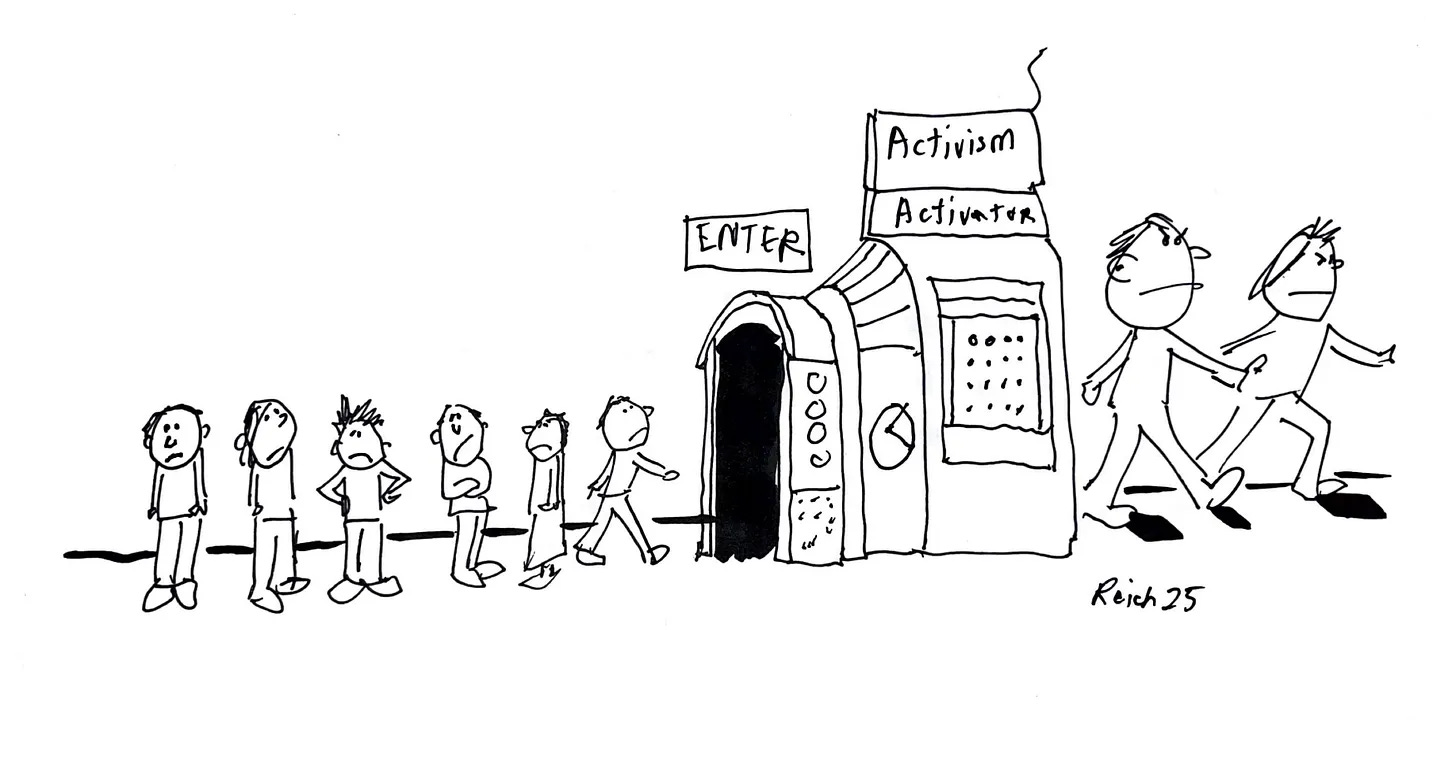
An important way to fight Trump fascism.
You can organize it.
Friends,
Many of you responded to my “What You Can Do Now” post last Thursday with additional initiatives and ideas.
Here’s a particularly important one.
As you’re painfully aware, Trump’s ICE is rapidly morphing into a national police-state — targeting legal immigrants as well as the undocumented, some of them awaiting their asylum hearings, others working with approved green cards. Many have been hardworking members of their communities for decades.
Soon, 10,000 more ICE agents will join the ranks of this federal police force — covering their faces with masks, wearing no identification badges, and driving unmarked cars — taking people from their homes and jobs and sending them to crowded and unsanitary prison camps like Florida’s new “Alligator Alcatraz” or to prisons in other countries.
At A Glance

Petunia is crowned world's ugliest dog.
Meteorite that crashed into Georgia is older than Earth.
Helsinki goes one year without traffic deaths.
Coral-shaped rock, billions of years old, discovered on Mars.
Humans' connection to nature is down 60% since 1800.
Thieves steal $7K in Labubu dolls from Los Angeles store.
Top Secret D-Day maps bought for $10.
Indiana man grows over 30-foot-tall sunflower.
Do animals get drunk?
Clickbait: Santa's elves begin cycling.
Historybook: Author and historian Alex Haley born (1921); Apple cofounder Steve Wozniak born (1950); Actress Viola Davis born (1965); Final US ground combat troops leave South Vietnam during Vietnam War (1972); Robin Williams dies by suicide (2014).

In The NEWS

Taxing Trade
What are tariffs?
A tariff—a word derived from the Arabic "arafa," meaning “to make known”—is a tax imposed by a government on goods that are imported or exported.
Economically, tariffs aim to protect domestic industries, generate government revenue, and influence trade policy. Tariffs can be specific (a fixed fee per unit) or ad valorem (a percentage of the item's value).
Historically, tariffs have served as a primary source of revenue and a means to protect domestic industries, as they make foreign products more expensive—encouraging consumers to purchase locally produced goods. The tools have a checkered history, famously bolstering US textiles, German steel, Japanese cars, South Korean technology, and more, while arguably contributing to major economic downturns like the Great Depression.
... Read our full explainer on tariffs here.
Also, check out ...
> The role of tariffs in ancient Rome. (More)
> Worldwide use of tariffs has trended downward for decades. (More)
> One of America's first acts implemented tariffs. (More)
Frigid Confections
Ice Cream, 101
Whether it’s in a sundae, a cone, or blended into a shake, ice cream is one of the United States’ favorite indulgences—97% of Americans say they like or love the chilly treat. US ice cream production hit 1.31 billion gallons in 2024, with the average American eating a whopping 19 pounds.
Ice cream is the final result of a complex process that blends several ingredients. As it’s being made, the ingredients change significantly throughout the production process, ultimately giving the dish its signature “scoopable” texture.
Ice cream’s celebratory nature brings people together, especially in the days before widespread home refrigeration. In the late 1600s, Paris’s Café Procope first began serving the sweet treat to the public; the trend quickly spread, particularly in Italy, where some parlors have been open since the 1700s.
... Read our full overview on ice cream here.
Also, check out ...
> America's ice cream obsession began under Prohibition. (More)
> George Washington spent thousands on ice cream one summer. (More)
> Visualizing Ben & Jerry's legendary flavors. (More)
SOURCE: 1440 NEWS
It's Just the South
.jpg)
I have always been a southern boy, born and bred and spent my working career down here as well. Not much money to be made when working in the south but the location offers other advantages, such as:
- low cost of living
- low cost of housing
- less traffic-congestion
- less smog-farmland
- recreational parks and lakes
- less crime and violence
The home that I purchased here for $200K would cost me twice that up north or even in certain places in Georgia or North Carolina and Florida.
But, it is the rural south... suburbia... not farms or farmland that is the ideal place to live. Large lots with enough space to plant a row of fence trees for privacy. Close enough to be neighbors but far enough away to where one cannot hear their voices.
We have crime in the south but only in large cities and I suppose that is the same for all states to a certain degree, but crime seems to be more prevalent up north than in the south.
I remember visiting NYC back in the 70s, left the bus station that brought me to town from the airport, and asked a passer by the time, his response (never forgotten) was: What the fuck do l look like a clock!?"
Politeness is what the south has over the north or what some call SOUTHERN HOSPITALITY. It is true, but that too is changing as more and more northerners move down here to escape crime and high taxes.


8 simple ways to live a happy life

We live in a world obsessed with opinions, validation, and the relentless pressure to care—about everything. From social media likes to career status, from family expectations to self-imposed perfection, the weight of “caring too much” can quietly suffocate our happiness.
But here’s the secret: happiness isn’t about doing more, achieving more, or caring more. It’s often about letting go. Letting go of what doesn’t serve you. Letting go of the noise. Letting go of trying to control the uncontrollable.
Sunday, August 10


Subscribe to:
Posts (Atom)