Monday, July 21

F4U CORSAIR_@Sylvia70485099๐Ÿ‡ซ๐Ÿ‡ท๐Ÿ‡บ๐Ÿ‡ฆvia X


TimcastIRL


News Variable


Spider


Headlines


Wenjie Zheng/Getty Images


Alaska Airlines temporarily grounded its entire fleet last night. According to an FAA advisory, the airline sought approval to ground over 200 planes under its brand. It later expanded the stoppage to include planes from its Horizon Air unit. Alaska Airlines said the decision stemmed from a computer network outage. While the ground stop was lifted about three hours later, around 11pm Pacific, Alaska said that “residual impacts” to its operations would be felt, adding, “It will take some time to get our overall operations back to normal.” As NBC News noted, the disruption comes almost exactly a year after a faulty CrowdStrike update caused chaos for airlines.

Japanese prime minister will stay in role to tackle inflation, tariffs. PM Shigeru Ishiba held a press conference Monday morning local time after his party lost an important parliamentary election on Sunday to announce he would not step down. The Liberal Democratic Party and its junior coalition partner were unable to retain a majority in the upper house of Japan’s Parliament, meaning the LDP is now a minority in both houses despite still being the leading party. He cited the need to tackle inflation at home and reach a trade deal with the US as reasons why he wanted to remain premier and avoid political instability.

Astronomer CEO Andy Byron resigned following Coldplay debacle. The software startup announced on Saturday that its board of directors accepted Byron’s resignation after the married executive got caught on the “kiss cam” at a Coldplay concert last Wednesday night in an intimate pose with another woman, the company’s Chief People Officer Kristin Cabot. Axios reported that Cabot is on leave from Astronomer pending an investigation into the incident, which to the wider world has become a meme. One example: At Citizens Bank Park in Philadelphia, the Phanatic recreated the moment on the Phillies jumbotron.—HVL


Robert Reich


This week’s Neville Chamberlain Award Goes to Sian Beilock. Who’s She?
Let me tell you


Friends,

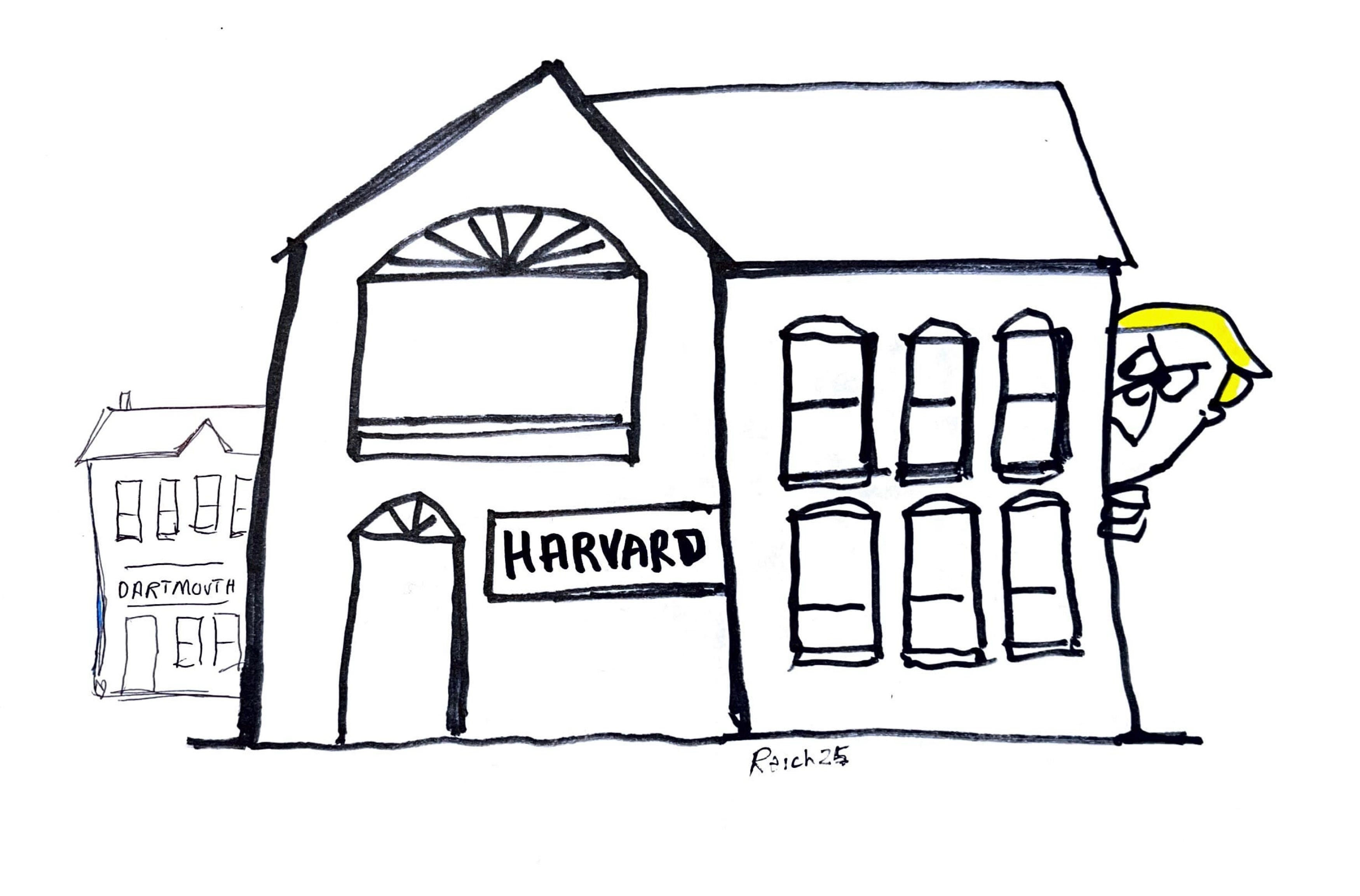
The Trump regime’s battle with Harvard University will be aired in court today when a federal judge hears arguments in Harvard’s lawsuit challenging Trump’s attack on it.

At stake is not just $2.2 billion in grants for scientific research, but the larger question of whether Trump can impose his agenda on independent universities in America — forcing them to bring their admissions, disciplinary procedures, academic hiring, and curricula in line with his priorities.

With the Trump regime ramping up its attacks on colleges and universities across America — using the pretexts of “DEI,” antisemitism, and transgender athletes to undermine academic freedom — it would seem more important than ever for universities to join together to stop him.


At A Glance


The cities where college graduates are landing jobs.

Over half of US workers feel anxiety about taking time off.

Parent's biology may, in some cases, influence a baby's sex.

Man wins coding marathon against OpenAI model.

What to expect from this year's Shark Week.

Astronomer CEO resigns amid
Coldplay kiss cam controversy.

Woman inundated with calls about fictional missing cat.

Chefs cook the world's largest Scotch egg.

Clickbait: Examining the Gen Z stare.

HOW TO COOK LENTILS IN THE INSTANT POT

Quick Clips


In The NEWS


Critical minerals, explained

Critical minerals are used to build the batteries, computer chips, and magnets that power modern technologies, from personal devices to clean energy sources, and advanced military apparatuses. The US government has identified 50 minerals as “critical,” deeming them to be essential to the national interest but to have a vulnerable supply chain (see the list).

Rare earth elements are some of the most sought-after minerals because their unique atomic structures give rise to various electrical, luminescent, and magnetic properties. Sixteen of these 17 metallic elements clustered at the center of the periodic table are on the US’ latest critical mineral list published in 2022.

Developed nations like the US, Canada, and China are sprinting to control critical mineral mines in Africa and South America. China is currently dominating the race. It accounts for about 70% of global rare earth ore extraction and 90% of rare earth ore processing.

... Read our full deep dive on critical minerals here.

Also, check out ...
> The one location that holds 75% of the world's lithium. (More)
> How your phone is powered by rare earth elements. (More)
> Why seemingly abundant copper can't keep up with demand. (More)


The National Debt, 101
The national debt is the total amount of money the federal government has borrowed, plus interest. This borrowed money supplements taxpayer dollars to fund government operations, from national defense to welfare programs. Today, the debt stands at over $36T, double the amount in 2014.

The US has accrued debt since its infancy. Only seven years into nationhood, debts from the Revolutionary War totaled $43M. To raise money beyond taxes, the US government primarily sells bills, notes, and bonds (collectively called securities) to domestic and foreign individuals, companies, and other governments (see chart on annual interest payments on the debt here).

Where the nation should cut spending and how much, in order to rein in debt, is an ongoing political debate. While much focus is put on debt, the debt-to-gross domestic product ratio and interest payments on debt relative to GDP are widely considered to be key indicators of fiscal health. The lower a country’s debt-to-GDP ratio and interest rates are, the stronger its economy is likely to be.

... Read our full take on the national debt here.

Also, check out ...
> The time the US fully eliminated the national debt. (More)
> What happens if we hit the national debt ceiling. (More)
> Who owns the federal government's debt? (More)


SOURCE:  1440 NEWS

Socialism


Is Socialism bad for the USA?

Let's start by defining Socialism.

Socialism is a political and economic system where the people collectively own or control the means of production, rather than private individuals or corporations. It's characterized by social ownership of resources and a more equitable distribution of wealth and resources. Different forms of socialism exist, ranging from those that eliminate markets and competition to those that incorporate them.


The people, in socialism, control everything, rather than private individuals or corporations.  This means that the GOVERNMENT, on behalf of the people control everything.

The government owns your home and land and gives you the same size home that everyone else has based upon your size family. The government decides on your wages and instead of joining a union, your employer is the government.

It will be the government who decides what food is available or what clothes are available, cars, shoes, computers, etc.  Since there is no competition in a socialistic society, there is no need to have a variety of cars or computers.

The government will also be responsible for all law enforcement.  The government will decide what laws will be passed and enforced, and what punishment is awarded, since there will be no need for courtrooms, juries, or lawyers.


AI Overview
While the US is largely considered a capitalist country, some socialist policies and ideas have been implemented or are gaining traction. Examples include social security, Medicare, and public education, which are forms of social safety nets and government provision of services that are also found in socialist systems. Additionally, there's a growing political movement, particularly among Democratic Socialists, advocating for policies like universal healthcare and affordable housing, which aligns with some socialist principles.


The government will be in charge of everything.  Everyone will get paid the same regardless of the quality of output.  The government will own all housing and will be responsible for maintaining all housing.  Have you ever known anyone who works for the government, to work fast...  think about that when you air conditioner fails in the middle of summer or the heat pump in the middle of winter.

The government worker, being paid the same, has no incentive to worry about the consumer...  Doctors, Dentists, Surgeons all being paid the same, because wealth is BAD, will have no incentive to do a good job...

Somewhat Political


First electronic–photonic quantum chip created in commercial foundry


In a milestone for scalable quantum technologies, scientists from Boston University, UC Berkeley, and Northwestern University have reported the world's first electronic–photonic–quantum system on a chip, according to a study published in Nature Electronics.

The system combines quantum light sources and stabilizing electronics using a standard 45-nanometer semiconductor manufacturing process to produce reliable streams of correlated photon pairs (particles of light)—a key resource for emerging quantum technologies. The advance paves the way for mass-producible "quantum light factory" chips and large-scale quantum systems built from many such chips working together.

"Quantum computing, communication, and sensing are on a decades-long path from concept to reality," says Miloลก Popoviฤ‡, associate professor of electrical and computer engineering at BU and a senior author on the study. "This is a small step on that path—but an important one, because it shows we can build repeatable, controllable quantum systems in commercial semiconductor foundries."


Bob Dylan - Hurricane (Live on PBS, 1975) [RARE ORIGINAL AUDIO]

Sunday, July 20

Surviving


The Shannon Joy Show


Eric Clapton


Dinesh D'Souza


The Amber May Show


Doorway


The Alex Jones Show


News Variable


Love


The White House


The Big MIG


Peace


TimcastIRL


Thrivetime


History


New-age chess pros are raking in big paydays


Gukesh Dommaraju, Indian chess grand master. 
Simon Lim/AFP


It’s never been so lucrative to be the best in the world at nontraditional chess. Amid a chess resurgence that started when that fictional redhead hallucinated pieces on the ceiling, pro tournaments are adapting to our TikTok-ified attention spans—and rewarding the players who can keep up.

Chess joins one of the world’s biggest video-game tourneys. Grand masters are about to rub shoulders with gamers at the Esports World Cup (EWC) in Saudi Arabia, where World No. 1 Magnus Carlsen already got a fist-bump from Post Malone during the opening ceremony. Chess is debuting at EWC later this month:Sixteen players will compete for a $1.5 million prize pool, a sum that’s become par for the course in international pro chess, which historically hasn’t minted many millionaires.

The games won’t be normal—players will only have 10 minutes each to make their moves, which will likely lead to more time-crunched blunders.


This will make the matches feel “a bit more gamified,” Fabiano Caruana, the world No. 5 chess player, told CNN. The cup’s organizers decided on the high-speed format to appeal to the esports crowd and to the new generation of chess fans that will be in the audience, as many young aficionados discovered the game on livestream platforms like Twitch.

The world’s most attended chess cup is evolving, too. A record 3,000+ players registered to play in the annual Grenke Chess Festival this year, where freestyle chess—a format that randomizes your starting positions—replaced one of the tournament’s classic events for the first time.

That checkmate cha-ching: The FIDE World Chess Championship offers the biggest wheel of cheese, with $2.5 million in winnings doled out last year. With chess cups upping their prize pools, some grand masters can finally afford to live lavishly—34-year-old world No. 1 Carlsen, who’s known for his quick moves, has made more than $10 million in lifetime tournament prizes, and emerging star Gukesh Dommaraju made more than $1.5 million last year alone, according to Chess.com.—ML