Monday, June 16
In The NEWS
In partnership with
What is blood?
The heart pumps roughly 2,000 gallons of blood around the body each day. Human blood has three distinct parts: plasma, white blood cells and platelets, and red blood cells (watch 101). In general, blood ferries oxygen, nutrients, and hormones to cells in need while regulating body temperature and collecting cellular waste and byproducts, such as carbon dioxide, for removal. Explore its functions here.
In adult humans, bone marrow produces all the body's platelets and red blood cells, while other organs, including the spleen and lymph nodes, assist white cell production. Some of these organs also run quality control on blood cells.
Red blood cells are covered in antigens, protein molecules that let the immune system know to boot anything that doesn't match. In humans, the type of antigens you have determines your blood type, leading to four main types (A, B, AB, and O). For blood transfusions, it's crucial that individuals receive blood of their type, or their immune system will reject the donated blood.
... Read our full deep dive on blood here.
Also, check out ...
> The history of drinking blood for health reasons. (More)
> Can we synthesize blood instead of requiring donations? (More)
> How blood pressure works. (More)
The Master of Suspense
Alfred Hitchcock, 101
Alfred Hitchcock is one of the most influential movie directors of all time. He was the director of more than 50 films and also the host and producer of an American television anthology series.
Hitchcock blended the macabre with gallows humor, sexual innuendo, and terror. He also frequently appeared in his own films. Born in Great Britain in 1899 (see timeline), his six-decade career produced many films now considered classics and helped legitimize the thriller genre.
Nine Hitchcock movies have been inducted into the National Film Registry, and four of them are listed in the American Film Institute’s list of the most important American movies (see list). Hitchcock has influenced generations of filmmakers (like "The Sixth Sense" director M. Night Shyamalan), employing iconic soundtracks, popularizing tropes like the MacGuffin, and innovating camera techniques.
... Read our full deep dive on Hitchcock here.
Also, check out ...
> What is a "Hitchcock Blonde"? (More)
> How Hitchcock's "Psycho" broke all the rules. (More)
> A visual guide to Hitchcockian motifs. (More)
Everything to know about ancient Egypt
Historians divide Egypt's timeline into three kingdoms: Old, Middle, and New. A long, broken line of kings further divides its timeline into 31 dynasties. Its history was mostly forgotten until the late 18th century, when Napoleon's armies plundered its treasures and jump-started an "Egyptomania" that endures today (watch 101).
The vast, complex culture ebbed and flowed on the 4,000-mile-long, north-flowing Nile River, whose predictable annual flooding—caused by snowmelt and rains in the Ethiopian highlands—nourished its banks.
Egyptian power began and ended with the all-powerful pharaoh, a Greek term meaning "great house," which only became common usage in modern times. At death, Egyptians believed a person's spiritual parts were separated from the body but required the physical remains or a replica as a place to live. This belief gave rise to mummification (how it works) and extravagant tomb-making.
... Read our full deep dive on ancient Egypt here.
Also, check out ...
> How "The Book of the Dead" is a guide for the underworld. (More)
> An interactive map of ancient Egypt's wonders. (More)
> Two hundred years ago, the Rosetta Stone cracked hieroglyphics. (More)
About My Career
Perpendicular Planet: A 90° Orbit Over Twin Suns Leaves Scientists Stunned
A Bizarre New System in Space
Astronomers have uncovered one of the strangest planetary systems ever seen. Nicknamed 2M1510, this system appears to include a planet that loops far over the poles of two brown dwarfs—mysterious celestial bodies that are too heavy to be planets but not quite massive enough to ignite like stars. These two brown dwarfs orbit each other closely, while a third one drifts even farther out, orbiting the pair from a great distance.
In most star systems, including our own solar system, planets typically orbit in the same flat plane as their parent star’s equator. The star’s spin also lines up with this orderly layout, creating a calm, pancake-like structure in space where everything moves together. Everyone is “coplanar:” flat, placid, stately.
Sunday, June 15
Speaking Out
What amazes me on a day like today (Father's Day), many of the memes and jpegs I see, depict a father with a son, instead of a daughter or a son and daughter. Not sure what the meaning of this might be, but there is clearly a subtle message being sent.
I used to speak out a lot but cut back after realizing nobody really gave a damn about what I thought because I was not a celebrity or rich and famous. It seems like those are the one we only want to listen to while at the same time, those are the ones that are putting us in the situation we are currently in. Americans never learn their lessons unless they are veterans.
Is our world much better off TODAY than it was YESTERDAY... with the understanding that yesterday is not really yesterday but years ago???
The ways in which we are better are offset by the ways in which we have remained the same or gotten worse... like:
- education
- healthcare
- quality of life
- the American dream
- wealth distribution
- value of the dollar
- global respect
- purchasing power
- national debt
Why some companies are rethinking the use of AI
Mario Tama/Getty Images
AI in most workplaces is here to stay. But several businesses bought into the early hype that generative AI would eliminate the need for hiring people and help trim payrolls, only to learn the hard way that robots aren’t yet ready to replace humans.
AI-ers’ remorse: A recent survey from Orgvue noted that more than half of business leaders said they regretted laying off employees as a result of an AI deployment. The research also found that 40% of executives reduced staffing in order to implement AI, and 55% of those robot-lovers regretted that decision. Per S&P Global, 42% of companies abandoned their generative AI pilot projects in 2025, up from 17% last year.
To err is human, to rehire divine
Several companies quickly embraced AI as the employee of the month only to find themselves like Rose in the freezing cold Atlantic, blowing her whistle after the Titanic sank. Here are some of the companies that want people to come back:Klarna: CEO Sebastian Siemiatkowski said his push to use AI in a customer service role was a mistake because people would prefer to talk to humans than robots, something that eluded him even though that’s been true since the first automated voice on the other end of a phone call said, “To speak to an operator, press 0.” Siemiatkowski is not above AI replacing himself, though: You can call a hotline to give feedback to his AI-generated clone.
IBM: After laying off 8,000 people, including many people in human resources roles who were replaced with the AskHR AI service, the company reversed course upon realizing humans may be better equipped for a job with “human” in the title.
McDonald’s: Using AI to take orders at drive-thrus turned out to be a clown show, with the tech adding bacon to an ice cream order (among other issues).
Duolingo: CEO Luis von Ahn made a big statement that the company was going “AI-first” and replacing contractors with AI, but he walked back that plan after facing backlash from customers.
Zoom out: The rush to get up to speed with a hot new technology was partly due to fear of falling behind competitors welcoming it with open arms, like Apple being left in the dust by its rivals on the AI front. But according to a report from The Economist, most companies aren’t clamoring for AI that’s more clever—they need tech that’s more applicable to their businesses.—DL
Robert Reich
Sunday Thought
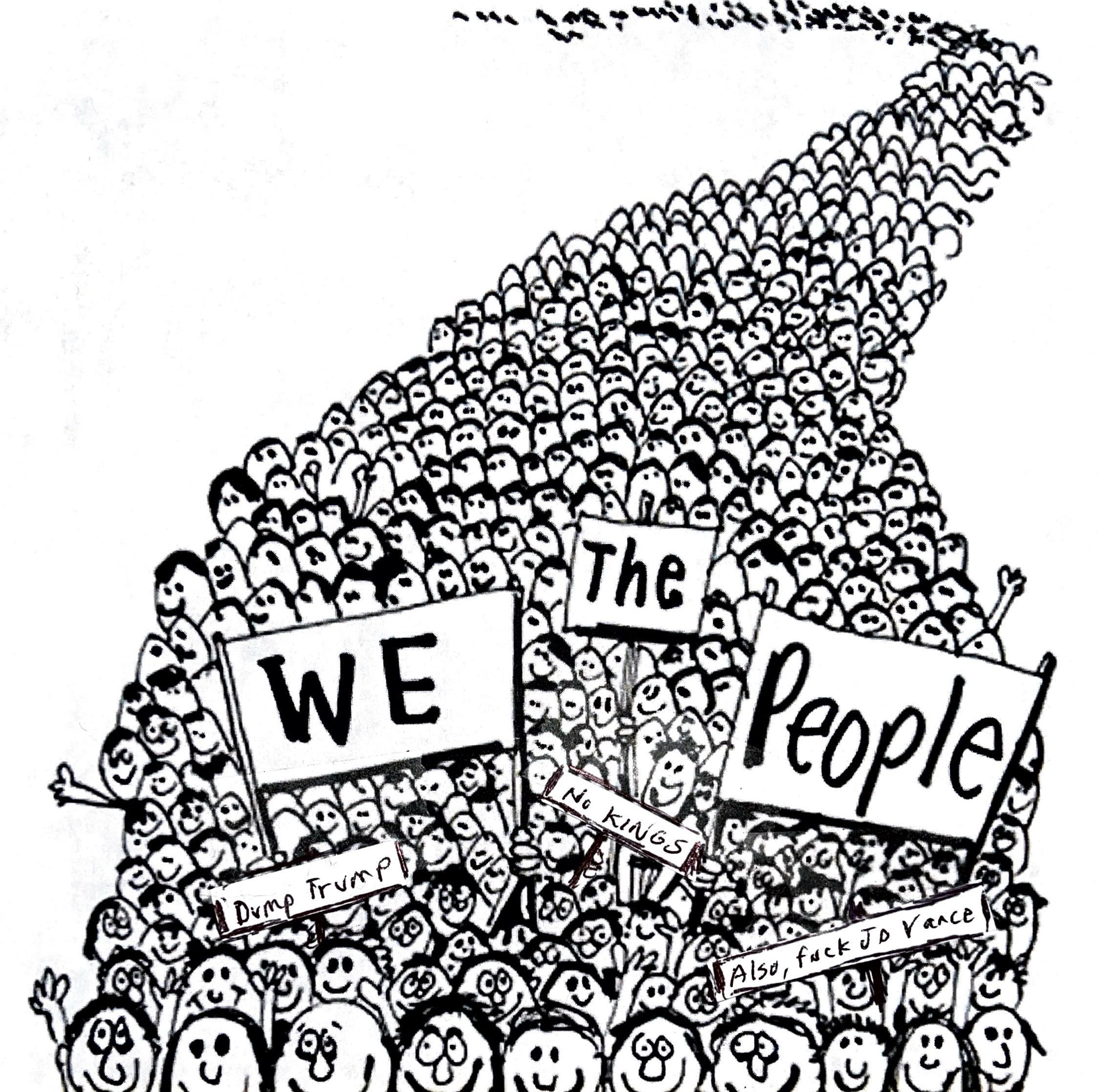
We the People
Friends,
Yesterday’s demonstrations across the nation in favor of democracy and against Trump’s dictatorship revealed the power of the people.
The energy, exuberance, and solidarity of those demonstrations stood in sharp contrast to Trump’s noxious display of tanks and military equipment on Constitution Avenue in Washington, D.C. While Trump continues to politicize the military, hundreds of thousands of us are saying no to his usurpation of power that belongs to the people.
We will not be intimidated by the violence he has stirred up — not by the shootings of state legislators and their spouses in Minnesota, nor by the death threats against federal judges, nor by the thuggish removal of a United States senator from a Trump official’s news conference, nor by the arrest of a judge who didn’t cooperate with ICE, nor by the abductions of people from our streets and places of work.
The origins of Father's Day.
A wire around Manhattan allows observant Jews to carry things on the Sabbath.
Is it safe to microdose Ozempic?
The wildest sports moments of the last 25 years.
The era when Earth was ice-covered and inhabited with life.
Visualizing the highest-earning films since 1979.
The US tried to ban fake photos in 1912.
Defining the latest in slang: from "aura farming" to "clock it."
The unique franchise economics of Chick-fil-A.
How the death of a whale feeds the seafloor ecosystem for centuries.
Steps for buying your first hearing aids.
The origins of the Rolling Stones.
How reusable rocket boosters actually work.
Why "The Phantom of the Opera" lasted for decades on Broadway.
Hosting the World Cup is exciting—and extremely costly.

.jpg)