Monday, June 9


Headlines

Gina Ferazzi/Getty Images
 Los Angeles protests continued into the night. The demonstrations, which began Friday after ICE officers executed search warrants at multiple locations in the city, including a clothing warehouse, continued throughout the day and spread. In response, President Trump signed a memo on Saturday ordering 2,000 National Guardsmen to Los Angeles County, the first time since 1965 that the National Guard was activated in a state without the request coming from the state’s governor. On Sunday, Gov. Gavin Newsom called on Defense Secretary Pete Hegseth to rescind the order, writing that the deployment was “a serious breach of state sovereignty that seems intentionally designed to inflame the situation.” Just after 9pm PT on Sunday, the LAPD declared various gatherings downtown as an unlawful assembly.
 Trade talks between the US and China begin in London today. And each side is bringing its wish list. American trade officials will press their Chinese counterparts to ease export controls on rare earth minerals and the magnets containing them. For its part, China wants the US to lift recent restrictions on its ability to buy jet engines and other technology products. US Treasury Secretary Scott Bessent will lead the American side. The negotiations aim to build on the progress made between the two countries in Geneva in May, when they agreed to a 90-day pause on some of the aggressive tariffs they had imposed on each other this year. The talks are expected to run through Friday.
 The 2025 Tony Awards celebrated a record-setting season. Broadway’s honors went to Sarah Snook (best leading actress in a play for The Picture of Dorian Gray), Nicole Scherzinger (best leading actress in a musical for Sunset Boulevard), Cole Escola (best leading actor in a play for Oh, Mary!), and Darren Criss (best leading actor in a musical for Maybe Happy Ending). The awards show, held at Radio City Music Hall, featured a medley of Hamilton songs performed by 28 members of the original cast to honor the show’s 10th anniversary. See the full list of 2025 winners here.—HVL
Robert Reich
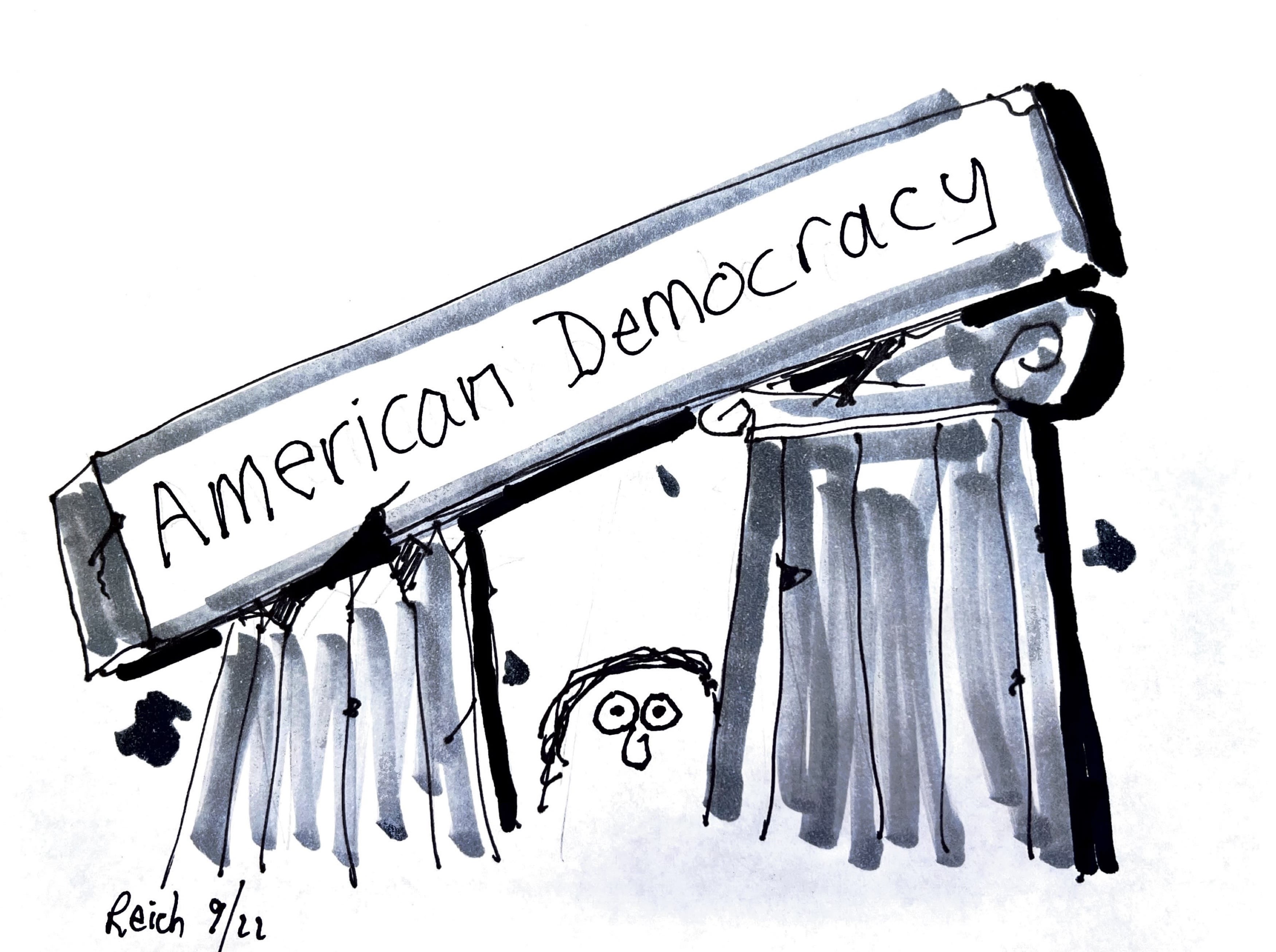
Trump’s Police State
It endangers all of us
Friends,
Now that Trump’s tariffs have been halted, his One Big Beautiful Bill has been stymied, and his multibillionaire tech bro has turned on him, how does he demonstrate his power?
On Friday morning, federal agents from ICE, the Department of Homeland Security, the Federal Bureau of Investigation, and the Drug Enforcement Administration conducted raids across Los Angeles, including at two Home Depots, a doughnut shop, and a clothing wholesaler, in search of workers they suspected of being undocumented immigrants.
They arrested 121 people.
At A Glance

Ed the pet zebra has been found.
A 236-million-year-old excrement fossil reveals butterflies predate flowers.
Cornclave, and other vegetable sculpture contest submissions.
States with the worst road rage.
World's smallest violin is thinner than human hair.
Check out a blind-adaptive skateboard park.
TSA warns Costco IDs no substitute for travel documents.
App uses health risk factors to predict how you will die.
Clickbait: See Chicago zoo's dolphin doula.

In The NEWS

Strokes, 101
A stroke occurs when blood flow to part of the brain is suddenly interrupted, either by a blockage or bleeding. Each year, nearly 800,000 Americans experience a stroke—with about one happening every 40 seconds (watch explainer).
While age is the greatest risk factor (stroke risk doubles each decade after 55), high blood pressure is the single most important controllable risk factor, contributing to both types of stroke (see all risk factors).
About 85% of cases are events called ischemic strokes where blood clots block blood vessels that supply the brain. These clots can form locally or travel from elsewhere in the body. Less common (15% of cases) are hemorrhagic strokes, where blood vessels in the brain can rupture and bleed.
... Read our full deep dive on strokes here.
Also, check out ...
> Why hibernating bears don't get blood clots. (More)
> A quiz to find your brain care score. (More)
> An interactive map of heart disease and stroke in the US. (More)
The Panama Canal, explained
The Panama Canal is a 51-mile-long waterway across the Isthmus of Panama in Central America. Each year, it allows as many as 14,000 vessels to travel between the Pacific and Atlantic oceans.
After its debut in 1914, the canal shaved weeks off global shipping times, helping to make the United States a global superpower. It now accounts for about 5% of global seaborne trade.
To traverse the region's elevation, American engineer John Frank Stevens proposed a series of locks—watertight chambers that can be filled or emptied as needed to raise and lower transiting ships. Vessels entering from the Atlantic side pass through a set of ascending locks, sail across a 15-mile artificial lake, then descend to the Pacific—a process that now takes 8 to 10 hours to complete
... Read our full deep dive on the canal here.
Also, check out ...
> Watch a ship pass through the canal. (More)
> The doctor who made the Panama Canal possible. (More)
> Mapping the world's shipping chokepoints. (More)
Trans in Female Sports
.jpg)
I am not a constitutional scholar or expert; I am not even a lawyer or a legal aid; I am just an American Vet who believes that MALES and FEMALES have a constitutional right to be TRANS, if and when that is part of their pursuit of happiness.
I know that there is a lot of adult porn that revolves around trans females, so these individuals can live a financially stable life if that is the direction into which they want to go.
HOWEVER, I firmly believe, and I do not see how I will ever change my mind, although that is a distinct possibility one day... that BIOLOGICAL MALES SHOULD NOT PLAY IN FEMALE SPORTS.
I also do not believe that BIOLOGICAL FEMALES SHOULD PLAY IN MALE SPORTS, although I don't believe that happens very often.
I would suspect that when biological males are playing in female sports, they typically win the contest or have a dramatic impact on the team that wins.
My only child was a female but she never played female sports, so I am not influenced by her participation... and, if she was young enough today to play sports and wanted to, it would be her decision to compete against a biological male, not mine.
I am just rendering my person opinion, and I fear that the future of female sports is in jeopardy, but again, what may or may not happen is really none of my business.
Either females like this and continue to play or they don't like it and stop playing.
It is just that simple.


Iceland approved the 4-day workweek in 2019, nearly 6 years later, all the predictions made by Generation Z have come true.

In 2019, Iceland made headlines by becoming one of the first countries in the world to adopt the four-day working week, not through a general law, but through agreements allowing workers to negotiate shorter weeks or reduced hours. Five years on, the results are indisputable.
Initial fears finally allayed
The Icelandic experiment began in 2015 with a pilot phase involving around 2,500 employees, or just over 1% of the country’s working population. Following the resounding success of this initiative, with 86% of the employees involved expressing their support, the project was formalized in 2019. Today, almost 90% of Icelandic workers benefit from a reduced working week of 36 hours, compared with 40 hours previously, with no loss of pay.


