Saturday, May 31

CEO says AI could replace 50% of entry-level jobs


Surely a bot can’t spend a full morning deleting emails and call it a day by 3pm…or can it? The billionaire CEO of Anthropic, Dario Amodei, told Axios this week that AI could eliminate 50% of all white-collar, entry-level roles within the next one to five years, potentially pushing unemployment rates up 10% to 20%.


Those are strong words, especially coming from the guy who just rolled out the wildly powerful Claude Opus 4, which threatened to blackmail an engineer to keep from being deleted, in a possible éclaircissement for the tech. Amodei also urged the US government to start levying taxes on the industry that he claims will exacerbate income inequality as AI companies (like his) rake in buckets of cash:Amodei told Axios that the government should look into “taxes on people like me, and maybe specifically on the AI companies.”
He even floated a “token tax” that would require AI companies to pay 3% of their revenue from each use of their models to the government, which could then reinvest it in some way, such as into retraining programs for workers.
Is he for real?

Critics immediately pointed out that “white-collar bloodbath” rhetoric is just as much a part of the AI hype machine as Studio Ghibli memes. Mark Cuban said Amodei needed to chill, pointing to past technological advancements and automation pushes that displaced workers like secretaries for a while, but ultimately created new industries and jobs.

Still, the fear of AI taking your job may be warranted…especially if you’re just entering the workforce. Recent college grad unemployment rose to 5.8% during Q1, the highest it’s been since 2021, according to a recent report from the Federal Reserve Bank of New York. And unemployment has spiked in technical fields that have seen rapid advancements in AI.Earlier this month, Microsoft announced it was laying off 3% of its staff, including many engineers.
Cybersecurity company CrowdStrike cut 5% of its workforce (500 jobs), saying AI was reshaping the industry.

But AI may not be ready for prime time. A few weeks ago, Klarna reversed course and started hiring humans again after pivoting to AI customer service agents.—MM

Chill


Energy


What if the truth offends? Publish it anyway


Are we protecting the vulnerable, or suppressing dissent? In an era marked by cancel culture, outrage cycles, and the censorship of opposing views, philosopher Peter Singer makes a powerful case for freedom of thought and expression. He argues that silencing uncomfortable ideas doesn’t make us safer, it makes us less capable of growing, reasoning, and addressing the pressing challenges of our time.


At A Glance


Bookkeeping

> 10.38 carats: The size of a rare kite-shaped pink diamond ring headed to auction, with ties to Queen Marie Antoinette.
> 8%: The number of fake reviews detected from 31.1 million reviews submitted on Tripadvisor in 2024.

Browse
> Mapping every understaffed US air traffic control tower.
> The benefits of having good posture.
> Margarita cocktail recipes for every mood.
> ... and how root beer got its name.
> When a tailless alligator crosses the road.

Listen
> The "planet hunter" searching for alien life.
> Could brain scans help us cure depression?

Watch
> How our age affects our decision-making on risks.
> Inside OpenAI's Stargate megafactory and the $500B bet on the future of AI.
> An investigation into why a Stradivarius violin costs $14M.
> Six Wienermobiles compete in the inaugural Oscar Mayer Wienie 500.

Long Read
> How millennials learned to sit at their desks and love the lunch bowl.
> A visual deep dive into drug and alcohol abuse among music stars.
> The history of how snails and oysters became luxury foods.

Most Clicked This Week: Toddler becomes youngest-ever Mensa member.

10 Healthy Kitchen Staples for Easy Meals + Snacks

Quick Clips


In The NEWS

Sports, Entertainment, & Culture
> Music legend Smokey Robinson files $500M defamation lawsuit against four women who accused him in lawsuit of sexual assault (More) | Michael Sumler, member of iconic R&B band Kool & the Gang, dies in car crash at age 71 (More)

> Texas seventh grader Faizan Zaki spells "éclaircissement" correctly to win 97th Scripps National Spelling Bee after finishing runner-up last year (More)

> The 2025 NCAA baseball tournament kicks off today; see previews for all 16 regional sites (More) | MLB to invest in upstart women's professional softball league; Athletes Unlimited Softball League set to launch in June (More)


Science & Technology
> Leinweber Foundation makes largest philanthropic gift ever in the field of theoretical physics, granting a total of $90M to Princeton, MIT, and the universities of Michigan, Chicago, and California, Berkeley (More)

> Meta and Anduril to develop combat-ready virtual reality glasses and wearables for the US military; Anduril cofounder Palmer Luckey previously founded VR startup Oculus, acquired by Meta in 2014 (More)

> White-nose syndrome in bats can be traced to two separate strains of fungi originating from Ukrainian caves; an epidemic responsible for killing 90% of certain North American bat species likely brought over by cave explorers (More)


Business & Markets
> US stock markets close up (S&P 500 +0.4%, Dow +0.3%, Nasdaq +0.4%) (More) | Gap shares drop 15% in after-hours trading after retailer reports it expects tariffs to cost between $100M to $150M with mitigation efforts (More) | Dell shares rise in after-hours trading after raising full-year earnings outlook on AI demand (More)

> Ex-Goldman Sachs banker sentenced to two years in prison for role in taking more than $4.5B in kickbacks and stolen funds from a Malaysian sovereign wealth fund intended for energy and infrastructure projects (More)

> CEO compensation in 2024 for S&P 500 executives up nearly 10% over previous year to a median of $17.1M (More, w/chart)


Politics & World Affairs
> Health and Human Services cancels $766M award to pharmaceutical company Moderna to develop bird flu vaccine (More) | No H5N1 bird flu cases have been found in humans in three months (More)

> Supreme Court rules to greenlight 88-mile expansion of oil and gas railroad project in Utah, curbing judicial authority to block projects on environmental grounds (More)

> State Department notifies Congress of plan to reduce staff by 18%, above the 15% flagged weeks earlier; will also eliminate a division focused on resettling Afghan refugees (More) | Elon Musk ends tenure as chief operating officer at the Department of Government Efficiency, returns full time to businesses (More)


SOURCE:  1440 NEWS

Peace of Mind


Yesterday, I wrote about the simplicity of life and happiness.


Let me share my personal story...


Facts:

  • I am 77 years old and before 2025 ends, I will be 78.
  • I have been constantly treated for one or two cancers since I was 60 (Lymphoma/Melanoma).
  • At 60 I have a serious heart attack and had five stints inserted to avoid a triple bypass.
  • At 74, I had L2-L3-L4-L5-S1 fused.
  • At 75, I tore one tendon off my right rotator cuff and 2 tendons off my left rotator cuff.
  • I do not have a company retirement program, nor a 401K - I can only rely on Social Security and what my wife and I have saved.
  • I have never earned more than $50,000/year and that was only for one year.
  • My wife has had both hips replaced and is currently living with a degenerative spine and could potentially be losing her eyesight.
  • She has had cancer but has been in remission for 6 years (knock on wood).

Needless to say, our lifestyle is SIMPLE and it suits us both fine.  We watch what we spend, buy NOTHING we don't need.  We vacation twice a year at Myrtle Beach, SC and go out to dinner once or twice a month.  Eating half, bringing the rest home to eat the next night.  We look for bargains.

We are both happy and content and want for nothing.
We take care of four cats, three are ours, one is a stray that seems to like it here.
We enjoy what we have, seldom fight and never go to bed angry.
We live life one day at a time and are grateful for every aspect of that day even when it does not go according to plan.

Maybe age has given this to us or maybe we just finally learned how to properly live life.  My brother and sister do not live like we do and cannot understand why we are like that.  Telling us we have no motivation or desire to become better.

Every day, I try to do things a little bit better than I did the day before.  Recognize what needs to be done rather than have it be suggested.  Not forgetting to brush my teeth.  Making sure that I notice nature and enjoy its beauty.

I very seldom think about my health or what I cannot do.  I take daily chemo pills and two infusions monthly for my cancers, so the reminder is constantly there, but it does not cloud my thoughts or my behavior.  

LIFE IS WHAT IT IS...  and nothing more...


Somewhat Political


Why Substack will be the intellectual engine of the 21st century


The last time humans created a new civilization was during The Enlightenment, the period of time from about 1680 to 1800 that gave birth to many of the core technologies, economic systems, and government institutions that led to the modern world.

My last essay laid out how the people of that time created six mega-inventions that changed the world in fundamental ways: mechanical engines, carbon energies, the Industrial Revolution, financial capitalism, representative democracy, and nation states.

Each of those mega-inventions has a direct parallel that has emerged or is emerging in our world today, as you can see in the graphic below. They are artificial intelligence, clean energies, the biological revolution, and what might soon come to be known as sustainable capitalism, digital democracy, and global governance.


Janis Joplin Live 1969

Good Morning


Friday, May 30

Good Evening


Goodbye Hot Lips


Fitness


Octopus


VINCE


Thrivetime Show


Daylight


Cloud Sculptures


Dinesh D'Souza


Bongino Report


Isolated


Robert Reich


The End of Trump II, Part 1


Friends,

Today ends Part 1 of the second Trump regime.
First, Elon Musk has departed the Trump White House, not altogether happily.


He signed off via X after 128 wild days of mayhem and havoc, but the damage Musk did to our government and its capacities to serve the people will be felt for years — although many of his cuts were swiftly reversed by the courts. His slash-and-burn tactics, his raids on government (and personal) data, and his almost cruel delight in firing government employees and closing entire agencies leave a horrific legacy.


White Cliffs of Dover


Sailing


Abandoned


Courts Play with Trump's Tariffs


A federal appeals court decided yesterday that President Trump does not have to rip up his tariff playbook (for now).

It temporarily paused a ruling by the Court of International Trade, which determined on Wednesday that Trump did not have the authority to impose most of the economy-shaking tariffs he’s unveiled since January. That included his sweeping “Liberation Day” blanket tariffs of 10% or more on virtually all foreign goods, as well as additional duties on Canadian and Mexican imports—all of which Trump introduced under the International Emergency Economic Powers Act (IEEPA).

The White House is expected to ask the Supreme Court to decide whether this was fair game if lower appeals courts don’t ultimately preserve the tariffs.
But even if Trump loses, tariffs aren’t over

White House trade officials have derided the tariff-foiling decision by the Court of International Trade as a minor “hiccup” caused by “activist judges.” They insist that using the IEEPA to implement tariffs is just plan A, and Trump has plenty of other (albeit less powerful) legal options to impose duties:Federal law allows Trump to impose tariffs of up to 15% for up to 150 days in situations where imports exceed exports to a degree deemed a crisis.
He could also use a legal provision called Section 232 to impose industry-specific tariffs following an investigation into how imports affect national security, as he’s recently done with steel, aluminum, vehicles, and auto parts.
And then there’s Section 301, which allows the president to investigate a country for abusive trade practices—a rule he leveraged to put tariffs on China during his first term.

But...experts say that the uncertainty surrounding whether Trump’s current tariffs will pass legal muster might push some countries to adopt a wait-and-see approach to negotiating trade deals with the US. The Trump administration is currently in high-stakes talks with key economic partners, including the EU and Japan.—SK


Robert Reich


The Tragic History of Neoliberalism
Don’t buy revisionist attempts to rehabilitate it. Instead, push for a bold progressive populism.


Friends,

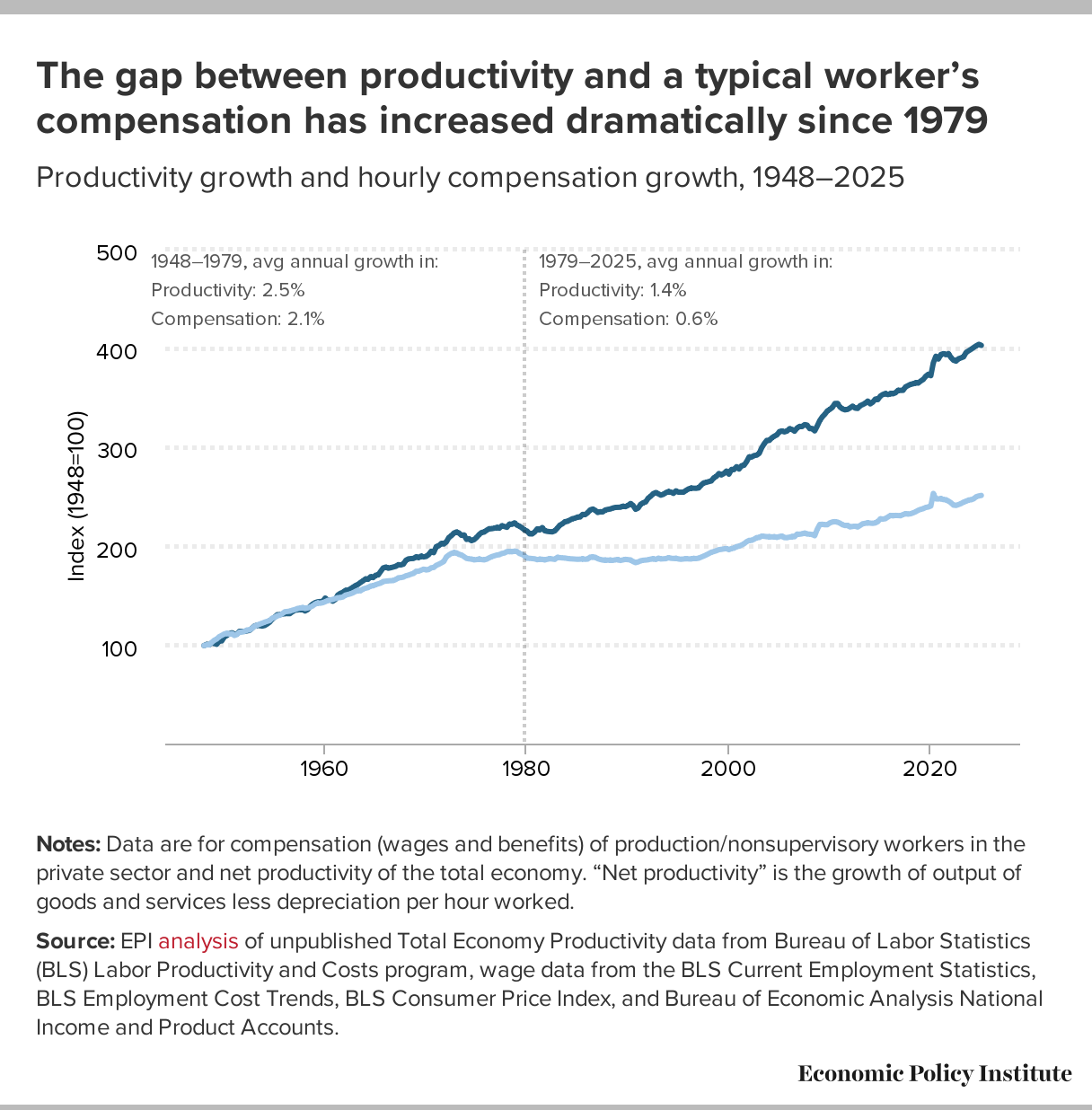
I rarely ask you to look at charts. Today is an exception. This one is from the Economic Policy Institute. It compares the typical American’s pay starting just after World War II (light blue line) with the nation’s increasing productivity since then (dark blue).

The chart shows the widening divergence between the rise of pay and the yields from productivity.

In the first three decades after World War II, the typical American’s pay rose in tandem with the nation’s growing productivity. The benefits from higher productivity were broadly shared.

But then, starting in the late 1970s and dramatically after 1980, pay barely grew, even as productivity continued to soar. The benefits from higher productivity went increasingly to the top.

Why?