
Friday, March 21


Who Has Time for Hobbies?

One of the bigger lessons I got from reading Cal Newport’s recent book, Digital Minimalism, was the importance of scheduling your leisure time.
Scheduling time for hobbies may sound unnecessary. Aren’t those the things you do for fun?
Yet, I would wager that most of us have activities we’d like to do on the side but never seem to have time for:
- Learning a language
- Art
- Sports and activities
- Reading for fun
- Creating something
A common way to look at this state of affairs is to argue that we don’t have time for these things because we’re too busy. We want to relax at the end of a hard day, with whatever meager hours are left over.
This idea assumes we mostly use our time wisely, and if there isn’t time for something at the end of the day, it must be because there wasn’t time for it to begin with.
Where Does Your Free Time Really Go?
The view put forth by Newport in his book is that we tend to invest a lot of our time on various, low-value leisure activities that neither give us meaning or much enjoyment. Think television, Netflix, video games, social media and web surfing.
These activities often don’t provide much value, but they have really low barriers to get started. That combined with carefully engineered reward mechanisms keep them occupying our attention for many hours in the day.
The view put forth by Newport in his book is that we tend to invest a lot of our time on various, low-value leisure activities that neither give us meaning or much enjoyment. Think television, Netflix, video games, social media and web surfing.
These activities often don’t provide much value, but they have really low barriers to get started. That combined with carefully engineered reward mechanisms keep them occupying our attention for many hours in the day.
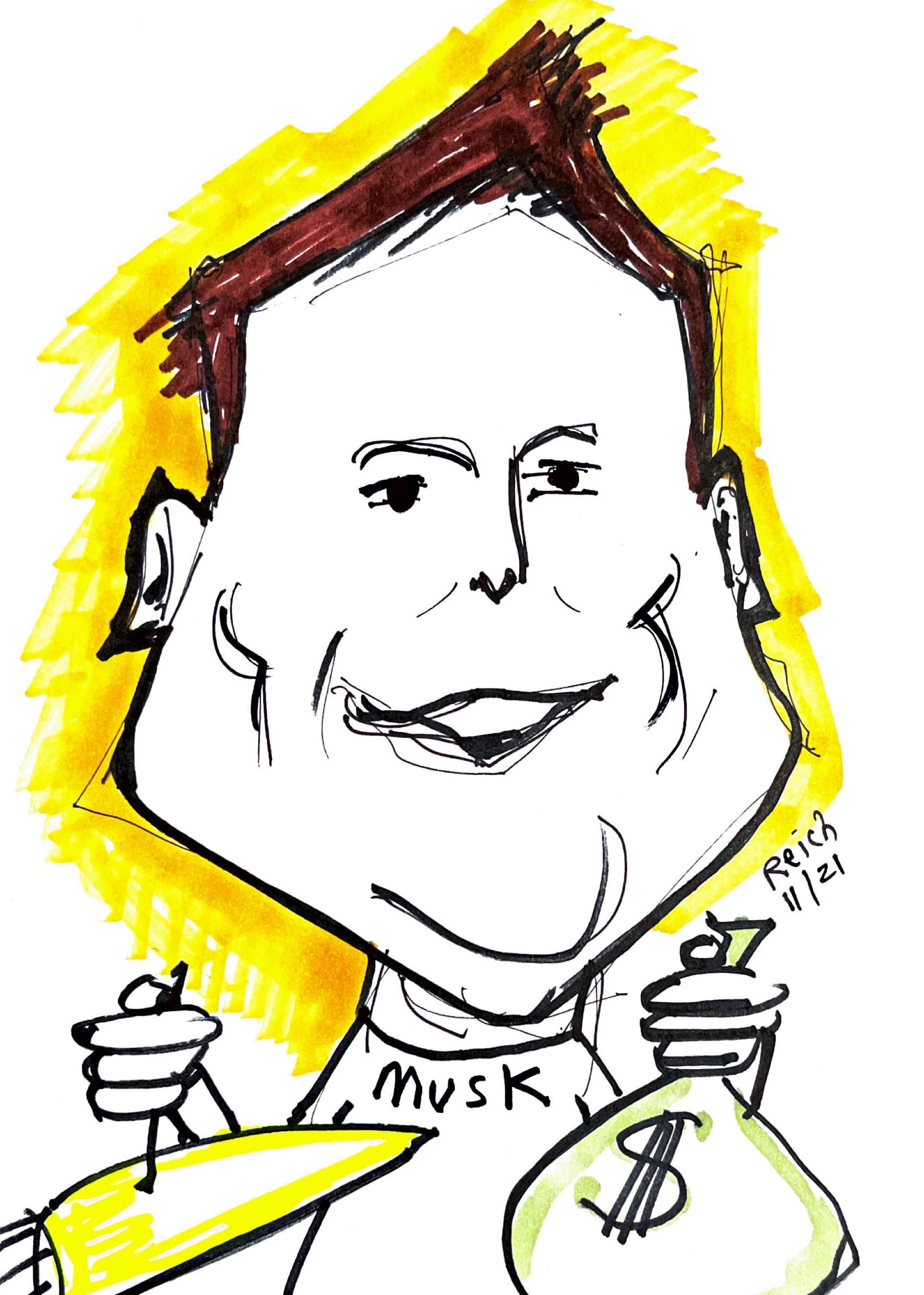
Robert Reich - Is the Muskrat working for China? (Is Trump working for Putin?)
Friends,
There are two huge national security questions at the heart of the Trump regime.
The first is whether Elon Musk is working, at least in part, for China’s Xi Jinping. Consider:
(1) China is the location of Musk’s largest Tesla factory in the world in which China invested $2.8 billion. The state-of-the-art facility was built in Shanghai with special permission from the Chinese government, and now accounts for more than half of Tesla’s global deliveries.
(2) China is the world’s biggest market for Teslas and is the only electronic vehicle market where Tesla sales are continuing to grow.
(3) Chinese investors have been funneling money into Musk’s other businesses.
(4) China is a hotbed of other technologies that Musk would like to get his hands on.
(5) In 2022, Musk told The Financial Times that China should be given some control over Taiwan by making a “special administrative zone for Taiwan that is reasonably palatable.”
(6) In 2023, at a tech conference, he called Taiwan “an integral part of China that is arbitrarily not part of China,” and compared the Taiwan-China situation to Hawaii and the United States.
(7) On X, the social platform he owns, Musk has long used his account to praise China, encouraging more people to visit the country.
(8) One of the Pentagon’s biggest worries is that China has developed a suite of weapons capable of attacking U.S. military and non-military satellites.
At A Glance

Octopus hitches ride on a shark's back. (w/video)
How head hair is different from body hair.
What causes powerful winds that fuel extreme weather?
Charting the decline of US drug-overdose deaths.
Finland tops world's happiest countries (again).
A bizarre minivan concept from 1992.
Ancient Roman and Greek statues once smelled nice.
Whiff of penguin poo strikes fear in krill.
Clickbait: The French guide to surviving major world crises.


In The NEWS

Sports, Entertainment, & Culture
> March Madness kicks off in earnest today with the first round of the men's tournament; see complete tourney preview (More) | ... and the women's "First Four" matchups wrap up tonight (More)
> Trump administration suspends $175M in federal funding for the University of Pennsylvania over the participation of a transgender athlete on Penn's swim team (More) | Columbia University faces deadline today to make a wide range of policy changes or lose $400M in federal funding (More)
> Global music streaming revenue topped $20B in 2024, a 7% increase over 2023; Taylor Swift was biggest-selling global artist for third straight year (More)
Science & Technology
> Federal appeals court rules copyright can only be granted to artworks originally created by humans; case centered on a dispute over AI-generated, "Star Trek"-themed poetry (More)
> Humans and parrots share common brain circuitry for complex vocalizations, new study finds; species known as budgerigars are the only animals known to share the trait (More)
> Genetic study suggests modern humans descended from two separate populations that split around 1.5 million years ago, but intermixed again roughly 300,000 years ago (More)
Business & Markets
> European regulators announce antitrust charges against Google, warn Apple of violations under the Digital Markets Act (More)
> Yum Brands partners with chipmaker Nvidia to accelerate its use of AI in operations; parent company is owner of Taco Bell, Pizza Hut, and KFC, among others (More)
> Nissan to cut 20% of top managerial positions; timing coincides with arrival of new CEO Ivan Espinosa (More)
Politics & World Affairs
> US Institute of Peace sues to block efforts by Department of Government Efficiency; DOGE staff required local police to enter property earlier this week, IOP officials argue the group is an independent nonprofit (More)
> President Donald Trump, Ukrainian President Volodymyr Zelenskyy hold hourlong call on plan toward ending Russia's war in Ukraine; discussion comes one day after a separate call between Trump and Russian President Vladimir Putin (More)
> Historians begin to examine new trove of roughly 63,000 pages of documents related to the assassination of former President John F. Kennedy, released by President Donald Trump Tuesday (More)
SOURCE: 1440 NEWS
Novel Writing

I have ten pages more to write to complete my twelfth novel, leaving four unfinished to completed. Two of the six start but not finished novels were 70% so it did not take me long to finish. However, the other four are only 20% finished or less, so I am planning on a couple of months for each one.
With persistence, I should have the remaining four completed by the end of 2025 or the end of my tenth year of retirement. So, it took me ten years to write 16 novels.
Bear in mind that each novel is over 100,000 words in length or about 200, 8X10 pages. The general rule of thumb is to divide by 20 and multiply that answer by 30... however, what it really depends upon is the type and font size and the margins that are being used.
With 11 novels written all of which are over 100,000 words, for those 11 novels, I have written over a million and a half words. For me that is quite a lot of words.
I use Grammarly to check my spelling and sentence structure, although sometimes I have to override the corrections because I want to use slang expressions in my dialogues.
I also have Microsoft 365 which comes with CoPilot and this service can be used to rewrite your entire novel. However, it is only good at rewritten a page at a time. You might as well depend on adding a week to your time if you decided to use CoPilot at the end.
I have not used CoPilot yet, but if I do, it will be used from the very beginning where I write a page or two, then use CoPilot to rewrite. I usually take my time and write 3-5 pages each day.


China achieves quantum supremacy
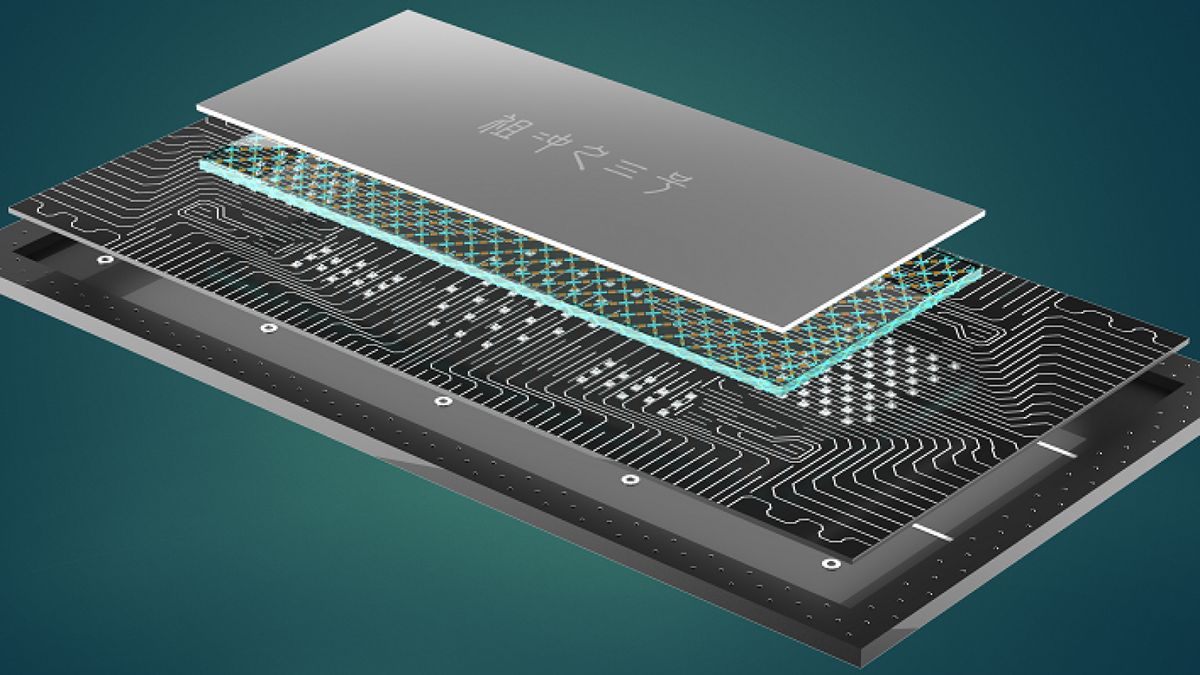
he latest iteration of Zuchongzhi includes 105 transmon qubits — devices made from metals like tantalum, niobium, and aluminum that have reduced sensitivity to noise. (Image credit: D. Gao et al.
Researchers in China have developed a quantum processing unit (QPU) that is 1 quadrillion (10¹⁵) times faster than the best supercomputers on the planet.
The new prototype 105-qubit chip, dubbed "Zuchongzhi 3.0," which uses superconducting qubits, represents a significant step forward for quantum computing, scientists at the University of Science and Technology of China (USTC) in Hefei said.
It rivals the benchmarking results set by Google's latest Willow QPU in December 2024 that allowed scientists to stake a claim for quantum supremacy — where quantum computers are more capable than the fastest supercomputers — in lab-based benchmarking.
Researchers in China have developed a quantum processing unit (QPU) that is 1 quadrillion (10¹⁵) times faster than the best supercomputers on the planet.
The new prototype 105-qubit chip, dubbed "Zuchongzhi 3.0," which uses superconducting qubits, represents a significant step forward for quantum computing, scientists at the University of Science and Technology of China (USTC) in Hefei said.
It rivals the benchmarking results set by Google's latest Willow QPU in December 2024 that allowed scientists to stake a claim for quantum supremacy — where quantum computers are more capable than the fastest supercomputers — in lab-based benchmarking.
Thursday, March 20
Age & Experience

We have two political parties here in the US of A, a liberal party and a conservative party and there are all sorts of feelings in between those two extremes.
Pure and simple, we need both parties and both parties need us.
Americans have changed over the years and that is good because on the whole they have gotten smarter and also on the whole they have learned to voice their opinions in order to strongly influence outcomes.
What Americans have not learned yet is that what goes around ALWAYS comes back around at a time you least expect it or want it.
Not only that but Americans have yet to grasp the UNINTENDED CONSEQUENCES of their actions, oftentimes creating a worse situation than before, although it took 2-3 years to get here.
What amazes me is that most of this confusion comes about as a result of YOUNG AMERICANS who lack the experience and the wisdom of that experience.
When they finally realize that EDUCATION does not make one SMART then they begin to alter the way they look at life and what they expect to get out of life.


Robert Reich -The biggest upward transfer of wealth in history
Friends,
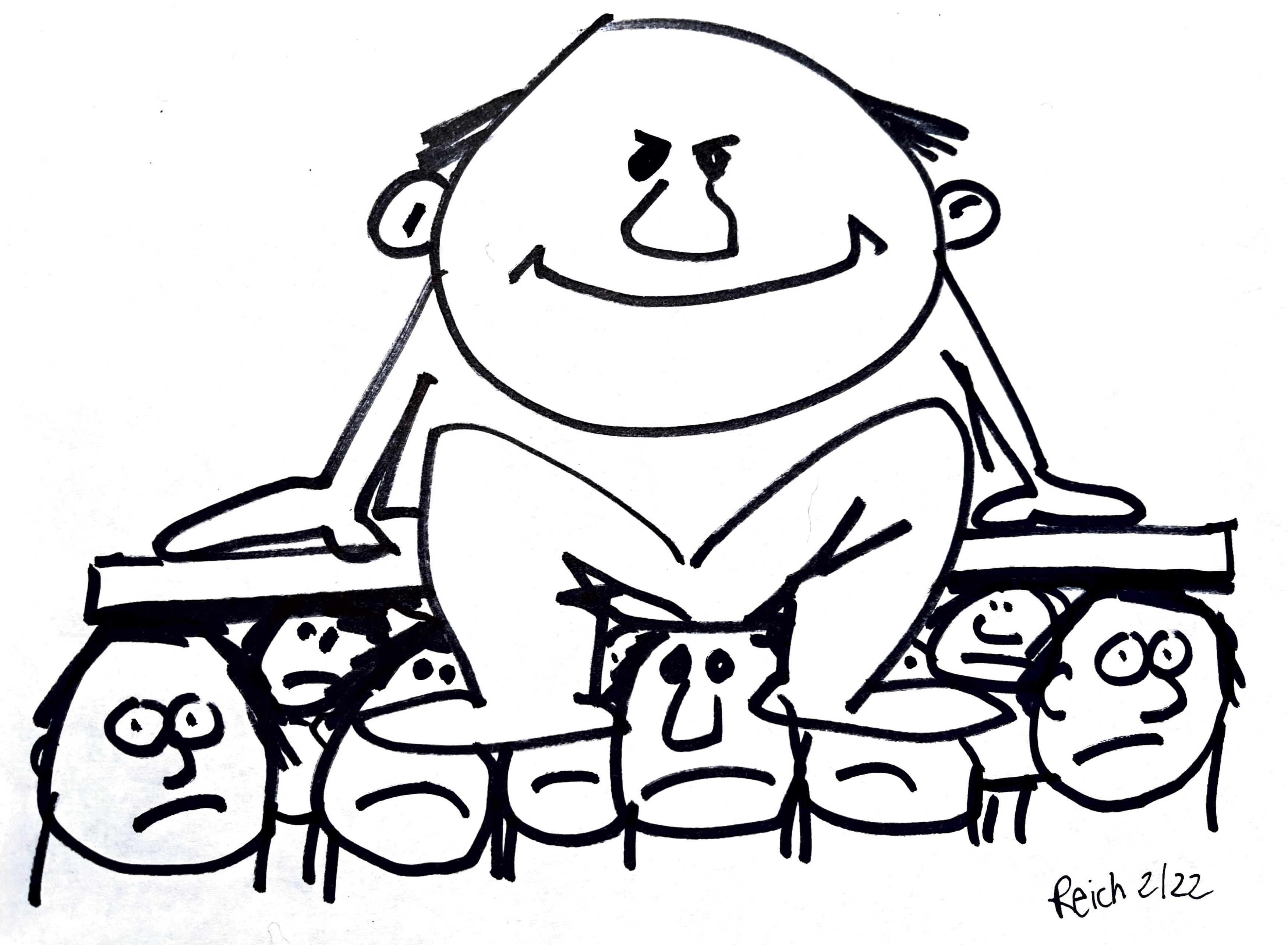
Donald Trump believes his tariffs will bring so much money to the U.S. treasury that the U.S. will be able to afford another giant Trump tax cut.
But Trump’s tariffs — and the retaliatory tariffs already being imposed on American exports by the nation’s trading partners — will be paid largely by the American working class and poor.
And the people who will benefit most from another giant Trump tax cut are America’s wealthy.
It will be a giant upward transfer of wealth.
Trump has made astronomical estimates about how much money tariffs can raise.
“We will take in trillions and trillions of dollars and create jobs like we have never seen before,” he said during his recent joint address to Congress. “Tariffs are about making America rich again and making America great again.”
Last Sunday on Air Force One, Trump was even more ebullient. “We’re going to become so rich, you’re not going to know where to spend all that money,” he said.
The Committee for a Responsible Federal Budget estimates that if Trump’s already-announced tariffs on China, Mexico, and Canada went into effect, they’d bring about $120 billion a year into the U.S. treasury, and $1.3 trillion over the course of 10 years.
Among Trump’s first actions at the outset of his second term was to order the treasury to establish an “External Revenue Service” to collect tariff revenue that would enable the U.S. to pay down its debt and reduce taxes.
Howard Lutnick, Trump’s secretary of commerce, said on Fox News in late February that the goal of the External Revenue Service “is very simple: to abolish the Internal Revenue Service and let all the outsiders pay.”
At A Glance

Does wearing a hat cause baldness?
Meet the man who stole billions in crypto. (via YouTube)
How being antisocial could hurt your health.
Go back in time with this spring break time machine.
Dolphins welcome NASA astronauts back to Earth.
The stats on why people bet on March Madness.
What happens if you shoot a gun in space.
Clickbait: New Zealand celebrates the world's ugliest animal.

Subscribe to:
Posts (Atom)