Showing posts with label Space.com. Show all posts

Friday, November 21

The solar system may be racing through space 3 times faster than expected

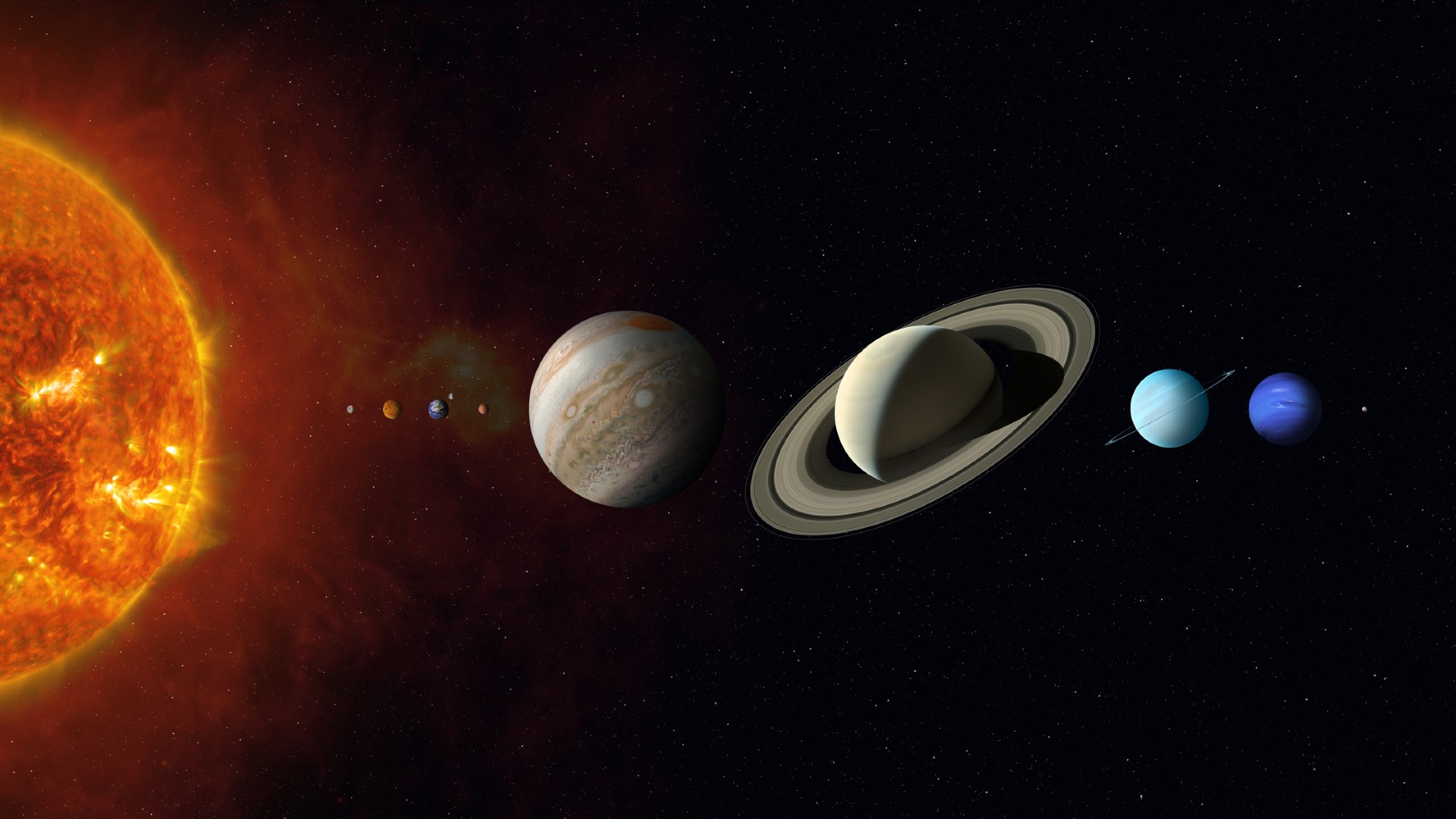
An illustration of our solar system (not to scale). (Image credit: buradaki/iStock/Getty Images Plus)


Astronomers have discovered that the solar system may be moving through the cosmos over three times faster than was previously theorized. The discovery could have implications for the standard model of cosmology, our current best model to explain the structure, composition and evolution of the universe.


The team behind this research reached its conclusions using the Low Frequency Array (LOFAR) radio telescope network and two other radio telescopes to map the distribution of radio galaxies, which they then used to measure the motion of the solar system. Radio galaxies are galaxies that emit unusually strong radio waves from "lobes" that extend well beyond their visible structure of stars.

Wednesday, November 19

Does quantum gravity exist?

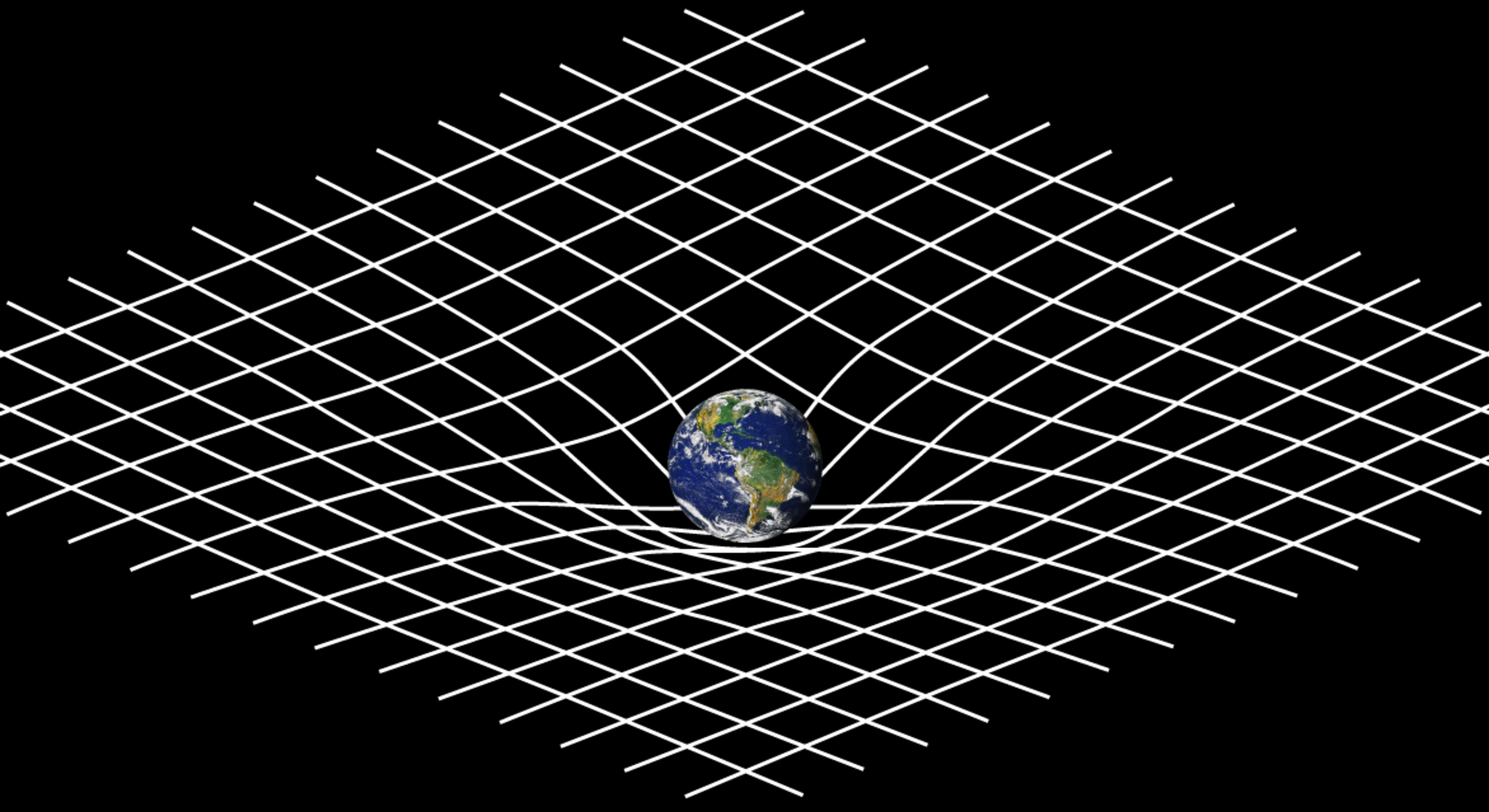
A visualization of how the earth creates a warp in spacetime, in line with general relativity theory. But where does the quantum realm fit in? (Image credit: NASA)


A new discovery suggests gravitational fields can enable matter to become quantum entangled — and that's even if the concept of quantum gravity does not exist. The idea comes from two London-based physicists who are challenging the way we think about quantum fields and how classical gravity operates.


The search for quantum gravity is the next big step in physics, as researchers seek to unify the physics of the very small with that of the very large. Quantum mechanics explains the former while general relativity theory — which famously describes how gravity works — explains the latter. Both quantum physics and the theory of general relativity were products of the first quarter of the 20th century, but 100 years later, scientists are still none the wiser as to how the two can be unified. As it stands, the theories contradict one another.


Wednesday, February 26

SpaceX Starship Flight 8 launch: Live updates


SpaceX's Starship megarocket is the world's biggest and most powerful rocket, and the giant booster that will launch the moon lander for NASA's Artemis 3 mission that aims to land astronauts on the moon by 2027.

The next Starship launch by SpaceX will be Starship Flight 8 on Friday, Feb. 28. at 6:30 p.m. EST (2330 GMT). 

It will be the second flight of a new version of the Ship and test new enhancements to the Super Heavy Booster while flying a similar profile to that of Flight 5 on Oct. 13, which saw the successful first landing and capture of the Super Heavy booster. It is also expected to include a relight of the Ship engines, test reentry gear for Ship in space and mark the first deployment of simulated Starlink satellites.  READ MORE...

Sunday, November 17

SpaceX's Dragon


Dragon successfully completed the orbital reboost of the International Space Station at approximately 12:50 p.m. ET (1750 GMT), Nov. 8. Read our full story.


SpaceX will boost the space station for the first time Friday (Nov. 8), as the company prepares to eventually kill the orbiting complex.


A Dragon cargo spacecraft docked to the International Space Station (ISS) will fire its engines for 12.5 minutes on Friday (Nov. 8), NASA officials said at a press conference Monday (Nov. 4). Other spacecraft have done this before, but it will be a first for a SpaceX capsule — and an important precursor to a bigger Dragon vehicle that will one day drive the ISS to its demise.     READ MORE...

Thursday, October 24

What the Euclid Space Telescope Sees


The Euclid Space Telescope has revealed the "first page" of the cosmic atlas it is building. The section of the map of the cosmos being built by Euclid was released on Monday (Oct. 15), and it features tens of millions of stars within the Milky Way and around 14 million distant galaxies beyond our own.


The vast cosmic mosaic was constructed from 260 Euclid observations collected between March 25 and April 8, 2024 and contains 208 gigapixels of data. The region charted is around 500 times as wide as the full moon appears in the sky over Earth.

Perhaps most astoundingly, the mosaic accounts for just 1% of the total survey Euclid will conduct over the next six years as it tracks the shapes, distances and movements of galaxies as far as 10 billion light-years away. Not only will this result in the largest 3D map of the cosmos ever created, but the vast scale of this map will help scientists investigate the mysteries of dark matter and dark energy, sometimes collectively known as the "dark universe."     READ MORE...

Sunday, September 8

Twisted Tatooine Double Star Systems


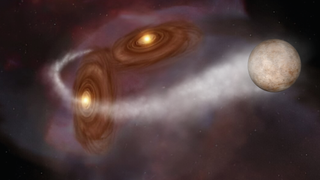
An illustration of a rogue planet being ejected from a 'tilted Tatooine' binary star system. (Image credit: ALMA (ESO/NAOJ/NRAO)/Robert Lea (created with Canva))


Star Wars fans will definitely get a kick out of binary star systems nicknamed "Tatooine" systems — a reference to the planet Luke Skywalker stands on to gaze up at twin suns in Star Wars: A New Hope. As it turns out, some of the planets in the real-life versions of these systems may have been getting a much more literal kick out of them, too.


New research suggests "rogue planets" that wander the Milky Way — aka, planets that are isolated from parent stars and live as cosmic orphans — may be getting kicked out of double, or binary, star systems. But there's a twist (literally)!


The team found that rogue planets are more likely to be ejected from "twisted Tatooine" systems specifically. These are systems in which the stars and the planets that orbit those are misaligned, thus existing at tilted angles from one another.     READ MORE...

Thursday, July 4

Pillars of Creation


In 1995, the Hubble Space Telescope released images of the Pillars of Creation — stunning effervescent clouds of interstellar dust and gas, the place where stars are born.


Now, combining data from Hubble and the James Webb Space Telescope, NASA has released a gorgeous 3D visualization of the cosmic structures in both visible and infrared light.


"By flying past and amongst the pillars, viewers experience their three-dimensional structure and see how they look different in the Hubble visible-light view versus the Webb infrared-light view," principal visualization scientist Frank Summers said in a statement.


"The contrast helps them understand why we have more than one space telescope to observe different aspects of the same object," he continue


The Pillars of Creation, which lie about 5,700 light-years from Earth, are composed of cool molecular hydrogen and dust. Due to strong winds and radiation from young nearby hot stars, the pillars are starting to get stripped of their contents. Long, finger-like structures can be seen emerging from the top of the pillars, which are larger than our own solar system.


Inside these structures, hydrogen and dust is gravitationally collapsing into new, infant stars. These new stars will add to the continued dispersion of materials within the pillars. The tallest of the pillars spans 3 light-years from top to bottom — three-quarters of the distance between the sun and our closest star.         READ MORE...

Sunday, June 23

Center of the Universe


The universe is undeniably vast, and from our perspective, it may seem like Earth is in the middle of everything. But is there a center of the cosmos, and if so, where is it? If the Big Bang started the universe, then where did it all come from, and where is it going?


To start tackling these questions, let's go back about 100 years. In the 1920s, astronomer Edwin Hubble made two amazing back-to-back discoveries: Early in the decade, he found that "island universes," now known as galaxies, sit very far away from us; later that decade, he discovered that, on average, all galaxies are receding away from us.     READ MORE...

Saturday, May 11

A Glitch in Einstein's Theory


This James Webb Space Telescope deep-field image shows some of the earliest and most distant galaxies ever seen. (Image credit: NASA, ESA, CSA and STScI)


There is no denying the awesome predictive power of Albert Einstein's 1915 theory of gravity, general relativity — yet, the theory still has inconsistencies when it comes to calculating its effect on vast distances. And new research suggests these inconsistencies could be the result of a "cosmic glitch" in gravity itself.


In the 109 years since it was first formulated, general relativity has remained our finest description of gravity on a galactic scale; time and again, experiments have confirmed its accuracy. This theory has also been used to predict aspects of the universe that would later be observationally confirmed. This includes the Big Bang, the existence of black holes, the gravitational lensing of light and tiny ripples in spacetime called gravitational waves.


Yet, like the Newtonian theory of gravity that it surpassed, general relativity may not offer us the full picture of this enigmatic force.  READ MORE...

Sunday, May 5

The Cat's Paw Nebula


An illustration of 2-Methoxyethanol found in space for the first time using radio telescope observations of the star-forming region NGC 6334I. (Image credit: Fried, et al)


Scientists have discovered a hitherto unknown space molecule while investigating a relatively nearby region of intense star birth, a cosmic spot about 5,550 light-years away. It's part of the Cat's Paw Nebula, also known as NGC 6334.


The team, led by Zachary Fried, a graduate student at the Massachusetts Institute of Technology (MIT), examined a section of the nebula known as NGC 6334I with the Atacama Large Millimeter/submillimeter Array (ALMA). This revealed the presence of a complex molecule known as 2-methoxyethanol, which had never been seen before in the natural world, though its properties had been simulated in labs on Earth.     READ MORE...

Wednesday, April 24

Superfast Drone


The drone, which resembled a rocket, flew 10 miles (16 km) at Mach 0.9 — over 680 miles per hour — using 80% of the engine's available thrust. This image is purely illustrative. (Image credit: Alexyz3d/Getty Images)


Venus Aerospace has completed the inaugural test flight of a drone fitted with its "rotating detonation rocket engine" (RDRE) — accelerating it to just under the speed of sound. The company wants to one day build superfast commercial jets using this new type of engine.


In the test flight, conducted Feb. 24, the company flew the drone, which is 8 feet (2.4 meters) long and weighs 300 pounds (136 kilograms) to an altitude of 12,000 ft (3658 m) by an Aero L-29 Delfín plane, before it was deployed and the RDRE was activated, company representatives said in a statement.


The drone flew 10 miles (16 km) at Mach 0.9 — over 680 miles per hour — using 80% of the RDRE’s available thrust. The successful flight proved the viability of RDRE and the associated onboard flight systems. Three weeks earlier, Venus Aerospace demonstrated the viability of its RDRE technology with a long-duration test burn — during which engineers showed their engine worked for the duration of this test flight.  READ MORE...

Sunday, March 3

Humanoid Robot Crew Operates India's Spacecraft


ISRO's Launch Vehicle Mark-3 (LVM3) will ferry a humanoid robot to space on a test flight later this year and carry three astronauts next year. (Image credit: ISRO)


India is steadily inching toward the first uncrewed flight in its human spaceflight program, Gaganyaan (Sanskrit for "celestial vehicle"). Early last week, the nation's space agency successfully completed the final test to qualify the test flight's rocket engine, approving it to be capable of safely ferrying astronauts to space.


This engine test was the seventh of its kind in which flight conditions were simulated to assess the device's endurance and performance under normal, and abnormal, conditions including varying thrust and propellant tank pressure, officials said in a statement on Wednesday (Feb. 21). These tests are being carried out at the ISRO Propulsion Complex (IPRC) in the southern state of Tamil Nadu.


Since 2014, seven years after the Gaganyaan program was first initiated, ISRO has has been perfecting its homegrown flight hardware including engines, solid rocket boosters, crew escape systems and parachutes ahead of the uncrewed Gaganyaan-1 (G1) mission, tentatively scheduled for the third quarter of this year.  READ MORE...

Thursday, January 18

A Dark Primordial Galaxy


Hydrogen gas in the primordial galaxy J0613+52 with red indicating regions turning away from Earth and blue showing regions turning toward us (Image credit: STScI POSS-II with additional illustration by NSF/GBO/P.Vosteen.)


Astronomers have accidentally discovered a dark galaxy filled with primordial gas untouched that appears to have no visible stars.


The researchers behind the discovery say this galaxy, designated J0613+52, could be "the faintest galaxy found to date." Interestingly, scientists using the Green Bank Telescope (GBT) discovered the "dark" galaxy through a complete error.

"The GBT was accidentally pointed to the wrong coordinates and found this object. It's a galaxy made only out of gas — it has no visible stars," Green Bank Observatory senior scientist Karen O'Neil said in a statement. "Stars could be there. We just can't see them."  READ MORE..

Thursday, November 30

Dark Matter Hiding in Collider's Particle Jets


A new search for dark matter has turned up empty handed — but, in a silver lining, the effort provided important limits that will help future experiments narrow down the hunt for this elusive substance.

Most astronomers believe that dark matter accounts for 85 percent of all mass in the universe, and that its existence would explain the apparent extra gravity detectable around galaxies and within huge galaxy clusters. However, so far, no one has been able to identify what dark matter is made of.    READ MORE...

Tuesday, November 14

SpaceX to Launch 2nd Starship

SpaceX's next Starship test launch could lift off as early as Nov. 17, pending regulatory approval from the Federal Aviation Administration and other agencies.

The potential launch from SpaceX's Starbase test site at Boca Chica Beach near Brownsville, Texas will mark the company's second test flight of an orbital class Starship and Super Heavy booster — the largest and most powerful rocket ever built. SpaceX launched its first Starship test flight in April, but it exploded shortly after liftoff.

"Starship preparing to launch as early as November 17, pending final regulatory approval," SpaceX wrote on X, formerly known as Twitter, late Friday (Nov. 10).  READ MORE...

Monday, October 30

Software Updates Millions of Miles Away

About 46 years after NASA's Voyager 1 and Voyager 2 launched on an epic journey to explore space, the probes’ antique hardware continues to receive tweaks from afar.

One update, a software fix, ought to tend to the corrupted data that Voyager 1 began transmitting last year, and another set aims to prevent gunk from building up in both spacecraft's thrusters. Together, these updates intend to keep the spacecraft in contact with Earth for as long as possible.

"This far into the mission, the engineering team is being faced with a lot of challenges for which we just don’t have a playbook," Linda Spilker, project scientist for the mission at NASA's Jet Propulsion Laboratory, said in a statement. "But they continue to come up with creative solutions."  READ MORE...

Saturday, October 7

Space Force to Guard the Moon


Artist's illustration of NASA astronauts near the moon's south pole, a region thought to be rich in water ice, a key resource that could help humanity extend its footprint out into the solar system. (Image credit: NASA)


It's been reported that United States Space Force Commander Gen. Chance Saltzman surveyed the Force's members to develop a mission statement for America's newest military branch. Aside from the novelty of crowdsourcing soldiers as to their interpretation of their mission (which I like but could draw criticism from more constitutionalist folks), the result seems to be on target: "Secure our nation's interests in, from and to space."


However — and with all due respect to the general from this son of a sergeant — I believe his interpretation of at least a part of this statement may be incorrect and informed by a bias that is all too common in the sometimes overly conservative and hallowed halls of the Pentagon.

First, having a simple and concise statement is essential. Shorter is better. Having that statement be co-generated by those forming the first cadres of the Force is an excellent idea to encourage buy-in and ownership.

The term "secure" is also essential. Protecting U.S. national interests is the chief priority of all our military branches, from under the sea to above the sky and all places in between.


He interprets securing that national interest "from space" as the defense of systems and technologies such as communications, navigation and missile warning. In other words, protecting those elements of the defense infrastructure vital to what the military refers to as the "Joint Force" (i.e., all the branches that might be part of a combined military action or activity on Earth).

So far, this is all great stuff. However, what the good general is missing in his reading and interpretation, and perhaps, in what his soldiers are saying (although I bet not, given their probable age demographic), is anything referring to the outward-facing phase of developing space activities without reference to direct support of our on-the-planet military posture and capabilities. In other words, the Space Force's role in securing our national interests beyond low Earth orbit (LEO).   READ MORE...

Thursday, July 20

Carrying Astronauts to the Moon

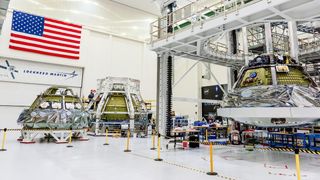
    From left to right: The Orion spacecraft for the Artemis 2, Artemis 3 and Artemis 4 moon missions at NASA's Kennedy Space Center in Florida. (Image credit: NASA/Marie Reed)


Three crew-carrying spacecraft are getting ready for their big moon missions.

The Orion capsules for the Artemis 2, Artemis 3 and Artemis 4 moon missions are coming together at NASA's Kennedy Space Center in Florida under stewardship of contractor Lockheed Martin.

"The future of @NASA_Orion is looking pretty good," Lockheed officials wrote on Twitter Friday (July 14) of the three spacecraft, each of which is expected to ferry astronauts to the moon starting in late 2024 or so.

Artemis 2 will send Orion the moon in November 2024 with an already-named crew of four astronauts, while we are still awaiting word of who will fly the Artemis 3 and 4 missions for later in the decade.

Artemis 2 includes NASA astronauts Reid Wiseman, Victor Glover and Christina Koch, along with Canadian Space Agency astronaut Jeremy Hansen. Artemis 3 and 4 will both include astronauts from NASA and the European Space Agency.

Artemis 3 is currently scheduled to launch in 2025 or 2026, pending readiness of the SpaceX Starship system that will ferry some of the crew to the surface. Artemis 4 would then follow later in the 2020s, if current schedules hold.

Lockheed Martin is under contract to deliver Orion spacecraft for future Artemis moon missions across several delivery orders. In recent years, the orders for Artemis 3 through 5 had values of $2.7 billion, while Artemis 6 through 9's order is worth $1.9 billion. Lockheed officials previously stressed that building the spacecraft in groups allows them the company realize cost savings via production efficiencies.  READ MORE...

Friday, July 7

Space-Time Distortions


Observing time distortions could show whether Einstein's theory of general relativity accounts for the mysteries of dark matter and dark energy.

Scientists could soon test Einstein's theory of general relativity by measuring the distortion of time.


According to new research published June 22 in the journal Nature Astronomy, the newly proposed method turns the edge of space and time into a vast cosmic lab to investigate if general relativity can account for dark matter  -  a mysterious, invisible form of matter that can only be inferred by its gravitational influence on the universe's visible matter and energy -  as well as the accelerating expansion of the universe due to dark energy. The method is ready to be tested on future surveys of the deep universe, according to the study authors.

General relativity states that gravity is the result of mass warping the fabric of space and time, which Einstein lumped into a four-dimensional entity called space-time. According to relativity, time passes more slowly close to a massive object than it does in a mass-less vacuum. This change in the passing of time is called time distortion.

Since its introduction in 1915, general relativity has been tested extensively and has become our best description of gravity on tremendous scales. But scientists aren't yet sure if it can explain invisible dark matter and dark energy, which together account for around 95% of the energy and matter in the universe.  READ MORE...

Friday, June 23

Earth's Water Came From Space


Earth may have formed much more rapidly than previously believed after born as tiny millimeter-sized pebbles that accumulated over a period of just a few million years.

The new theory also implies that rather than water being delivered to Earth by icy comets, this vital ingredient for life is present on our planet due to our young planet thirstily sucking up water from its space environment. 

The theory could have important implications for the search for life outside the solar system, indicating that watery and habitable planets around other stars may be more common than currently theorized.

The new theory put forward by the team suggests that around 4.5 billion years ago when the sun was an infant star surrounded by a disk of gas and dust, known as a proto-planetary disk, tiny particles of dust would be quickly sucked up by forming planets once they reached a certain size. 

In the case of the infant Earth, this "vacuuming up" of disk material ensured our planet was supplied with water.  READ MORE...