Showing posts with label Galaxies. Show all posts

Friday, November 21

The solar system may be racing through space 3 times faster than expected

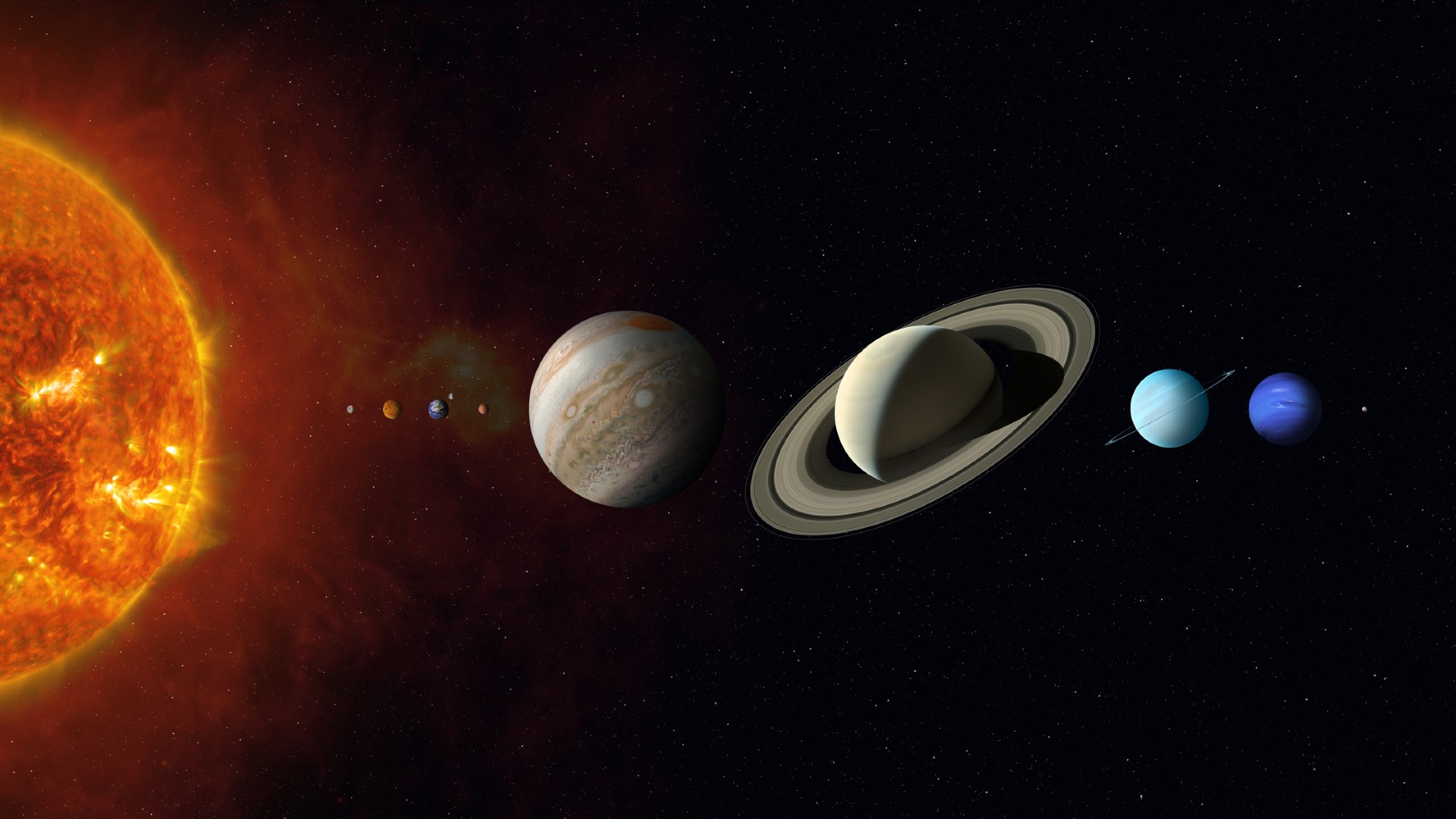
An illustration of our solar system (not to scale). (Image credit: buradaki/iStock/Getty Images Plus)


Astronomers have discovered that the solar system may be moving through the cosmos over three times faster than was previously theorized. The discovery could have implications for the standard model of cosmology, our current best model to explain the structure, composition and evolution of the universe.


The team behind this research reached its conclusions using the Low Frequency Array (LOFAR) radio telescope network and two other radio telescopes to map the distribution of radio galaxies, which they then used to measure the motion of the solar system. Radio galaxies are galaxies that emit unusually strong radio waves from "lobes" that extend well beyond their visible structure of stars.


Wednesday, October 29

James Webb telescope finds that galaxies in the early universe were much more chaotic than we thought


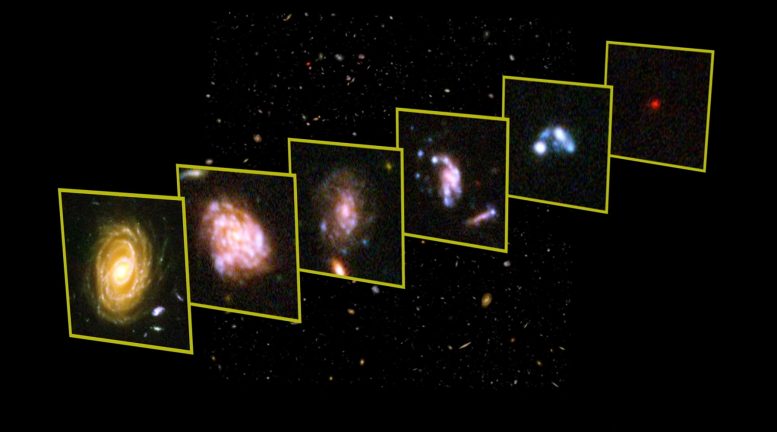
When the James Webb Space Telescope examined young galaxies with its Near Infrared Camera (NIRCam), it uncovered the messy early stages 
of formation in these distant objects. (Image credit: NASA, ESA, CSA, STScI, B. Robertson (UC Santa Cruz), B. Johnson (CfA), S. Tacchella 
(Cambridge), P. Cargile (CfA))


Like cosmic toddlers, galaxies in the young universe were messy and had difficulty settling down, a new study shows.

Using the powerful James Webb Space Telescope (JWST), scientists peered at more than 250 galaxies in the early universe. The research team charted the movement of gas long ago, when the universe was growing up — between 800 million and 1.5 billion years after the Big Bang. (The cosmos is roughly 13.8 billion years old.)

Their findings, published Tuesday (Oct. 21) in the journal Monthly Notices of the Royal Astronomical Society, show that galaxies were restless in their youth.     


Monday, September 1

NASA’s Webb Telescope Discovers 300 Mysterious Objects That Shouldn’t Exist


In a recent study, researchers from the University of Missouri examined distant regions of the universe and made a surprising discovery. By analyzing infrared images captured by NASA’s James Webb Space Telescope (JWST), they detected 300 objects shining more brightly than expected.

“These mysterious objects are candidate galaxies in the early universe, meaning they could be very early galaxies,” said Haojing Yan, an astronomy professor in Mizzou’s College of Arts and Science and co-author on the study. 

“If even a few of these objects turn out to be what we think they are, our discovery could challenge current ideas about how galaxies formed in the early universe — the period when the first stars and galaxies began to take shape.”


Sunday, July 6

JWST discovers how we’re able to see the Universe at all


One of JWST’s main science goals was to teach us how the Universe grew up to be the way it is today, and one important cosmic mystery to solve was how the Universe came to be transparent to starlight. 

Previous studies had shown that the most prominent early JWST galaxies, the big, bright, massive ones, were too rare and too few in number to create enough ultraviolet photons to be responsible.

But a new study, highlighting many gravitationally lensed early, low-mass, but rapidly star-forming galaxies, measured their abundance exquisitely. We’ve found, at last, the main culprit behind cosmic reionization.


Thursday, July 3

New research finds the universe is twice as old as we previously thought


New observations from the James Webb Space Telescope (JWST) suggest the cosmos may be much older than once believed. For decades, scientists have held that the universe is about 13.8 billion years old. That number now faces serious doubt, thanks to the telescope’s groundbreaking data.

The JWST wasn’t just designed for clearer images—it was built to peer deeper into time than ever before. Its precision and range allow it to detect light from the earliest galaxies, opening a window into the universe’s youth. And what it's seeing doesn’t match the script cosmologists have followed for years.

Some of the most puzzling finds have been dubbed “impossible early galaxies.” These ancient structures appear to have formed just 500 to 800 million years after the Big Bang. But that’s where the problem lies: they look far too developed for their supposed age.


Saturday, February 1

AI Models Big Bang


Researchers from the Flatiron Institute and collaborators have developed an innovative method that uses artificial intelligence (AI) to estimate the universe's cosmological parameters with unprecedented precision. This breakthrough could reshape how scientists study the cosmos.


The method, called Simulation-Based Inference of Galaxies (SimBIG), extracts hidden insights from galaxy distributions, offering a significant improvement over traditional techniques.


By leveraging AI, the team reduced uncertainty in key parameters, such as the universe’s matter clumpiness, to less than half that of conventional methods. This enhanced accuracy aligns closely with other observations, including measurements of the universe’s oldest light, further validating the approach.


Published in Nature Astronomy, the findings promise to advance our understanding of the universe's fundamental properties.     READ MORE...

Thursday, October 24

What the Euclid Space Telescope Sees


The Euclid Space Telescope has revealed the "first page" of the cosmic atlas it is building. The section of the map of the cosmos being built by Euclid was released on Monday (Oct. 15), and it features tens of millions of stars within the Milky Way and around 14 million distant galaxies beyond our own.


The vast cosmic mosaic was constructed from 260 Euclid observations collected between March 25 and April 8, 2024 and contains 208 gigapixels of data. The region charted is around 500 times as wide as the full moon appears in the sky over Earth.

Perhaps most astoundingly, the mosaic accounts for just 1% of the total survey Euclid will conduct over the next six years as it tracks the shapes, distances and movements of galaxies as far as 10 billion light-years away. Not only will this result in the largest 3D map of the cosmos ever created, but the vast scale of this map will help scientists investigate the mysteries of dark matter and dark energy, sometimes collectively known as the "dark universe."     READ MORE...

Saturday, September 28

Dark Matter Does Not Exist


For centuries, scientists have grappled with the fundamental forces that govern our universe, chief among them being gravity, and more recently, dark matter.

Gravity is the invisible force that attracts objects with mass towards each other, playing a crucial role in shaping the cosmos, from the formation of galaxies to the orbits of planets.

However, as our understanding of the universe has expanded, so too have the mysteries surrounding it.

Dark matter dilemma
One of the most perplexing of these mysteries is the concept of dark matter, a hypothetical form of matter that is believed to make up a significant portion of the universe’s total mass.

Unlike ordinary matter, which we can see and interact with directly, dark matter does not emit, absorb, or reflect light, making it invisible to telescopes and other detecting instruments.  READ MORE...

Tuesday, September 17

Galaxy with Impossible Light Signature


This region of space, viewed first iconically by Hubble and later by JWST, shows an animation that switches between the two. Both images still have fundamental limitations, as they were acquired from within our inner Solar System, where the presence of zodiacal light influences the noise floor of our instruments and cannot easily be removed. The extra presence of point-like red objects in JWST images, also known as “little red dots,” has finally been explained, but other puzzles still remain.


Since its launch in December of 2021, the James Webb Space Telescope (JWST) has spotted record-setting objects all across the Universe, including at the greatest distances ever seen.

Many distant galaxies are energetic and show signatures of emission lines from specific atoms and molecules, particularly hydrogen. However, the Lyman-α line has never been seen earlier than 550 million years after the Big Bang.

Until now. With the discovery and spectroscopic follow-up on galaxy JADES-GS-z13-1-LA, we now have strong evidence for that emission line from a galaxy just 326 million years after the Big Bang. The question is: how?              READ MORE...


Tuesday, January 9

A Vast Galactic Neighborhood


This image from the NASA/ESA Hubble Space Telescope features a richness of spiral galaxies: the large, prominent spiral galaxy on the right side of the image is NGC 1356; the two apparently smaller spiral galaxies flanking it are LEDA 467699 (above it) and LEDA 95415 (very close at its left) respectively; and finally, IC 1947 sits along the left side of the image.


This image is a really interesting example of how challenging it can be to tell whether two galaxies are actually close together, or just seem to be from our perspective here on Earth. A quick glance at this image would likely lead you to think that NGC 1356, LEDA 467699, and LEDA 95415 were all close companions, while IC 1947 was more remote. 

However, we have to remember that two-dimensional images such as this one only give an indication of angular separation: that is, how objects are spread across the sphere of the night sky. What they cannot represent is the distance objects are from Earth.     READ MORE...

Monday, August 21

Defining Our Physical Universe


On the smallest of physical scales, we have the fundamental, elementary particles, which build up to assemble nuclei, atoms, molecules, and even larger structures. 

On larger scales, we have planets, stars, stellar systems, galaxies, clusters of galaxies, and vast voids between them, all contributing to the enormous cosmic web.

Overall, there are many different scales to view the Universe on. Here's the grand cosmic tour, from the extremely tiny to the unfathomably large.


Our Universe spans from subatomic to cosmic scales.
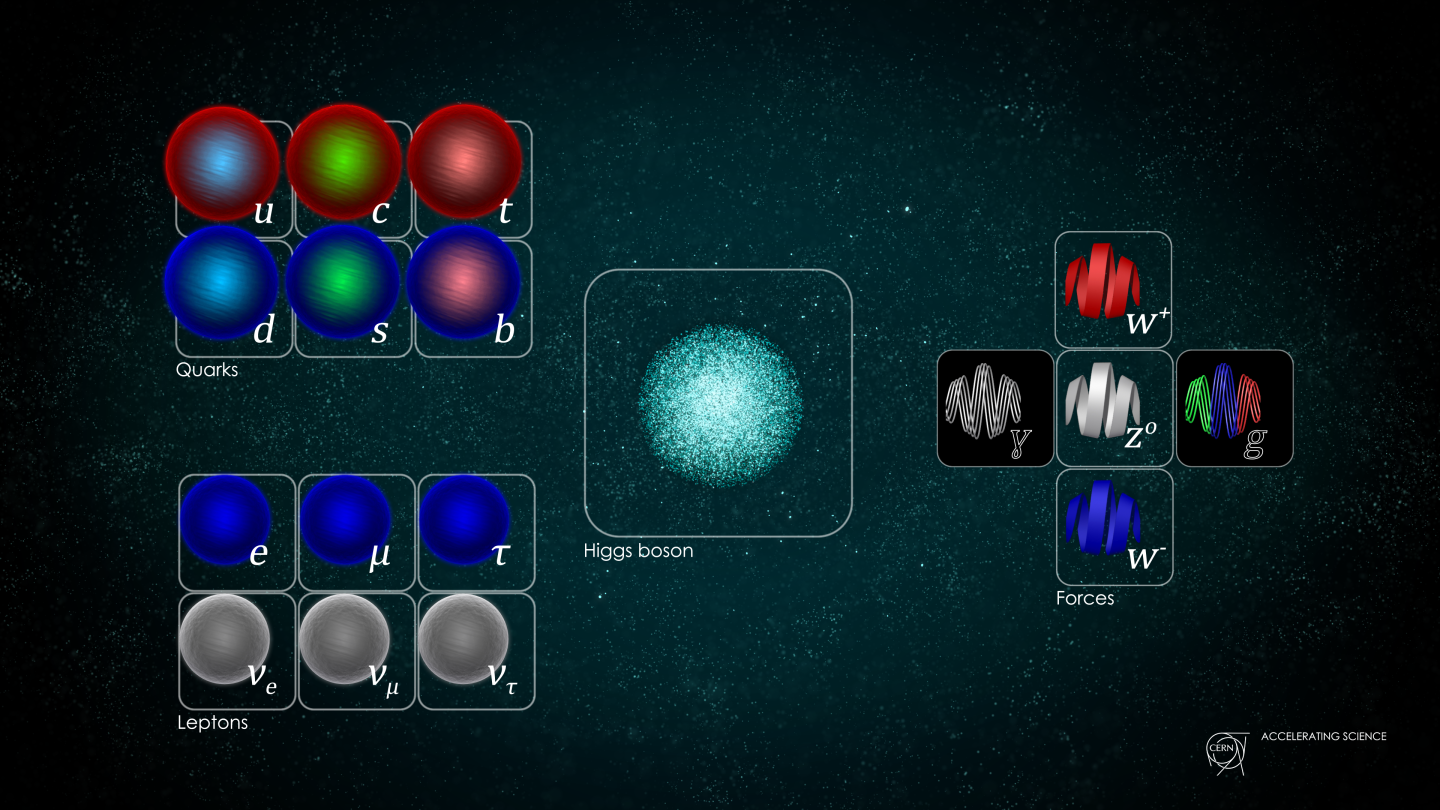
The journey from macroscopic scales down to subatomic ones spans many orders of magnitude, but going down in small steps can make each new one more accessible from the previous one. Humans are made of organs, cells, organelles, molecules, atoms, then electrons and nuclei, then protons and neutrons, and then quarks and gluons inside of them. This is the limit to how far we’ve ever probed nature.Credit: Magdalena Kowalska/CERN/ISOLDE team

All told, 13 different scales are presently known.
On the right, the gauge bosons, which mediate the three fundamental quantum forces of our Universe, are illustrated. There is only one photon to mediate the electromagnetic force, there are three bosons mediating the weak force, and eight mediating the strong force. This suggests that the Standard Model is a combination of three groups: U(1), SU(2), and SU(3), whose interactions and particles combine to make up everything known in existence. With gravity thrown into the mix, there are a total of 26 fundamental constants required to explain our Universe, with four big questions still awaiting explanation.Credit: Daniel Domingues/CERN

1.) Fundamental, elementary particles. Down to 10-19 meters, these quanta have never been divided.
When two protons, each one made of three quarks held together by gluons, overlap, it’s possible that they can fuse together into a composite state dependent on their properties. The most common, stable possibility is to produce a deuteron, made of a proton and a neutron, which requires the emission of a neutrino, a positron, and possibly a photon as well.Credit: Keiko Murano

2.) Nuclear scales. On femtometer (~10-15 m) scales, individual nucleons, composed of quarks and gluons, bind together.
Although you yourself are made of atoms, what you experience as “touch” doesn’t necessarily require another, external atom to come in actual overlapping contact with the atoms in your body. Simply getting close enough to exert a force is not only enough, it’s what most commonly occurs.        READ MORE...

Thursday, January 26

Multiverse Theory


Multiverse theory suggests that our universe, with all its hundreds of billions of galaxies and almost countless stars, spanning tens of billions of light-years, may not be the only one. Instead, there may be an entirely different universe, distantly separated from ours — and another, and another. 

Indeed, there may be an infinity of universes, all with their own laws of physics, their own collections of stars and galaxies (if stars and galaxies can exist in those universes), and maybe even their own intelligent civilizations.

It could be that our universe is just one member of a much grander, much larger multitude of universes: a multiverse.  The concept of the multiverse arises in a few areas of physics (and philosophy), but the most prominent example comes from something called inflation theory. 

Inflation theory describes a hypothetical event that occurred when our universe was very young — less than a second old. In an incredibly brief amount of time, the universe underwent a period of rapid expansion, "inflating" to become many orders of magnitude larger than its previous size, according to NASA.

Inflation of our universe is thought to have ended about 14 billion years ago, said Heling Deng, a cosmologist at Arizona State University and an expert in multiverse theory. "However, inflation does not end everywhere at the same time," Deng told Live Science in an email. "It is possible that as inflation ends in some region, it continues in others."

Thus, while inflation ended in our universe, there may have been other, much more distant regions where inflation continued — and continues even today. Individual universes can "pinch off" of larger inflating, expanding universes, creating an infinite sea of eternal inflation, filled with numerous individual universes.

In this eternal inflation scenario, each universe would emerge with its own laws of physics, its own collection of particles, its own arrangement of forces and its own values of fundamental constants. This might explain why our universe has the properties it does — particularly the properties that are hard to explain with fundamental physics, such as dark matter or the cosmological constant, Deng said.

"If there is a multiverse, then we would have random cosmological constants in different universes, and it is simply a coincidence that the one we have in our universe takes the value that we observed," he said.   READ MORE...

Wednesday, November 23

Galaxies Newr the Dawn of Time

The small red dot highlighted inside the white box on this James Webb Space Telescope image is an early galaxy, seen as it looked just 350 million years after the Big Bang.       STScI/NASA


New baby pictures of the universe, taken by the James Webb Space Telescope, show that galaxies started forming faster and earlier than expected.

The telescope launched back in December and it now orbits the sun about a million miles away from Earth. Its giant mirror allows it to detect faint light that's been traveling for almost the entire history of the 13.8 billion-year-old universe. That means it can effectively see what galaxies looked like way back in time.

The snapshots captured so far have both thrilled and perplexed scientists, because it turns out that many luminous galaxies existed when the universe was very young.

"Just a few hundred million years after the Big Bang, there are already lots of galaxies," says Tommaso Treu, an astronomer at the University of California at Los Angeles. "JWST has opened up a new frontier, bringing us closer to understanding how it all began."

In research papers published in The Astrophysical Journal Letters, Treu and other astronomers report the discovery of one galaxy that dates back to just 450 million years after the beginning, and another that dates back to 350 million years.  READ MORE...

Tuesday, August 2

A Galaxy Deeper Back in Time


Data from the Webb Space Telescope has only gotten into the hands of astronomers over the last few weeks, but they've been waiting for years for this, and apparently had analyses set to go. The result has been something like a race back in time, as new discoveries find objects that formed ever closer to the Big Bang that produced our Universe. 

Last week, one of these searches turned up a galaxy that was present less than 400 million years after the Big Bang. This week, a new analysis has picked out a galaxy as it appeared only 233 million years after the Universe popped into existence.

The discovery is a happy byproduct of work that was designed to answer a more general question: How many galaxies should we expect to see at different time points after the Big Bang?

Back in time
As we mentioned last week, the early Universe was opaque to light at any wavelengths that carry more energy than is needed to ionize hydrogen. That energy is in the UV portion of the spectrum, but the red shift caused by 13 billion years of an expanding Universe has shifted that cutoff point into the infrared portion of the spectrum. 

To find galaxies from this time, we have to look for objects that aren't visible at shorter infrared wavelengths (meaning that light was once above the hydrogen cutoff), but do appear at lower-energy wavelengths.

The deeper into the infrared the boundary between invisible and visible is, the stronger the redshift, and the more distant the object is. The more distant the object, the closer in time it is to the Big Bang.  READ MORE...

Sunday, June 26

More Galaxies Than Ever Imagined


The Universe is a vast place, filled with more galaxies than we’ve ever been able to count, even in just the portion we’ve been able to observe. Some 40 years ago, Carl Sagan taught the world that there were hundreds of billions of stars in the Milky Way alone, and perhaps as many as 100 billion galaxies within the observable Universe. 

Although he never said it in his famous television series, Cosmos, the phrase “billions and billions” has become synonymous with his name, and also with the number of stars we think of as being inherent to each galaxy, as well as the number of galaxies contained within the visible Universe.

But when it comes to the number of galaxies that are actually out there, we’ve learned a number of important facts that have led us to revise that number upwards, and not just by a little bit. Our most detailed observations of the distant Universe, from the Hubble eXtreme Deep Field, gave us an estimate of 170 billion galaxies. 

A theoretical calculation from a few years ago — the first to account for galaxies too small, faint, and distant to be seen — put the estimate far higher: at 2 trillion. But even that estimate is too low. There ought to be at least 6 trillion, and perhaps more like 20 trillion, galaxies, if we’re ever able to count them all. Here’s how we got there.

The first thing you have to realize about estimating the number of galaxies in the Universe is that the part of the Universe we can see — both today and ever, even into the infinite future — is and will always be finite. The Universe, as we know and perceive it, began with the hot Big Bang some 13.8 billion years ago. 

With some 1080 atoms within it, about five times as much mass in the form of dark matter, as well as billions of times as many photons and neutrinos, gravitation has had plenty of time to pull the matter into clumps, collections, groups, and clusters. This has led to the formation of stars and galaxies with a variety of different properties: masses, sizes, brightnesses and more.  READ MORE...

Monday, March 21

How Fast are we Moving?


No matter what perspective you choose to look at it from, planet Earth is always in motion. Our planet rotates on its axis continuously, spinning and completing a full 360° rotation approximately once a day. As we spin, we also revolve around the Sun, completing a nearly 1 billion kilometer journey every single year. Moreover, the entire Solar System — Sun, planets, moons, and all — moves through the Milky Way galaxy, orbiting around the galactic center on timescales far greater than humanity has existed for. And finally, the Milky Way galaxy moves within the Local Group, which itself moves through intergalactic space.


Depending on what we’re measuring our motion relative to, we can quantify just how quickly planet Earth moves through the Universe. Even though our motion is barely detectable through the experiments we can perform here on Earth, a look out at the Universe enables us to understand precisely how we’re in motion on each and every scale. Here’s how we know what our cosmic motion is, from each individual component to the entire cumulative effects of everything combined.


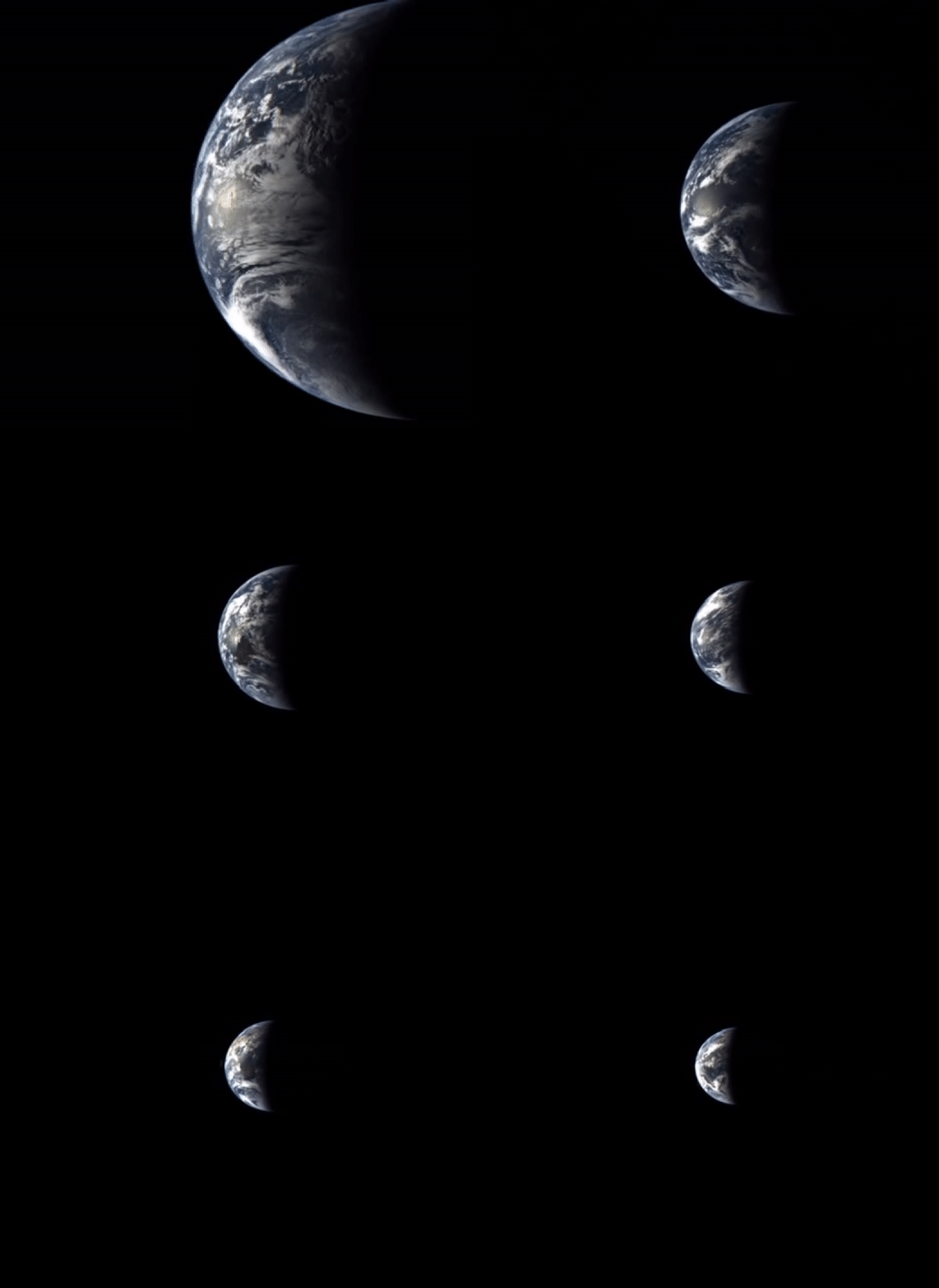
This view of the Earth comes to us courtesy of NASA’s MESSENGER spacecraft, which had to perform flybys of Earth and Venus in order to lose enough energy to reach its ultimate destination: Mercury. The round, rotating Earth and its features are undeniable, as this rotation explains why Earth bulges at the center, is compressed at the poles, and has different equatorial and polar diameters.(Credit: NASA/MESSENGER)


How fast does the Earth spin?
This question, although it might seem simple, has a different answer dependent on where, precisely, you are on the planet’s surface. Planet Earth is a rigid body, meaning that the land masses remain relatively constant with respect to one another over time. As the Earth rotates about its axis, practically every point on the surface completes a full rotation in just under 24 hours: 23 hours, 56 minutes, and 4.09 seconds, to be precise.  READ MORE...

Sunday, January 23

Laniakea Destroyed by Dark Energy


On the largest cosmic scales, planet Earth appears to be anything but special. Like hundreds of billions of other planets in our galaxy, we orbit our parent star; like hundreds of billions of solar systems, we revolve around the galaxy; like the majority of galaxies in the Universe, we’re bound together in either a group or cluster of galaxies. 

And, like most galactic groups and clusters, we’re a small part of a larger structure containing over 100,000 galaxies: a supercluster. Ours is named Laniakea: the Hawaiian word for “immense heaven.”

Superclusters have been found and charted throughout our observable Universe, where they’re more than 10 times as rich as the largest known clusters of galaxies. Unfortunately, owing to the presence of dark energy in the Universe, these superclusters ⁠— including our own ⁠— are only apparent structures. In reality, they’re mere phantasms, in the process of dissolving before our very eyes.

The Universe as we know it began some 13.8 billion years ago with the Big Bang. It was filled with matter, antimatter, radiation, etc.; all the particles and fields that we know of today, and possibly even more. 

From the earliest instants of the hot Big Bang, however, it wasn’t simply a uniform sea of these energetic quanta. Instead, there were tiny imperfections ⁠— at about the 0.003% level ⁠— on all scales, where some regions had slightly more or slightly less matter and energy than average.

In each one of these regions, a great cosmic race ensued. The race was between two competing phenomena:
  1. the expansion of the Universe, which works to drive all the matter and energy apart
  2. gravitation, which works to pull all forms of energy together, causing massive material to clump and cluster together
TO READ MORE ABOUT THIS, CLICK HERE...

Thursday, January 13

A Pixelated Space...


The search for signatures of quantum gravity forges ahead.
Sand dunes seen from afar seem smooth and unwrinkled, like silk sheets spread across the desert. But a closer inspection reveals much more. As you approach the dunes, you may notice ripples in the sand. Touch the surface and you would find individual grains. The same is true for digital images: zoom far enough into an apparently perfect portrait and you will discover the distinct pixels that make the picture.

The universe itself may be similarly pixelated. Scientists such as Rana Adhikari, professor of physics at Caltech, think the space we live in may not be perfectly smooth but rather made of incredibly small discrete units. “A spacetime pixel is so small that if you were to enlarge things so that it becomes the size of a grain of sand, then atoms would be as large as galaxies,” he says.

Adhikari and scientists around the world are on the hunt for this pixelation because it is a prediction of quantum gravity, one of the deepest physics mysteries of our time. Quantum gravity refers to a set of theories, including string theory, that seeks to unify the macroscopic world of gravity, governed by general relativity, with the microscopic world of quantum physics. At the core of the mystery is the question of whether gravity, and the spacetime it inhabits, can be “quantized,” or broken down into individual components, a hallmark of the quantum world.

“Sometimes there is a misinterpretation in science communication that implies quantum mechanics and gravity are irreconcilable,” says Cliff Cheung, Caltech professor of theoretical physics. “But we know from experiments that we can do quantum mechanics on this planet, which has gravity, so clearly they are consistent. The problems come up when you ask subtle questions about black holes or try to merge the theories at very short distance scales.”

Because of the incredibly small scales in question, some scientists have deemed finding evidence of quantum gravity in the foreseeable future to be an impossible task. Although researchers have come up with ideas for how they might find clues to its existence—around black holes; in the early universe; or even using LIGO, the National Science Foundation-funded observatories that detect gravitational waves—no one has yet turned up any hints of quantum gravity in nature.  READ MORE...

Wednesday, October 27

Beyond our Reach

Even if we traveled at the speed of light, we'd never catch up to these galaxies.

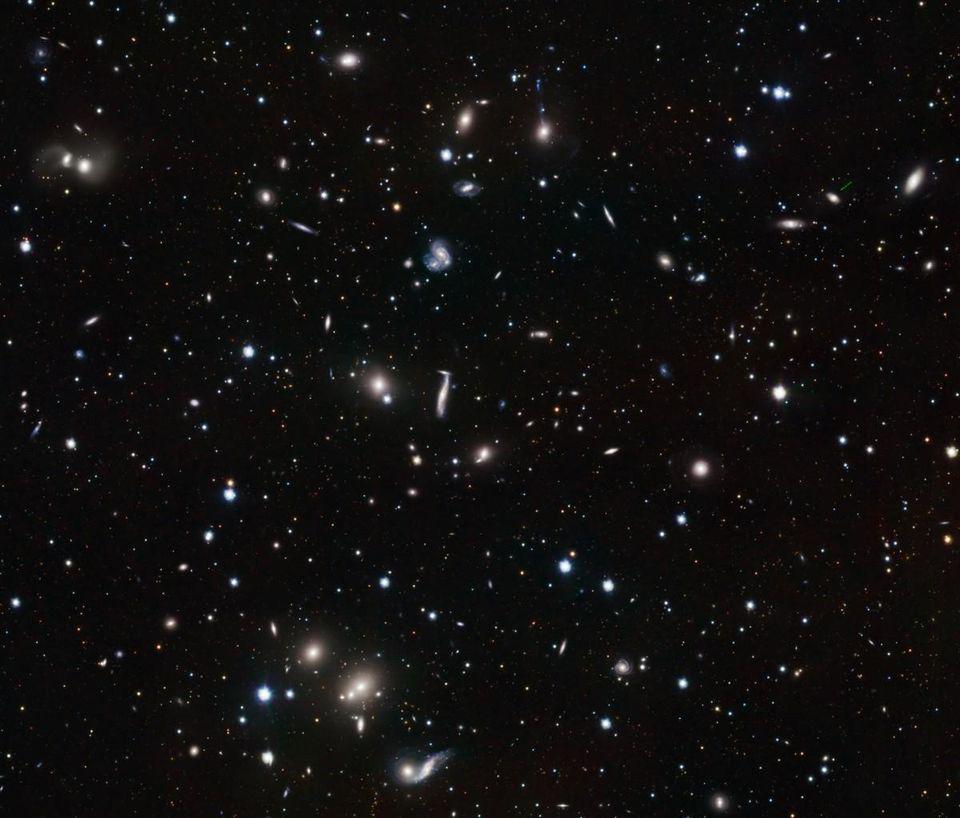
Distant galaxies, like those found in the Hercules galaxy cluster, are not only redshifted and receding away from us, but their apparent recession speed is accelerating. Many of the most distant galaxies in this image are receding from us at speeds that appear to exceed the speed of light. We will never be able to reach any of the ones presently located more than 18 billion light-years away. (Credit: ESO/INAF-VST/OmegaCAM. Acknowledgement:  OmegaCen/Astro-WISE/Kapteyn Institute.)

KEY TAKEAWAYS
  • The universe is expanding, with every galaxy beyond the Local Group speeding away from us.
  • Today, most of the universe's galaxies are already receding faster than the speed of light.
  • All galaxies currently beyond 18 billion light-years are forever unreachable by us, no matter how much time passes.
  • Our universe, everywhere and in all directions, is filled with stars and galaxies.

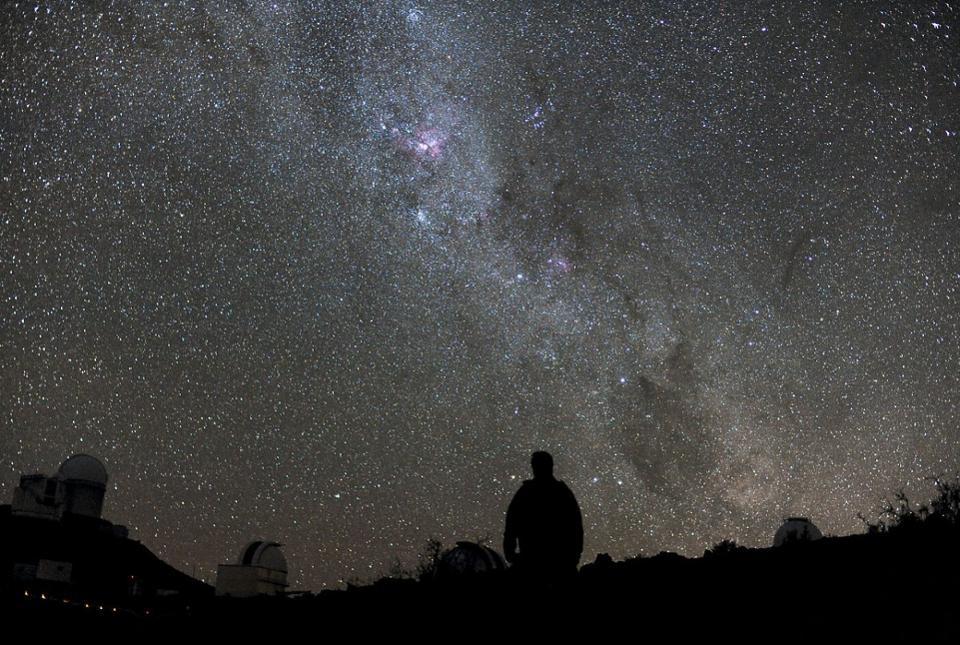
The Milky Way, as seen at La Silla observatory, is a stunning, awe-inspiring sight to anyone, and offers a spectacular view of a great many stars in our galaxy. Beyond our galaxy, however, are trillions of others, nearly all of which are expanding away from us. (Credit: ESO / HÃ¥kon Dahle)

  • From our vantage point, we observe up to 46.1 billion light-years away.

As long as the light from any galaxy that was emitted at the start of the hot Big Bang 13.8 billion years ago would have reached us by today, that object is within our presently observable universe. However, not every observable object is reachable. (Credit: F. Summers, A. Pagan, L. Hustak, G. Bacon, Z. Levay, and L. Frattere (STScI))

  • Our visible universe contains an estimated ~2 trillion galaxies.

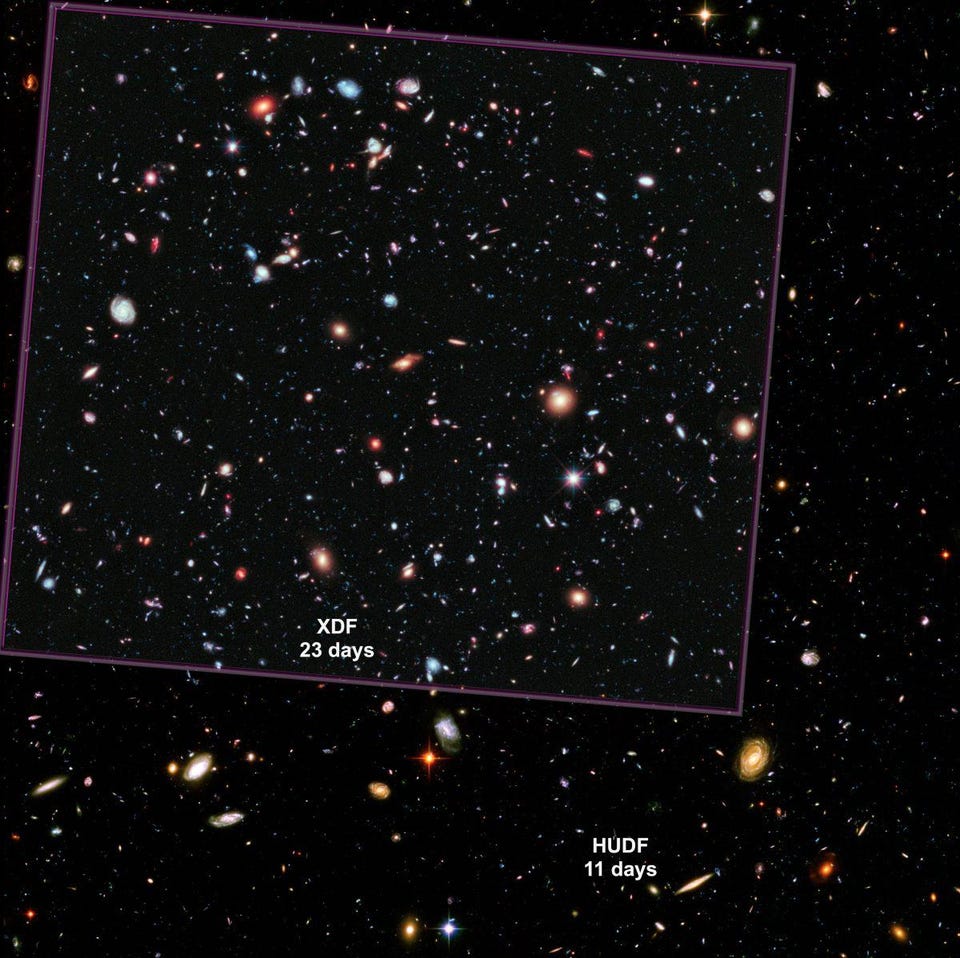
The Hubble eXtreme Deep Field (XDF) may have observed a region of sky just 1/32,000,000th of the total, but was able to uncover a whopping 5,500 galaxies within it: an estimated 10% of the total number of galaxies actually contained in this pencil-beam-style slice. The remaining 90% of galaxies are either too faint or too red or too obscured for Hubble to reveal. (Credit: HUDF09 and HUDF12 teams; Processing: E. Siegel)

However, most of them are already permanently unreachable by us.

TO READ MORE, CLICK HERE...

Wednesday, October 13

A Dangerous Dance Miles Away

Hubble Space Telescope image of Arp 91, a pair of intertwined galaxies (NGC 5953 and NGC 5954). Credit: ESA/Hubble & NASA, J. Dalcanton, Acknowledgement: J. Schmidt


This Picture of the Week features two interacting galaxies that are so intertwined, they have a collective name — Arp 91. This delicate galactic dance is taking place over 100 million light-years from Earth, and was captured by the NASA/ESA Hubble Space Telescope. 

The two galaxies comprising Arp 91 do have their own names: the lower galaxy, which in this image looks like a bright spot, is known as NGC 5953; and the ovoid galaxy to the upper right is NGC 5954. 

In reality, both of these galaxies are spiral galaxies, but their shapes appear very different because they are orientated differently with respect to Earth.

Arp 91 provides a particularly vivid example of galactic interaction. NGC 5954 is clearly being tugged towards NGC 5953 — it looks like it is extending one spiral arm downwards. It is the immense gravitational attraction of the two galaxies that is causing them to interact. 

Such gravitational interactions between galaxies are common, and are an important part of galactic evolution. Most astronomers nowadays believe that collisions between spiral galaxies lead to the formation of another type of galaxy, known as elliptical galaxies. 

These immensely energetic and massive collisions, however, happen on timescales that dwarf a human lifetime — they take place over hundreds of millions of years. So we should not expect Arp 91 to look any different over the course of our lifetimes!