Showing posts with label Science Alert. Show all posts

Saturday, November 29

Voids Detected Inside Giza Pyramid May Be Signs of a Hidden Entrance

The pyramids, in order from left: Menkaure, Khafre, and Khufu. (Travelpix Ltd/Getty Images)


Scans of the third-largest pyramid at Giza, the Menkaure pyramid, have revealed two anomalous pockets of nothing but air hiding behind its sloping stone walls.

The discovery follows earlier findings inside the Great Pyramid of Khufu, including a huge internal void and a corridor near its northern entrance. But the Menkaure cavities are dramatically different in shape, size, and layout – hinting at a very different construction history and purpose.

"The images revealed two anomalies directly behind the polished granite blocks, which would indicate the presence of air-filled voids," writes a team led by archaeologists Khalid Helal and Mohamed Elkarmoty of Cairo University.

"This interpretation was supported by a series of numerical simulations that considered various possible scenarios under real-world conditions."


Tuesday, November 11

A Giant Magnetic Anomaly Over 500 Million Years Ago Can Finally Be Explained


Magnetic signatures hidden inside rocks tell us a lot about Earth's magnetic field and the way continents and tectonic plates have shifted across millennia – but for some periods, the geological record doesn't make much sense.


A fresh analysis of rocks from one of these periods, the Ediacaran (about 630-540 million years ago), aims to solve a long-standing mystery: why is the magnetic record from this time showing wild and chaotic variations in the magnetic field, as if the continents were speeding unusually quickly across the planet's surface?


An international team of researchers led by Yale University has found that this glitch wasn't from the continents acting strangely. It was Earth's magnetic field.


Thursday, October 9

We Emit a Visible Light That Vanishes When We Die, Says Surprising Study


Life truly is radiant, according to an experiment conducted by researchers from the University of Calgary and the National Research Council of Canada.

An extraordinary experiment on mice and leaves from two different plant species has uncovered direct physical evidence of an eerie 'biophoton' phenomenon ceasing on death, suggesting all living things – including humans – could literally glow with health, until we don't.

The findings might seem a little fringe at first glance. It's hard not to associate scientific investigations into biological electromagnetic emissions with debunked and paranormal claims of auras and discharges surrounding living organisms.


Thursday, September 18

Primordial Earth Was Missing Materials Critical For Life, Study Shows

Artist's impression of ancient Earth. (NASA’s Goddard Space Flight Center/Francis Reddy)


The greatest challenge facing astrobiologists is that there is only one planet known to us that has life. Of all the bodies of the Solar System, only Earth has a dense atmosphere, liquid water on its surface, and the organic chemistry that supports life.


However, these conditions did not exist billions of years ago when Earth was still young. While the nebula from which the planets formed was rich in volatile elements, the high temperatures in the inner Solar System largely prevented them from condensing, leaving them mostly in a gaseous state.


As a result, these elements were not incorporated into the solid rocky materials from which the inner planets formed. Only celestial bodies that formed farther from the Sun retained the substances essential to life, which raises questions about how and when they were introduced to Earth.


Wednesday, August 27

Ants Are 'Superefficient' at Teamwork, Scientists Discover


Have you ever been part of a large group project? You might assume that with more people involved, the work gets done better and faster.


However, as more team members join the group, the effectiveness of each individual doesn't increase. It doesn't even stay constant – it gets worse. Many hands may make light work, but too many cooks spoil the broth.


This paradox is known as the Ringelmann effect, named after French engineer Max Ringelmann who discovered it in the late 19th century.


Wednesday, July 23

Extreme Conditions of Early Universe Recreated in Collider Experiment


A team of researchers have made progress in understanding how some of the Universe's heaviest particles behave under extreme conditions similar to those that existed just after the Big Bang.


A study published in Physics Reports provides new insights into the fundamental forces that shaped our Universe and continues to guide its evolution today.


The research, conducted by an international team from the University of Barcelona, the Indian Institute of Technology, and Texas A&M University, focuses on particles containing heavy quarks, the building blocks of some of the most massive particles in existence.


Thursday, July 10

Physicists Catch Light in 'Imaginary Time' in Scientific First

(agsandrew/Getty Images Pro/Canva)

For the first time, researchers have seen how light behaves during a mysterious phenomenon called 'imaginary time'.

When you shine light through almost any transparent material, the gridlock of electromagnetic fields that make up the atomic alleys and side streets will add a significant amount of time to each photon's commute.

This delay can tell physicists a lot about how light scatters, revealing details about the matrix of material the photons must navigate. Yet until now, one trick up the theorist's sleeve for measuring light's journey – invoking imaginary time – has not been fully understood in practical terms.


Sunday, June 8

Meditation And Mindfulness Have a Dark Side We Often Overlook


Since mindfulness is something, you can practice at home for free, it often sounds like the perfect tonic for stress and mental health issues.  Mindfulness is a type of Buddhist-based meditation in which you focus on being aware of what you're sensing, thinking, and feeling in the present moment.


The first recorded evidence for this, found in India, is over 1,500 years old. The Dharmatrāta Meditation Scripture, written by a community of Buddhists, describes various practices and includes reports of symptoms of depression and anxiety that can occur after meditation.


It also details cognitive anomalies associated with episodes of psychosis, dissociation, and depersonalization (when people feel the world is "unreal").  In the past eight years there has been a surge of scientific research in this area. These studies show that adverse effects are not rare.


Wednesday, May 28

World First: US Baby Treated With Personalized CRISPR Gene-Editing


A US infant with a rare condition has become history's first patient to be treated with a personalized gene-editing technique that raises hopes for other people with obscure illnesses, doctors said Thursday.

The wee pioneer is KJ Muldoon, now a 9-and-a-half-month-old boy with chubby cheeks and big blue eyes.

Shortly after birth, he was diagnosed with a rare and serious condition called CPS1 deficiency.

It is caused by a mutation in a gene that produces an enzyme key to liver function, and prevents people with it from eliminating certain kinds of toxic waste produced by their metabolism.


Monday, May 26

Dark Matter Could Be Evolving, And The Implications Are Profound


For a while now, there has been a problematic mystery at the heart of the standard cosmological model.


Although all observations support the expanding Universe model, observations of the early period of the cosmos give a lower rate of acceleration than more local observations. We call it the Hubble tension problem, and we have no idea how to solve it.


Naturally, there have been several proposed ideas: what if general relativity is wrong; what if dark matter doesn't exist; what if the rate of time isn't uniform; heck, what if the entire Universe rotates.


Thursday, May 22

New Theory Suggests Dark Matter Is Frozen Relics of Light-Speed Particles


In an ongoing quest to guess the secret behind the Universe's excess in gravity, two researchers from Dartmouth College in the US have proposed a chilling union between massless particles soon after the Big Bang.


For the better part of a century it's been frustratingly clear that estimates of the Universe's visible mass have failed to account for the way galaxies rotate, pointing to slow-moving clumps of matter we can't see. This stuff has been dubbed ' dark matter'.


Even as researchers whittle away at the list of properties describing this cold and silent corner of physics, its identity and origins remain elusive.


Friday, May 2

Physicists Found an Entirely New Way to Measure Time


Determining the passage of time in our world of ticking clocks and oscillating pendulums is a simple case of counting the seconds between 'then' and 'now'.

Down at the quantum scale of buzzing electrons, however, 'then' can't always be anticipated. Worse still, 'now' often blurs into a haze of vagueness. A stopwatch simply isn't going to work for some scenarios.

A potential solution could be found in the very shape of the quantum fog itself, according to a 2022 study by researchers from Uppsala University in Sweden.  Their experiments on the wave-like nature of something called a Rydberg state revealed a novel way to measure time that doesn't require a precise starting point.

Rydberg atoms are the over-inflated balloons of the particle kingdom. Puffed up with lasers instead of air, these atoms contain electrons in extremely high energy states, orbiting far from the nucleus.


Friday, April 11

Quantum Teleportation Achieved Over Internet For The First Time


A quantum state of light was successfully teleported through more than 30 kilometers (around 18 miles) of fiber optic cable amid a torrent of internet traffic – a feat of engineering once considered impossible.


The impressive demonstration by researchers in the US in 2024 may not help you beam to work to beat the morning traffic, or download your favourite cat videos faster.


However, the ability to teleport quantum states through existing infrastructure represents a monumental step towards achieving a quantum-connected computing network, enhanced encryption, or powerful new methods of sensing.


Friday, March 7

Yogurt Shows Great Potential Against Colon Cancer


Just two servings of yogurt a week may protect the bowels from some specific types of cancer, according to a new long-term study in the US.

For years now, scientists have suspected yogurt and its living bacteria have benefits for gastrointestinal health, and yet not all research on the topic aligns on what those benefits are and when they are reaped.  This new analysis helps explain some of the confusion.

Epidemiologists did not find a significant association between yogurt and the overall incidence of colorectal cancer – the third most common cancer worldwide and the second leading cause of cancer-related deaths.

However, when researchers split colorectal cancer cases into subtypes, they did find a significant result. The findings align with several other observational studies, which suggest yogurt intake may have anti-tumor properties.      READ MORE...

Thursday, February 13

Quantum Experiment Reveals Light Existing in Dozens of Dimensions


A paradox at the heart of quantum physics has been tested in an extraordinary fashion, pushing the boundaries of human intuition beyond breaking point by measuring a pulse of light in 37 dimensions.


Led by scientists from the University of Science and Technology of China, a team of researchers developed a method of testing a type of Greenberger-Horne-Zeilinger (GHZ) paradox according to strict criteria using a fiber-based photonic processor.


Their findings clarify how quantum weirdness operates on a fundamental level, potentially informing future applications in quantum technology. Not to mention reaffirming just how useless our brains are at understanding the operations manual for our Universe's engine.


If you want to know if there is any mail inside your mailbox, you merely need to walk out and take a look. From that one, simple observation you can deduce the postal service has been and popped a belated birthday card from Aunt Judy in through the slot. Thanks Aunt Judy!     READ MORE...

Tuesday, February 4

Eerie Features on Mars


Dark shapes and bright spots on sand dunes in Mars’ North Pole region. (Harvard University's John A. Paulson School Of Engineering And Applied Sciences)


Though it's a cold, dead planet, Mars still has its own natural beauty about it. This image shows us something we'll never see on Earth.


Mars has only a thin, tenuous atmosphere, and most of it (95%) is carbon dioxide. When Martian winter arrives, CO2 freezes and forms a thick coating on the ground in the polar regions. It lies there dormant for months.


As spring approaches, temperatures gradually warm. Sunlight passes through the translucent frozen layer of CO2, warming the ground beneath it.     READ MORE...

Tuesday, January 21

Alignment of SEVEN Planets


A very rare treat is about to grace Earth's night skies.


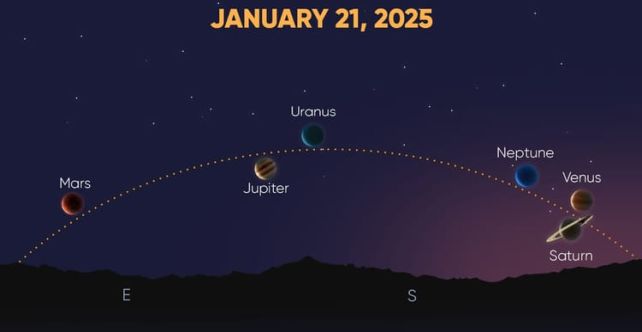
On the evening of 28 February 2025, all seven of the other planets in the Solar System will appear in the night sky at the same time, with Saturn, Mercury, Neptune, Venus, Uranus, Jupiter, and Mars all lining up in a neat row – a magnificent sky feast for the eyes known as a great planetary alignment.

But that's not all. Between now and then, on 21 January 2025, six of the seven other planets will appear in the sky at once in a large alignment – Mars, Jupiter, Uranus, Neptune, Venus, and Saturn, with the exception of Mercury.

An illustration of the upcoming January planetary alignment as seen from the Northern Hemisphere. (Star Walk)


Actually, it's not uncommon for a few planets to be on the same side of the Sun at the same time, but it's less common for most, or even all of the planets to align.

Any number of planets from three to eight constitutes an alignment. Five or six planets assembling is known as a large alignment, with five-planet alignments significantly more frequent than six.

Seven-planet great alignments are, of course, the rarest of all.     READ MORE...

Tuesday, January 14

Entangle Light and Sound


The quantum entanglement of particles is now an established art. You take two or more unmeasured particles and correlate them in such a way that their properties blur and mirror each other. Measure one and the other's corresponding properties lock into place, instantaneously, even when separated by a wide distance.


In new research, physicists have theorized a bold way to change it up by entangling two particles of very different kinds – a unit of light, or a photon, with a phonon, the quantum equivalent of a wave of sound.


Physicists Changlong Zhu, Claudiu Genes, and Birgit Stiller of the Max Planck Institute for the Science of Light in Germany have called their proposed new system optoacoustic entanglement.     READ MORE...

Wednesday, January 8

Quantum Teleportation Achieved


A quantum state of light has been successfully teleported through more than 30 kilometers (around 18 miles) of fiber optic cable amid a torrent of internet traffic – a feat of engineering once considered impossible.

The impressive demonstration by researchers in the US may not help you beam to work to beat the morning traffic, or download your favorite cat videos faster.

However, the ability to teleport quantum states through existing infrastructure represents a monumental step towards achieving a quantum-connected computing network, enhanced encryption, or powerful new methods of sensing.

"This is incredibly exciting because nobody thought it was possible," says Prem Kumar, a Northwestern University computing engineer who led the study.     READ MORE...

Thursday, December 5

A Quirk in SPACE-TIME


Gravitational lensing of galaxy cluster Abell 2390. (ESA/Euclid/Euclid Consortium/NASA, image processing by J.-C. Cuillandre (CEA Paris-Saclay), G. Anselmi)


The fabric of space and time is not exempt from the effects of gravity. Plop in a mass and space-time curves around it, not dissimilar to what happens when you put a bowling ball on a trampoline.


This dimple in space-time is the result of what we call a gravity well, and it was first described over 100 years ago by Albert Einstein's field equations in his theory of general relativity. To this day, those equations have held up. We'd love to know what Einstein was putting in his soup. Whatever it was, general relativity has remained pretty solid.


One of the ways we know this is because when light travels along that curved space-time, it curves along with it. This results in light that reaches us all warped and stretched and replicated and magnified, a phenomenon known as gravitational lensing. This quirk of space-time is not only observable and measurable, it's an excellent tool for understanding the Universe.         READ MORE...